
Grasses that feed the world | 10,000 years of cereals in one field
COME AND SEE FOR YOURSELF!
What do oats, barley, wheat, rye, etc. really look like?
Old or new varieties and wild relatives... are they all the same?
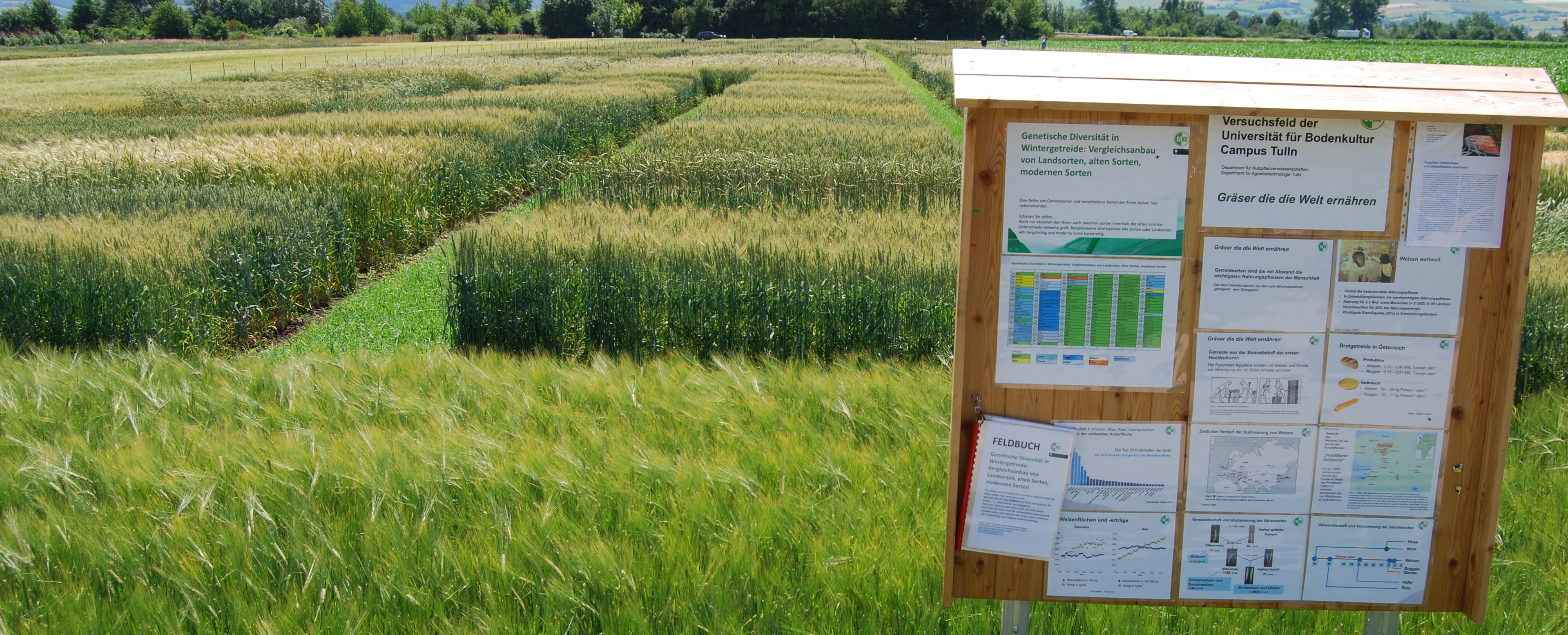
Currently on display – come and see for yourself! A field trial with over 200 display plots has been set up at the plant breeders' trial field at the BOKU site in Tulln.
All the typical cereals of our region can be admired: oats, barley, rye, triticale, wheat, as well as special cereals such as einkorn, emmer, spelt and also wild emmer wheat.
Old and new varieties and a display board with all kinds of information.
A fairly old wheat variety from 1877 is also there, a sample from the Haberlandt collection (Haberlandt was the first professor of plant production at BOKU), which was found at BOKU.
Location: Field south of the UFT, coordinates and map: 48.318891, 16.070277
More about the background and history of the test field:
As a collection of native cereal varieties—especially wheat—as a pool of genetic resources and as a glimpse into a cultural landscape throughout the annual cycle, we currently offer a rare insight into contemporary history here in Tulln. Join us on a historical journey that could not be more extraordinary.
But let's start at the very beginning:
As the first professor of plant production at the University of Natural Resources and Life Sciences, Friedrich Haberlandt (1826-1878) laid the foundation for what we see today at the experimental field, namely the breeding history dating back to 1877. The so-called “Haberlandt Collection.” His project began with the aim of researching the longevity of seeds. For his research purposes, he collected seeds, dried them, and stored them in countless glass vials. Unfortunately, he died too early and the collection fell into oblivion. A lucky coincidence in the 1960s brought Haberlandt's collection to light in a basement at BOKU. Just imagine: a grain of wheat loses its germination capacity after about 15 years of storage; it breaks down. Not so in this case. Despite lying dormant for almost 90 years, some of the seeds germinated, allowing us today to marvel at an old landrace from 1877 in the field.
From our grandparents, or rather great-grandparents, in 1877 to the youngest generation, we have been able to present an exemplary breeding history that is unparalleled. From the wild type to the domesticated crop that meets modern requirements, the plots allow a comparison of the characteristics, development, and breeding strategies of then and now. On the one hand, there is the wild type, which has been native to the Middle East for thousands of years and from which emmer wheat was first domesticated a staggering 10,000 years ago. Wild emmer wheat has strong husks, bristly awns, small grains, and brittle rachis, which represent a perfect adaptation to nature. On the other hand, there are the cultivars of the past decades, including last year's new registrations, which are based on these and other wild types. It is incredible how the wheel of time turns with us here.
This resulted in no fewer than 200 demonstration plots at the experimental field of the University and Research Center Tulln (UFT). Created by the staff of the Institute of Plant Breeding, it offers visitors an extraordinary insight.
This access is all the more valuable for our students, who can “grasp” and experience the diversity of cultivated plants up close in courses such as Genetics, Genetic Resources, and Plant Breeding.
And did you know that the soybean is also known as the “Haberlandt bean”? Haberlandt was the first to spread the importance and value of this plant beyond the borders of Asia.
| Files |
|---|
|
Fieldbook Download
Feldplan_Demo_WEB_2026.xlsx
Sowing list and field plan |