
Jose Julian
Molecular Mechanisms of Vacuolar Quality Control
What we do (in plain language)
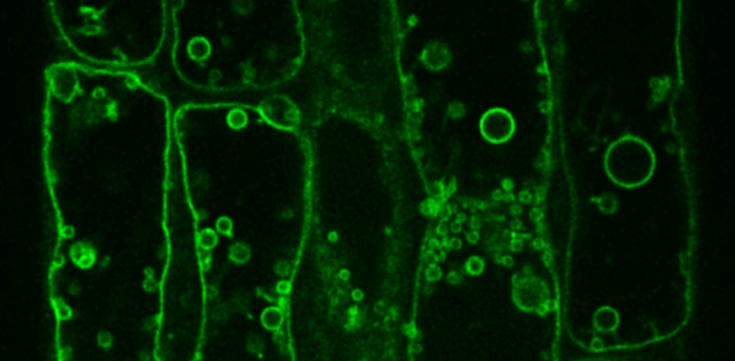
Our lab studies how plant cells keep their internal “recycling centers” —called vacuoles — healthy. The vacuole is a waste- and signaling-management hub that helps the cell survive when the environment gets tough. We discovered that when a plant’s cell wall is damaged, a protective system kicks in to repair and stabilize the vacuole. We are now exploring how this system works and how it helps plants cope with stress such as pathogen attack or changes in soil conditions.
We are hiring!
We are looking for a postdoctoral researcher to join the Julian Lab as part of our FWF ASTRA-funded VITAL project. The position will investigate how environmental stress triggers vacuolar membrane remodeling in plants, combining plant cell biology, advanced microscopy and molecular approaches, with a particular focus on APEX2-assisted electron microscopy.
We are especially looking for a curious and proactive scientist interested in plant cell biology, autophagy and organelle dynamics. Experience in plant electron microscopy is particularly welcome, but candidates with complementary backgrounds who are enthusiastic about developing these approaches are also encouraged to apply.
Starting: Early 2027 · Duration: 2 years · Application deadline: 30 September 2026
Overview

Cell wall damage and pathogen infection activate a protective vacuolar quality control pathway through ATG8ylation of the vacuolar membrane
Our lab investigates how plant cells maintain vacuolar integrity during stress. We discovered a conserved Vacuolar Quality Control (VQC) pathway that protects plant cells when the cell wall is damaged. This mechanism depends on ATG8ylation of the tonoplast, a process that remodels the vacuolar membrane and helps plants sustain growth under stress conditions.
By combining molecular genetics, live-cell imaging, and quantitative electron microscopy, we aim to understand how mechanical cues, turgor pressure, and ion balance are sensed and translated into protective responses at the vacuole. Our goal is to uncover how these processes contribute to plant adaptation and mechanical homeostasis (mechanostasis).
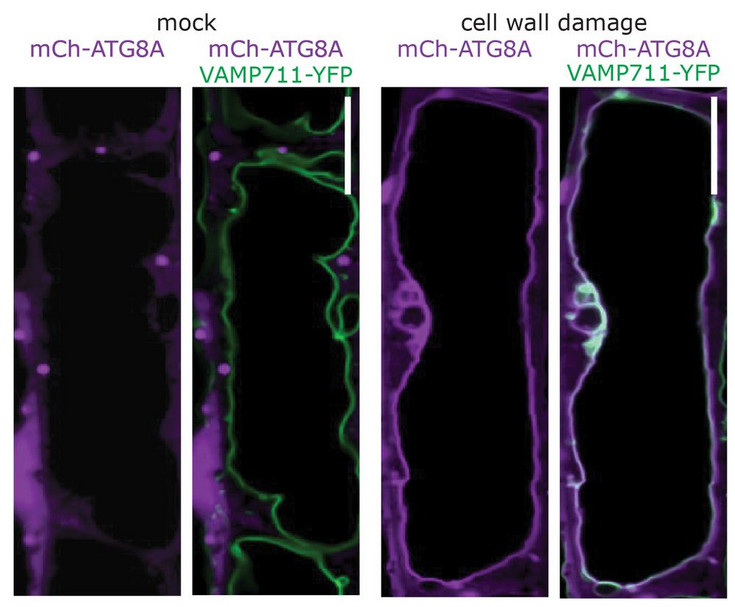
VAMP711 (green) marks the vacuolar membrane (tonoplast). ATG8A (magenta) relocates from autophagosomes to the tonoplast upon cell wall damage, visualized by confocal microscopy.
Major Grants
ASTRA 3135825 – FWF (01-2027/12-2031): The ASTRA-funded VITAL – Vacuolar Integrity Through Adaptive Remodeling project investigates how plants sense environmental stress and transmit these signals to the vacuole, triggering ATG8-dependent remodeling of the vacuolar membrane. The project will combine advanced microscopy, molecular genetics and proteomics to uncover the mechanisms and physiological functions of this newly discovered stress-response pathway.
ESPRIT 580 – FWF (01-2024/12-2026): This fellowship supports early-career researchers in establishing scientific independence and developing their own research direction. It provides the foundation for launching the Julian Lab’s work on Vacuolar Quality Control and plant stress adaptation.
Selected Publications
ATG8ylation of vacuolar membrane protects plants against cell wall damage (2025)
Jose Julian, Peng Gao, Alessia del Chiaro, Juan Carlos de la Concepción, Laia Armengot, Marc Somssich, Heloise Duverge, Marion Clavel, Nenad Grujic, Roksolana Kobylinska, Ingo Polivka, Maarten Besten, Tonni Grube Andersen, Christian Dank, Barbara Korbei, Andreas Bachmair, Nuria S. Coll, Elena A. Minina, Joris Sprakel & Yasin Dagdas
Nature Plants | Volume 11 | February 2025 | 321–339 [LINK]
Winner of BOKU Best Paper Award (2025) by the ANNIVERSARY FUND of the City of Vienna.
Vacuolar signaling, biogenesis, and quality control in plants (2025)
Jose Julian & Yasin Dagdas
Current Opinion in Plant Biology 2025, 86:102756 [LINK]
Electrostatic changes enabled the diversification of an exocyst subunit via protein complex escape (2025)
Juan Carlos De la Concepcion, Héloïse Duverge, Yoonwoo Kim, Jose Julian, Haonan D. Xu, Matthew N. Watt, Sara Ait Ikene, Anita Bianchi, Nenad Grujic, Ranjith K. Papareddy, Irina Grishkovskaya, David Haselbach, David H. Murray, Marion Clavel, Nicholas A. T. Irwin & Yasin Dagdas
Nature Plants | October 2025 [LINK]
Full Publication List [LINK]
Our Team

Group Leader
Dr. Jose Julian
ESPRIT Fellow (FWF)
Erasmus Student
Martina Jurcikova

Master Student
Alvar Pascual Garcia

Bachelor Student
Emma Fabsics
Why Join Us?
We are building a diverse and creative team to investigate how plants maintain internal stability when faced with environmental and pathogen stress. By joining us, you will contribute to fundamental discoveries that link plant physiology to global challenges. We encourage initiative, collaboration, and open communication, and support every member in developing both scientific and personal skills for the next step in their career.
Contact
Dr. Jose Julián
Institute of Molecular Plant Biology (IMPB)
Department of Biotechnology and Food Science, BOKU University
Muthgasse 18, 1190 Vienna, Austria
jose.julian(at)boku.ac.at
Google Scholar | ORCID
