
Alexandra Castilho
Plant Glycoengineering Group
Our Research Interests
Cell and Molecular Biology, Plant Molecular Farming, Plant Glycobiology and Glyco-engineering, Modulation of gene expression, Glyco-dependent protein-protein interactions.
Leader: Alexandra Castilho
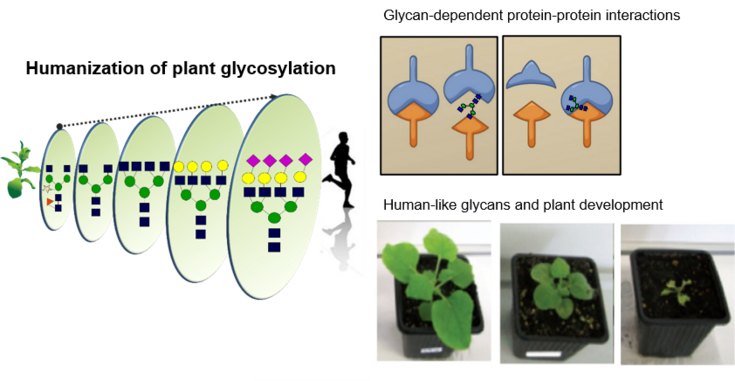
Research Overview
Our research explores how plant biotechnology and glycoengineering can be harnessed to advance both fundamental glycobiology and the development of next-generation biopharmaceuticals.
Plants have emerged as attractive production platforms for recombinant proteins because they offer scalability, safety, rapid manufacturing and cost-effective production. However, proteins produced in plants naturally carry glycan structures that differ from those found in humans. Since protein glycosylation plays a fundamental role in protein folding, stability, biological activity, immunogenicity and therapeutic efficacy, controlling glycosylation is essential for the successful production of recombinant therapeutics.
Our group investigates the molecular mechanisms that regulate glycosylation in plants and develops innovative strategies to precisely engineer the plant secretory pathway. Rather than simply introducing or deleting individual glycosylation enzymes, we aim to understand and control the complex biosynthetic network that determines glycan composition. By integrating plant biotechnology, glycobiology, synthetic biology and protein engineering, we develop technologies for producing recombinant proteins with homogeneous, human-like glycosylation profiles while gaining fundamental insights into the biological functions of glycans.
Research Areas
Plant Glycoengineering
We investigate the molecular mechanisms governing protein glycosylation in plants and develop technologies to precisely remodel N-glycan biosynthesis. Our work includes:
- Humanization of plant N-glycosylation pathways.
- Engineering glycosyltransferases and glycosidases to generate defined glycan structures.
- Optimization of enzyme localization and expression within the secretory pathway.
- Identification of factors influencing glycan processing and glycosylation-site accessibility.
- Development of novel strategies to produce homogeneous glycoforms of recombinant proteins.
These approaches enable the production of therapeutic glycoproteins with improved efficacy, stability and safety.
Plant Molecular Farming
We use transient expression systems in Nicotiana benthamiana to rapidly produce recombinant proteins for both fundamental research and biomedical applications. Our aim is to develop plant-based platforms capable of producing next-generation biopharmaceuticals with tailored glycosylation profiles.
Glycosylation and Protein Function
A major focus of our research is understanding how glycosylation regulates protein structure, stability and biological activity. By generating proteins with precisely defined glycan structures, we investigate how specific glycoforms influence (i) Protein-protein interactions; (ii) Immune receptor recognition; (iii) Antibody effector functions; (iv) Cell signalling and (v)Therapeutic efficacy.
This knowledge contributes to the rational design of glyco-optimized biopharmaceuticals and provides insights into the biological roles of protein glycosylation.
Glycosylation in Cancer and Immunotherapy
Aberrant protein glycosylation is a hallmark of many diseases, particularly cancer, where altered glycans influence cell signalling, immune evasion and therapeutic response.
Our research employs plant glycoengineering to produce recombinant proteins with customized glycosylation patterns for studying glycan-dependent mechanisms involved in cancer progression and immune regulation. We are particularly interested in understanding how glycosylation affects immune checkpoint proteins, receptor-ligand interactions and antibody-based therapeutics. These studies provide valuable tools for investigating disease mechanisms and support the development of improved glycan-based therapeutic strategies.
Glycosylation and Plant Development
Introducing human glycosylation pathways into plants not only modifies recombinant proteins but also affects endogenous plant glycoproteins. Understanding these effects is essential for developing robust plant expression hosts and provides unique insights into the biological roles of glycans in plants.
Our research investigates how humanization of the plant glycosylation machinery influences plant growth, development and physiology. We study how engineered glycosylation affects endogenous glycoproteins, cell wall composition, protein trafficking and developmental processes.
By combining genetics, glycomics, molecular biology and cell biology, we seek to uncover the molecular mechanisms linking glycosylation to plant development. This knowledge establishes design principles for future glycoengineered plant production platforms that combine optimal plant performance with efficient production of humanized recombinant glycoproteins.
Research Vision
Our long-term vision is to understand and engineer glycosylation in plants at both molecular and organismal levels.
We aim to establish plants as versatile and predictable platforms for producing recombinant proteins with customized glycosylation while uncovering the fundamental biological functions of glycans in plants and humans. Through the integration of plant biotechnology, glycobiology, synthetic biology and protein engineering, our research contributes to both fundamental plant science and the development of innovative biopharmaceuticals with improved efficacy, safety and functionality.
Funding


Collaborations
University of Oxford, UK: Professor Renier van der Hoorn | Department of Biology
i3S/Ipatimup, University of Porto; Portugal: i3S | Personal Information
Medical University of Vienna, Austria: Peter Steinberger Contact & CV | MedUni Vienna
UNL, Portugal: Paula Alexandra Videira - Universidade NOVA de Lisboa
Zatloukal Innovations GmbH, Austria: Zatloukal Innovations
Icon Genetics GmbH - Halle (Saale), Germany
Baiya Phytopharm | Plant-Based Biopharmaceuticals & Vaccines | Thailand