
Somanath Kallolimath
Translational Glycobiology

Orientation
Our research focuses on integrating plant molecular farming and advanced synthetic biology approaches to synthesize rare glycans and glycoconjugates, including KDN (2-keto-3-deoxy-D-glycero-D-galacto-nononic acid), tumor-associated carbohydrate antigens, and multifunctional glycopolymer polysialic acid. We aim to characterize and study the biological functions of these glycoconjugates. Thereby, accelerate the design, evaluation, and translation of these glycans into glycoengineered therapeutics, and develop tools for disease diagnostics and functional glycomics.
We further aspire to expand this plant-based expression system to facilitate the production of challenging-to-express proteins, which include peroxidases, antimicrobial peptides, toxin-derived substrates for targeted drug delivery, and IgG immunoglobulin subclasses.
Research Topics
• Biosynthetic pathway engineering for targeted glycans and glycoconjugates
• Glycan structure-functional elucidation
• Glycoanalytics tool development
• Glycan-based drug delivery systems development
• Engineering glycoproteins with enhanced therapeutic efficacy
• Produce challenging-to-express proteins (e.g., peroxidases, antimicrobial peptides)
Projects
Biosynthesis and Functions of KDNylated glycoproteins
Sialic acids are a diverse family of nine-carbon acidic monosaccharides that act as crucial modifications, typically occupying the terminal ends of glycans on glycolipids and glycoproteins at the cell surface. These modifications serve as key "bridging" molecules between cells and their environment, acting as both protective masks and recognition signals in diverse biological processes. However, KDN (2-keto-3-deoxy-D-glycero-D-galacto-nononic acid) is a fascinating yet underexplored member of this group. KDN is known for its resistance to sialidase, and its presence in tumor microenvironments highlights its biomarker potential. Current understanding of KDN-containing glycoconjugates is limited by their rarity and the complexity of their biosynthesis. This presents a challenge in synthesizing KDNylated glycoconjugates. In the current project, we aim to engineer the KDN biosynthetic pathway in a plant-based expression system to produce KDNylated glycoproteins to investigate how KDN influences factors such as serum half-life, immunogenicity, and receptor binding. This research is crucial for advancing our biological knowledge and has potential therapeutic and diagnostic applications, making it an exciting field of study.
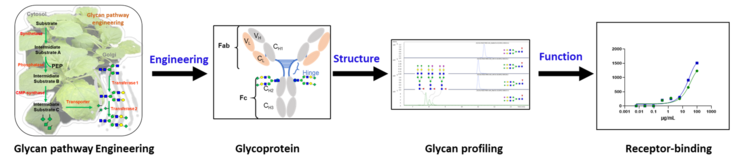
The workflow of the plant-based engineering approach to produce glycoproteins and study structure-function relations: On the left, a green plant leaf diagram labeled with pathway components. In the center, a protein structure carrying glycans. To the right, a chromatogram plot with peaks showing the glycan profile, followed by a graph showing a curve with increasing signal across concentrations of receptor binding.
Breaking BBB by protein engineering and glycodesign
Polysialic acid (PolySia) is a rare α2,8-linked sialic acid homopolymer with extremely high protein selectivity. Often, its function depends on the degree of polymerization (DP). The low-molecular-weight polySia (LMW-PolySia, DP20-30) has shown therapeutic effects in neurodegenerative diseases like age-related macular degeneration. Certain neuroinvasive bacteria like Neisseria meningitidis use its capsular polysaccharide polySia to evade the blood-brain barrier (BBB). A major challenge in effectively treating neurological diseases is the low permeability of drugs across the BBB. To overcome this challenge, the current project will mimic a natural mechanism by which neuroinvasive bacteria evade the human immune system and cross the BBB. Here, we apply protein- and glycoengineering strategies to synthesize LMW-polySia in plants. The resulting protein-conjugated glycopolymer will be assessed for its ability to penetrate neuronal tissue using an in vitro model.
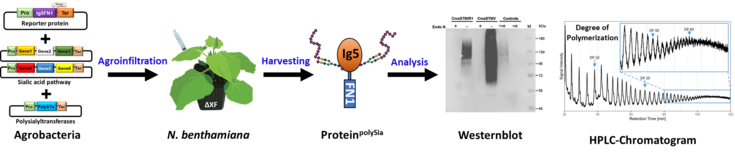
The schematic presentation of polysialylated glycoprotein production in plants: The colored block diagrams of DNA constructs with reporter protein, sialic biosynthetic pathway genes (1-6), and polysialyltransferase. delivering genes to Nicotiana benthamiana by Agrobacterium infiltration to transiently express the constructs to produce protein carrying polysialic acid. Western blot image with anti-polySia antibody showing polysialic acid signal. The chain-length analysis by HPLC reveals degree-of-polymerization peaks, annotated as DP 10, DP 20, DP 30, and DP 40.
Collaborations
International collaborations
Prof. Ken Kitajima
Integrated Glyco-Biomedical Research Center (iGMED)
Institute for Glyco-core Research (iGCORE)
Nagoya University, Japan
Prof. Manfred Wuhrer
The Center for Proteomics and Metabolomics
Leiden University Medical Center (LUMC), The Netherlands
Prof. Herbert Hildebrandt
Neuroglycobiochemistry
Institute of Clinical Biochemistry
Hannover Medical School (MHH), Germany
Prof. Anja Münster Kuhln
Sialoglycobiology in mammalian development
Hannover Medical School (MHH), Germany
Prof. Anne Herduin Lepers
Structural and Functional Glycobiology Unit
University of Lille, France
Prof. Winfried Römer
Synthetic Biology of Signalling Processes
University of Freiburg, Germany
Prof. Qiang Chen
School of Life Sciences
Arizona State University, USA
Prof. Satish Kumar R
Department of Biotechnology
Bharathiar University, India
National collaborations
Prof. Bernd Jilma
DAO Laboratory
Department of Clinical Pharmacology
Medical University Vienna, Austria
Dr. Stefan Meitner
Gynecologic Oncology Research Laboratory
Medical University Vienna, Austria
Prof. Johannes Stadlmann
Institute of Biochemistry
BOKU University, Vienna, Austria
Dr. Guruprakash Subbaihdoss
Institute of Colloid and Biointerface Science
BOKU University, Vienna, Austria
Funding


Awards
ÖGMBT Life Science PhD Award, year 2018
Best poster prize at the Gordon Glycobiology Conference 2025