
Curriculum + Courses
You can find detailed information on the courses in the SIFC-curriculum that is legally binding. You have to stick to this curriculum to be able to graduate!
Unfortunately this curriculum is written in German. Please find an English version here.
General Scheme
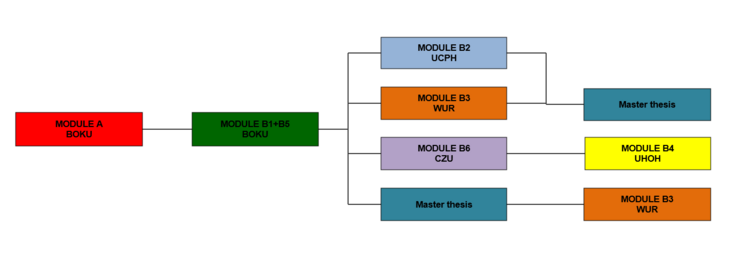
Basic Module A (30 ECTS):
This Module consists of compulsory courses - see the currently valid curriculum. It covers principles related to food safety to provide the students with basic knowledge in this area. Thus they will be optimally prepared for the following two advanced Modules.
Advanced Modules B (60 ECTS):
Subsequent to Module A, SIFC-students have to take 2 Advanced Modules B with 30 ECTS credits each.
One Module B has to be attended at the Home University (BOKU), while the second has to be done at a partner University. The SIFC-partner Universities (University of Hohenheim, Wageningen University, the Czech University of Life Sciences, Prague and University of Copenhagen) provide one Module which implies subjects related to its special expertises and core competencies.
You can find the specific courses for Module B1 and 5 in the currently valid curriculum.
Modules B2, B3, B4 and B6 are held by the partner universities and serve as specialisation in the Master study programme.
These specialisations offered by the individual universities are as follows:
- Module B2 - SCIENCE; University of Copenhagen, Faculty of Science (Winter semester)
Sanitation and Hygienic Design, Processing and Food Borne Microorganisms, International Food Law and Safety Management, Risk Analysis in a National and Global Context - Module B3 - WUR, Wageningen University (Winter or summer semester)
Risk Communication, Epidemiology and Public Health, Gene Technology, Predictive Modelling - Module B4 - UHOH, University of Hohenheim (Winter or summer semester)
Nutrient/Gene Interaction, Global Nutrition, Metabolic Syndrome, Safety in Agriculture and Organic Farming - Module B6 - CULS/CZU, Czech University of Life Sciences, Prague (Winter semester)
Water Management, Aquaculture, Parasitology, Plant Diseases, Herbs and Spices
Those courses that need to be completed successfully have to be agreed upon within the context of the Learning Agreement and together with the Programme Coordinator.
Master Thesis:
The Master thesis is a scientific assignment which covers 30 ECTS credits. It has to proof that students are able to work on any topic related to food safety in a scientific and independent way. The Master thesis can be performed in the winter or summer semester.