
16.02.2026 - Artificial Intelligence Improves Streamflow Forecasting
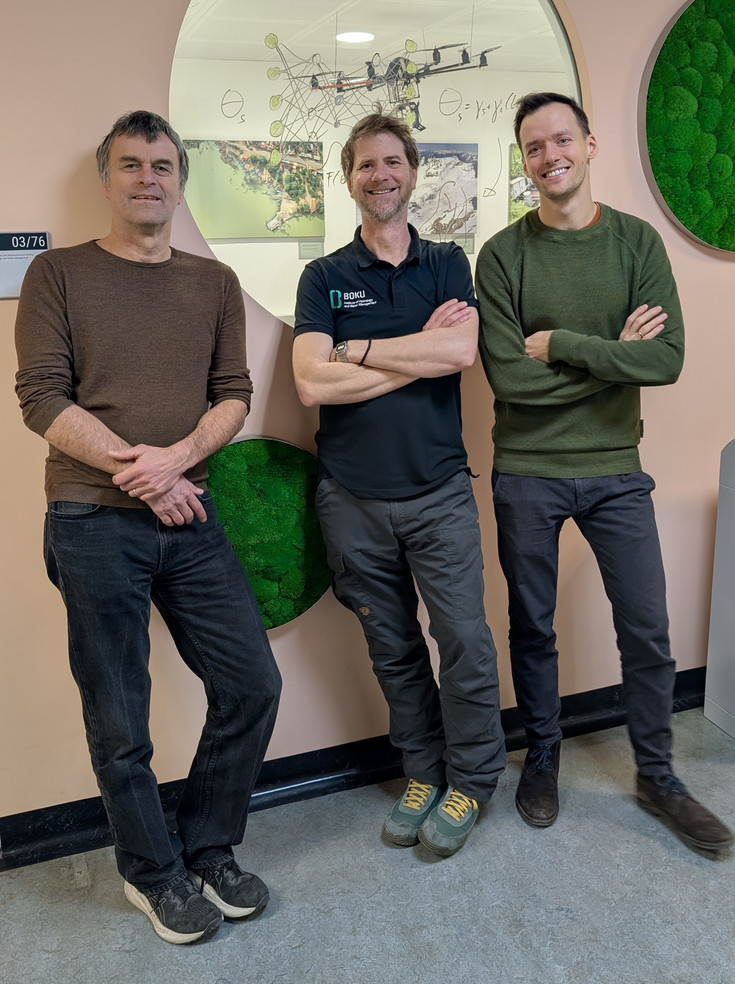
Forschungsteam: (v. l.) Karsten Schulz und Mathew Herrnegger vom Institut für Hydrologie und Wasserwirtschaft, und Moritz Feigl, BOKU-Promovend und Start-up baseflow AI solutions
How much water flows through a river after heavy rain? How do soils react to dry periods? And what happens in regions where little measurement data is available? In the current issue of the Springer Nature journal, a research team from BOKU University shows how artificial intelligence (AI) can help make flood and water balance predictions more accurate – even in areas where there are hardly any measuring stations.
Hydrological models are indispensable for predicting floods and managing water resources. However, their accuracy depends heavily on how well the model parameters are adapted to the respective areas. This is a particular challenge in regions where little measurement data is available.
A research team led by Karsten Schulz from the Institute of Hydrology and Water Resources at BOKU and the start-up baseflow AI solutions, founded by BOKU doctoral student Moritz Feigl, have now developed a novel approach that uses artificial intelligence to determine these parameters automatically and transparently.
The new approach: AI ‘discovers’ correlations
The AI learns from existing data and independently develops comprehensible formulas that describe how the characteristics of a catchment area – such as soil conditions, vegetation or topography – affect runoff behaviour.
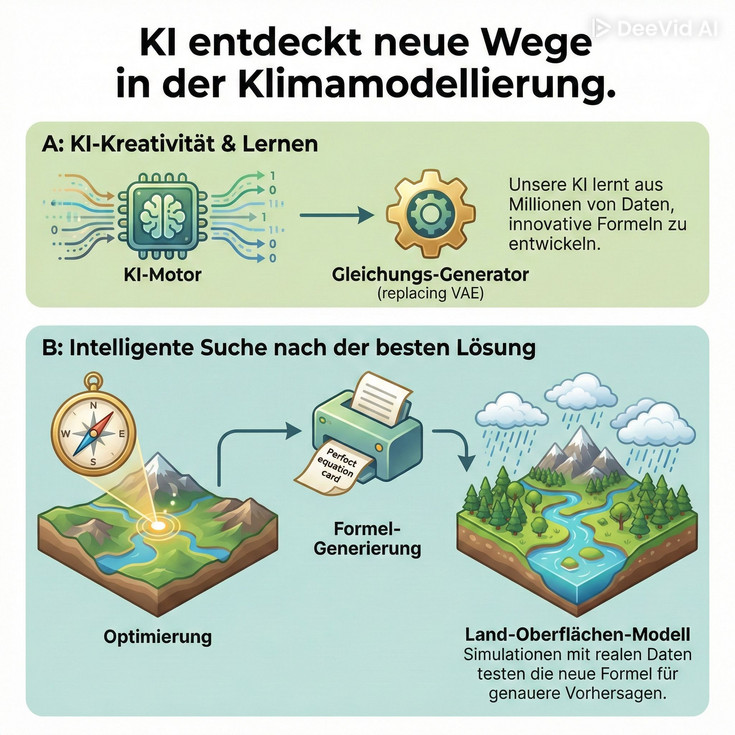
‘We don't use AI as a black box, but as a tool to discover comprehensible mathematical relationships,’ explains Karsten Schulz. ‘This enables us to develop physically interpretable models that are also more powerful.’
Tested in 162 catchment areas
The practicality of the method was tested on 162 German river catchment areas with different hydrological and physiogeographical conditions. The study area included alpine headwaters, lowlands dominated by loess, glacial moraine landscapes and regions with diverse soils and vegetation.
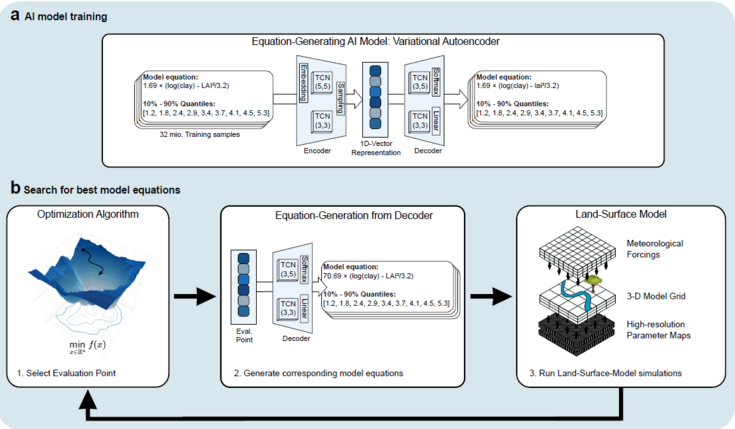
The result: The correlations derived by the AI led to more accurate predictions of runoff than established methods. In addition, the newly developed functions proved to be transferable to different regions and scalable to large areas.
‘Unlike previous approaches, where model equations had to be laboriously formulated by hand, our method finds these relationships automatically and optimises them,’ says Schulz. This is a decisive advantage over purely data-driven AI models.
Solution for missing data in many regions
‘It is particularly important that our method also works in so-called unobserved catchment areas – i.e. where little or no measurement data is available,’ the hydrologist concludes. ‘This opens up new possibilities for sustainable water resource management in the context of climate change.’
To the Springer Nature article: https://www.nature.com/articles/s44221-026-00583-3
DOI: 10.1038/s44221-026-00583-3
Scientific Contact
Univ.Prof. Dipl.Geoökol.Dr.rer.nat Karsten Schulz
BOKU University
Institute of Hydrology und Water Managment
karsten.schulz(at)boku.ac.at
Tel: +43 1 47654 81699