
NORDZIEKE Lab
Molecular Plant-Pathogen Interactions
Overview
Overview
Communication processes between fungal pathogens and their host plants. Focus on the identification of signaling molecules, molecular biological processes for signal perception and signal transmission, as well as the influence of the process on the development, establishment and spread of the plant disease.
Leader: University Assistant Dr. Daniela Nordzieke, Dipl. Biol.

Research Focus
Communication is essential for the coordination of processes within an organism as well as for its adaptation to external living conditions. We investigate self- and non-self-communication events in filamentous fungi with the aim of identifying signaling substances, corresponding receptors and the associated signaling pathways. In particular, communication processes between plant pathogenic fungi and their host plants are of interest to identify starting points for new, sustainable plant protection strategies. Applied methods range from genetics to molecular biological and biochemical analyses and includes microscopic investigations of fluorescently labeled proteins and the elucidation of dynamic protein environments.
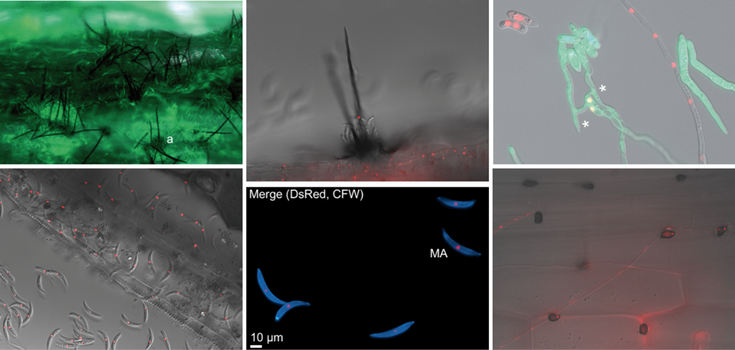
Research Projects
The role of specific asexual spore types in the development and distribution of corn anthracnose disease
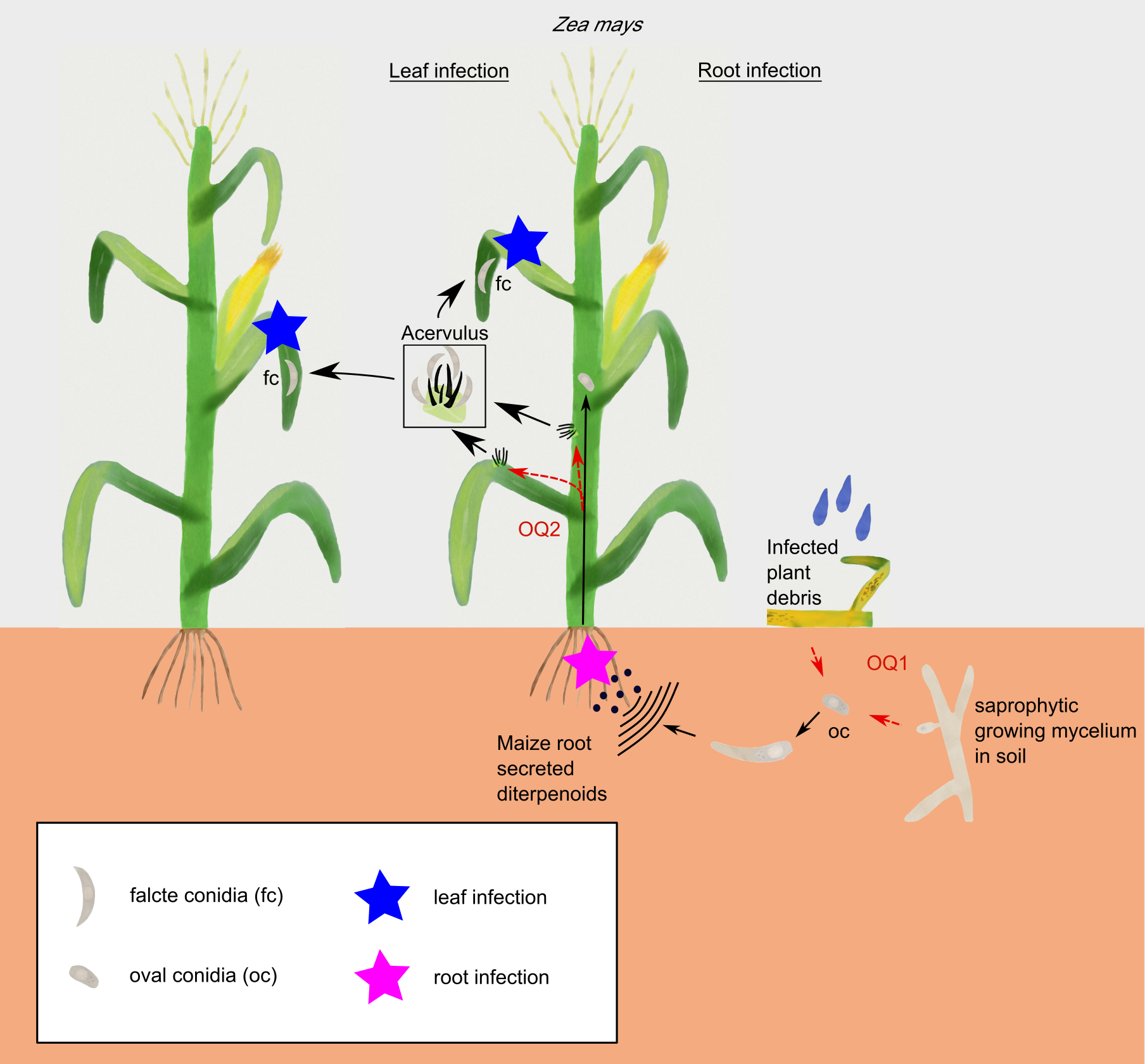
The maize anthracnose pathogen Colletotrichum graminicola forms two different types of asexual spores, oval and falcate conidia. In our research we showed that the development of both spore types is regulated very differently, impacting the infection process of the plant host. Whereas falcate conidia infect maize leaves highly efficiently, oval conidia are adapted to the infection of roots. In our current research, we investigate which molecular factors are responsible for this adaptation.
Nordzieke 2019 (doi: 10.1016/j.fgb.2019.103276)
Nordzieke 2022 (doi: 10.3390/microorganisms10061146)
Rudolph 2025 (doi: 10.1111/mpp.70155)
Rathi preprint (doi: doi: 10.1101/2025.11.19.689217)
image reference: Rudolph et al 2025 (doi: 10.1111/mpp.70155)
Communication of the maize anthracnose fungus Colletotrichum graminicola with plant roots and fungal germlings
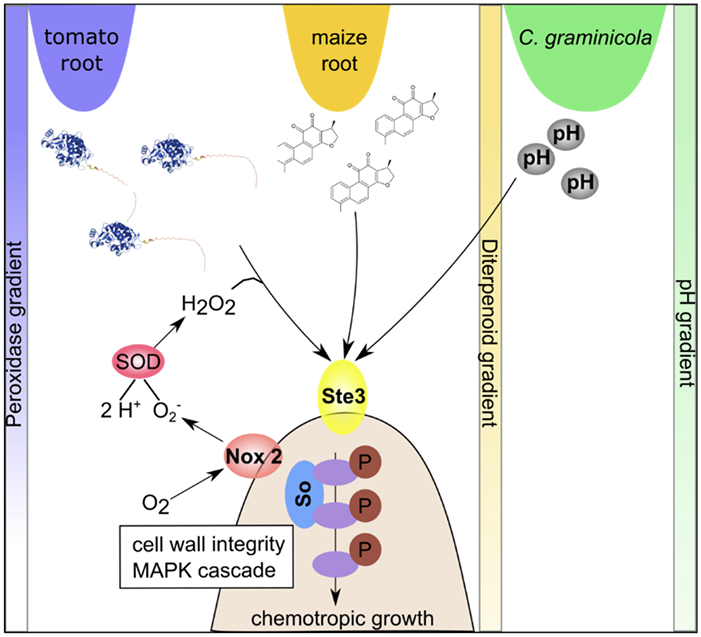
Filamentous fungi are highly polar-growing organisms and orient their growth direction according to external signals to optimize nutrient uptake, identify hosts, and find partners for sexual and asexual cell fusion. Oval conidia of the corn anthracnose fungus Colletotrichum graminicola are able to perceive signaling molecules exudated from the roots of the host plant (secondary metabolites), non-host plants (enzymes) or fungal germlings (acidic pH gradients) and to direct their growth accordingly. Our research revealed that a single G-protein-coupled receptor is responsible for the perception of all these signals. In our current research we investigate molecular mechanisms that lead to the activation of this receptor by the different signaling molecules.
Schunke 2020 (doi: 10.3389/fmicb.2020.584525)
Groth et al 2021(doi: 10.3390/jof7070580)
Rudolph 2024 (doi: 10.3389/ffunb.2024.1454633)
Rudolph 2025 (doi: 10.1111/mpp.70155)
Rudolph preprint (doi: 10.1101/2025.06.24.661326)
image reference: Rudolph, AY (2024), PhD thesis
Publications
(Publications as corresponding author*)
16. Rathi D, Andresen K, Daniel R, Guerreiro MA, Kretschmer M, Kronstad J, Nowrousian M, Pöggeler S, Poehlein A, Voll LM, Nordzieke DE* (preprint) Spore type-specific gene expression profiles underlying development and leaf infection processes of Colletotrichum graminicola. BioRxiv, doi: 10.1101/2025.11.19.689217
15. Rudolph AY, Rotermund N, Vasilevska N, Fleißner A, Nordzieke DE* (preprint) PmaI-dependent pH gradients initiate inter- and intraspecies germling fusion in filamentous fungi. BioRxiv, doi: 10.1101/2025.06.24.661326
14. Baroncelli R*, Voll LM*, Nordzieke DE* (2026) Editorial: Current perspectives on Colletotrichum: from molecules to ecosystems. Frontiers in Fungal Biology, 7:1817698. doi: 10.3389/ffunb.2026.1817698
13. Rudolph AY, Schunke C, Sasse C, Antelo L, Gerke J, Braus GH, Pöggeler S, Nordzieke DE* (2025) Maize Diterpenoid Sensing via the Ste3 A-Pheromone Receptor Guide Oval Conidia of Colletotrichum graminicola to Host Roots. Mol Plant Pathol, 26:e70155. doi: 10.1111/mpp.70155
12. Rudolph AY, Schunke C, Nordzieke DE* (2024) Conserved perception of host and non-host signals via the a-pheromone receptor Ste3 in Colletotrichum graminicola. Frontiers in Fungal Biology, 5:1454633. doi: 10.3389/ffunb.2024.1454633
11. Ludwig Navarro B, Blumenstein K, Nordzieke DE* (2023) Peroxiporins in plant-microbial interactions. In: Bienert GP, Medrano Fernandez I and Sitia R “Peroxiporins: Redox Signal Mediators In and Between Cells”, Taylor & Francis Group CRC Press/Chapman & Hall; doi: 10.1201/9781003160649
10. Nordzieke DE* (2022) Hyphal fusions enable efficient nutrient distribution in Colletotrichum graminicola conidiation and symptom development on maize. Microorganisms 10, 1146. doi: 10.3390/microorganisms10061146
9. Liu L, Sasse C, Dirnberger B, Valerius O, Fekete-Szücs E, Harting R, Nordzieke DE, Pöggeler S, Karlovsky P, Gerke J, Braus GH (2021) Secondary metabolites of Hülle-cells mediate protection of fungal reproductive and overwintering structures against fungivorous animals. eLife 10:e68058. doi: 10.7554/eLife.68058
8. Groth A, Schunke C, Reschka EJ, Pöggeler S, Nordzieke DE* (2021) Tracking fungal growth: Establishment of Arp1 as a marker for polarity establishment and active hyphal growth in filamentous ascomycetes. J. Fungi 7, 580. doi: 10.3390/jof7070580
7. Schunke C, Pöggeler S, Nordzieke DE* (2020) A 3D printed device for easy and reliable quantification of fungal chemotropic growth. Front Microbiol 11:584525. doi: 10.3389/fmicb.2020.584525
6. Prusky D, de Assis LJ, Baroncelli R, Benito EP, Casado del Castillo V, Chaya T, Covo S, Díaz-Mínguez JM, Donofrio NM, Espeso E, Ribeiro Fernandes T, Goldman GH, Judelson H, Nordzieke D, Di Pietro A, Sionov E, Sukno SA, Thon MR, Todd RB, Voll L, Xu JR, Horwitz BA, Wilson RA (2020) Nutritional factors modulating plant and fruit susceptibility to pathogens: BARD workshop, Haifa, Israel, February 25–26, 2018, Phytoparasitica 2020, doi: 10.1007/s12600-020-00803-w
5. Nordzieke DE*, Sanken A, Antelo L, Raschke A, Deising HB, Pöggeler S (2019) Specialized infection strategies of falcate and oval conidia of Colletotrichum graminicola, Fungal Genet Biol, 133:103276. doi: 10.1016/j.fgb.2019.103276.
4. Nordzieke DE, Fernandes TR, El Ghalid M, Turrà D, Di Pietro A (2019) NADPH oxidase regulates chemotropic growth of the fungal pathogen Fusarium oxysporum towards the host plant, New Phytol, 224(4):1600-1612. doi: 10.1111/nph.16085.
3. Nordzieke DE*, Medraño-Fernández I (2018) The plasma membrane: a platform for intra- and intercellular redox signaling, Antioxidants (Basel), 7(11). pii: E168. doi: 10.3390/antiox7110168.
2. Turrà D, Nordzieke D, Vitale S, El Ghalid M and Di Pietro A (2016) Hyphal chemotropism in fungal pathogenicity, Semin Cell Dev Biol, 57:69-75. doi: 10.1016/j.semcdb.2016.04.020.
1. Dirschnabel DE, Nowrousian M, Cano-Domínguez N, Aguirre J, Teichert I and Kück U (2014) New insights into the roles of NADPH oxidases in sexual development and ascospore germination in Sordaria macrospora, Genetics, 196(3):729-44. doi: 10.1534/genetics.113.159368.