
NORDZIEKE Lab
Molekulare Pflanze-Pathogen Interaktionen
Gebiet
Gebiet
Kommunikationsprozesse zwischen pilzlichen Schaderregern und ihren Wirtspflanzen. Fokus auf der Identifizierung von Signalmolekülen, molekularbiologischen Prozessen zur Signalperzeption und Signalweiterleitung, sowie dem Einfluss des Prozesses für die Entstehung, Etablierung und Verbreitung der Pflanzenkrankheit.
Leitung: Universitätsassistenz Dr. Daniela Nordzieke, Dipl. Biol.
Ausrichtung
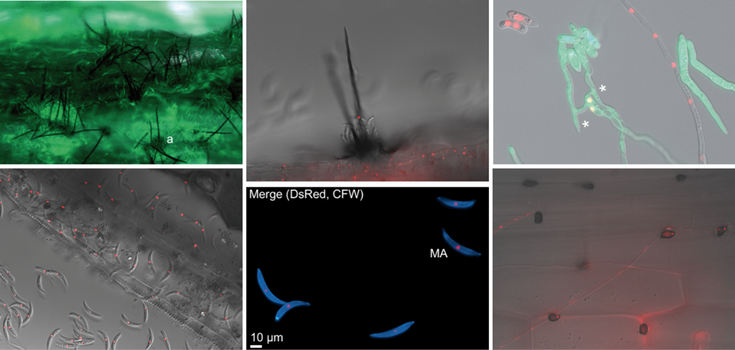
Kommunikation ist essenziell für die Abstimmung von Prozessen innerhalb eines Organismus sowie für seine Anpassung an äußere Lebensbedingungen. Wir untersuchen Selbst- und Fremdkommunikationsereignisse in filamentösen Pilzen mit dem Ziel Signalstoffe, entsprechende Rezeptoren und die zugehörigen Signalwege zu identifizieren. Insbesondere sind hier Kommunikationsprozesse zwischen Schadpilzen und ihren Wirtspflanzen für uns von Interesse, um Ansatzpunkte für neue, nachhaltige Pflanzenschutzstrategien zu identifizieren. Unser Methodenspektrum reicht von genetischen zu molekularbiologischen und biochemischen Analysen und inkludiert mikroskopische Untersuchungen von Fluoreszenz-markierten Proteinen und die Aufklärung von dynamischen Proteinumgebungen.
Forschungsprojekte
Spezialisierung im Krankheitsverlauf der Maisanthraknose: die Rolle von spezifischen asexuellen Sporentypen
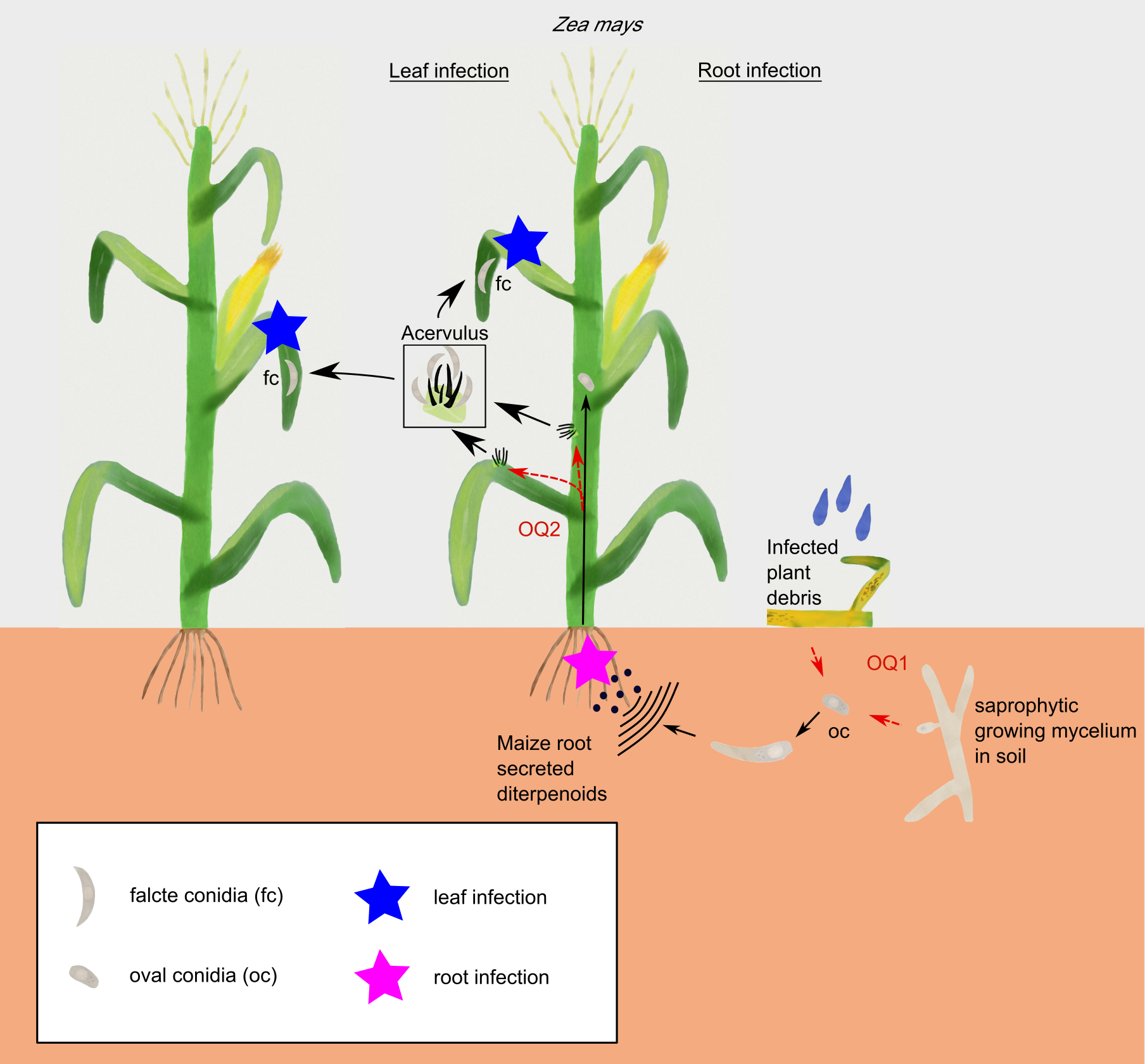
Der Maisanthraknose Erreger Colletotrichum graminicola bildet zwei verschiedene Typen von asexuellen Sporen, ovale und sichelförmige Konidien. Wie wir in unseren Forschungen zeigen konnten, ist die Entwicklung beider Sporentypen sehr unterschiedlich reguliert. Hierdurch wird auch die Infektion der Wirtspflanze beeinflusst: sichelförmige Konidien sind in der Lage schnell Maisblätter zu infizieren, wobei ovale Konidien an die Infektion von Wurzeln angepasst sind. In unserer aktuellen Forschung untersuchen wir, welche molekularen Faktoren für diese Anpassung verantwortlich sind und wie dies die Kommunikation mit der Wirtspflanze beeinflusst.
Nordzieke 2019 (doi: 10.1016/j.fgb.2019.103276)
Nordzieke 2022 (doi: 10.3390/microorganisms10061146)
Rudolph 2025 (doi: 10.1111/mpp.70155)
Rathi preprint (doi: 10.1101/2025.11.19.689217)
Bildreferenz: Rudolph et al 2025 (doi: 10.1111/mpp.70155)
Kommunikation des Maisanthracnose Pilzes Colletotrichum graminicola mit Pflanzenwurzeln und Pilzkeimlingen
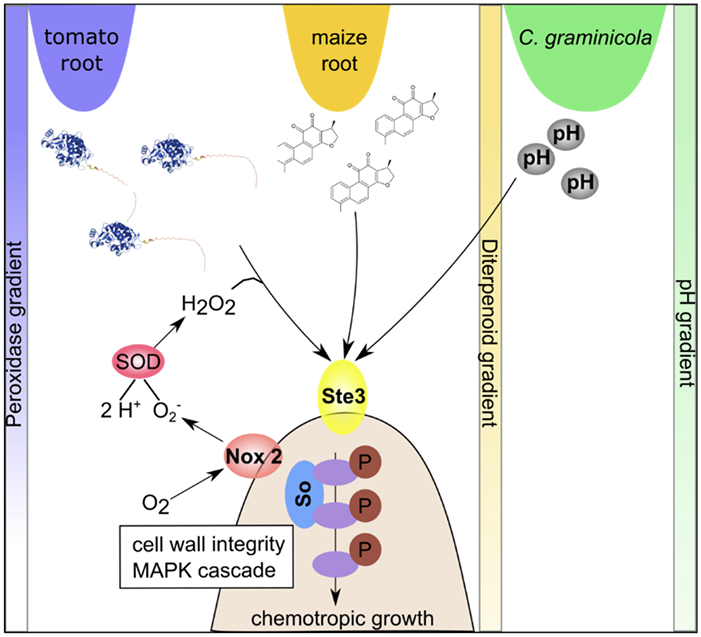
Filamentöse Pilze sind hoch polar-wachsende Organismen und orientieren ihre Wachstumsrichtung nach äußeren Signalen um die Nährstoffaufnahme zu optimieren, Wirte zu identifizieren, sowie Partner für die sexuelle und asexuelle Zellfusion zu finden. Ovale Konidien des Maisanthraknose Pilzes Colletotrichum graminicola sind in der Lage, Signalmoleküle ausgehend von Wurzeln der Wirtspflanze (Sekundärmetabolite), nicht-Wirtspflanzen (Enzyme) oder Keimlingen (saure pH Gradienten) wahrzunehmen und ihr Wachstum darauf auszurichten. Wie wir zeigen konnten, ist ein G-protein gekoppelter Rezeptor für die Perzeption all dieser Signale verantwortlich. In unserer aktuellen Forschung untersuchen wir molekulare Mechanismen, welche zur Aktivierung dieses Rezeptors durch die unterschiedlichen Signalmoleküle führen.
Schunke 2020 (doi: 10.3389/fmicb.2020.584525)
Groth et al 2021(doi: 10.3390/jof7070580)
Rudolph 2024 (doi: 10.3389/ffunb.2024.1454633)
Rudolph 2025 (doi: 10.1111/mpp.70155)
Rudolph preprint (doi: 10.1101/2025.06.24.661326)
Bildreferenz: Rudolph, AY (2024), PhD thesis
Publikationen
(Publications as corresponding author*)
16. Rathi D, Andresen K, Daniel R, Guerreiro MA, Kretschmer M, Kronstad J, Nowrousian M, Pöggeler S, Poehlein A, Voll LM, Nordzieke DE* (preprint) Spore type-specific gene expression profiles underlying development and leaf infection processes of Colletotrichum graminicola. BioRxiv, doi: 10.1101/2025.11.19.689217
15. Rudolph AY, Rotermund N, Vasilevska N, Fleißner A, Nordzieke DE* (preprint) PmaI-dependent pH gradients initiate inter- and intraspecies germling fusion in filamentous fungi. BioRxiv, doi: 10.1101/2025.06.24.661326
14. Baroncelli R*, Voll LM*, Nordzieke DE* (2026) Editorial: Current perspectives on Colletotrichum: from molecules to ecosystems. Frontiers in Fungal Biology, 7:1817698. doi: 10.3389/ffunb.2026.1817698
13. Rudolph AY, Schunke C, Sasse C, Antelo L, Gerke J, Braus GH, Pöggeler S, Nordzieke DE* (2025) Maize Diterpenoid Sensing via the Ste3 A-Pheromone Receptor Guide Oval Conidia of Colletotrichum graminicola to Host Roots. Mol Plant Pathol, 26:e70155. doi: 10.1111/mpp.70155
12. Rudolph AY, Schunke C, Nordzieke DE* (2024) Conserved perception of host and non-host signals via the a-pheromone receptor Ste3 in Colletotrichum graminicola. Frontiers in Fungal Biology, 5:1454633. doi: 10.3389/ffunb.2024.1454633
11. Ludwig Navarro B, Blumenstein K, Nordzieke DE* (2023) Peroxiporins in plant-microbial interactions. In: Bienert GP, Medrano Fernandez I and Sitia R “Peroxiporins: Redox Signal Mediators In and Between Cells”, Taylor & Francis Group CRC Press/Chapman & Hall; doi: 10.1201/9781003160649
10. Nordzieke DE* (2022) Hyphal fusions enable efficient nutrient distribution in Colletotrichum graminicola conidiation and symptom development on maize. Microorganisms 10, 1146. doi: 10.3390/microorganisms10061146
9. Liu L, Sasse C, Dirnberger B, Valerius O, Fekete-Szücs E, Harting R, Nordzieke DE, Pöggeler S, Karlovsky P, Gerke J, Braus GH (2021) Secondary metabolites of Hülle-cells mediate protection of fungal reproductive and overwintering structures against fungivorous animals. eLife 10:e68058. doi: 10.7554/eLife.68058
8. Groth A, Schunke C, Reschka EJ, Pöggeler S, Nordzieke DE* (2021) Tracking fungal growth: Establishment of Arp1 as a marker for polarity establishment and active hyphal growth in filamentous ascomycetes. J. Fungi 7, 580. doi: 10.3390/jof7070580
7. Schunke C, Pöggeler S, Nordzieke DE* (2020) A 3D printed device for easy and reliable quantification of fungal chemotropic growth. Front Microbiol 11:584525. doi: 10.3389/fmicb.2020.584525
6. Prusky D, de Assis LJ, Baroncelli R, Benito EP, Casado del Castillo V, Chaya T, Covo S, Díaz-Mínguez JM, Donofrio NM, Espeso E, Ribeiro Fernandes T, Goldman GH, Judelson H, Nordzieke D, Di Pietro A, Sionov E, Sukno SA, Thon MR, Todd RB, Voll L, Xu JR, Horwitz BA, Wilson RA (2020) Nutritional factors modulating plant and fruit susceptibility to pathogens: BARD workshop, Haifa, Israel, February 25–26, 2018, Phytoparasitica 2020, doi: 10.1007/s12600-020-00803-w
5. Nordzieke DE*, Sanken A, Antelo L, Raschke A, Deising HB, Pöggeler S (2019) Specialized infection strategies of falcate and oval conidia of Colletotrichum graminicola, Fungal Genet Biol, 133:103276. doi: 10.1016/j.fgb.2019.103276.
4. Nordzieke DE, Fernandes TR, El Ghalid M, Turrà D, Di Pietro A (2019) NADPH oxidase regulates chemotropic growth of the fungal pathogen Fusarium oxysporum towards the host plant, New Phytol, 224(4):1600-1612. doi: 10.1111/nph.16085.
3. Nordzieke DE*, Medraño-Fernández I (2018) The plasma membrane: a platform for intra- and intercellular redox signaling, Antioxidants (Basel), 7(11). pii: E168. doi: 10.3390/antiox7110168.
2. Turrà D, Nordzieke D, Vitale S, El Ghalid M and Di Pietro A (2016) Hyphal chemotropism in fungal pathogenicity, Semin Cell Dev Biol, 57:69-75. doi: 10.1016/j.semcdb.2016.04.020.
1. Dirschnabel DE, Nowrousian M, Cano-Domínguez N, Aguirre J, Teichert I and Kück U (2014) New insights into the roles of NADPH oxidases in sexual development and ascospore germination in Sordaria macrospora, Genetics, 196(3):729-44. doi: 10.1534/genetics.113.159368.