
Richard Strasser
Molecular Plant Glycobiology
Leader: Assoc. Prof. DI Dr. Richard Strasser
Research interest
Our research investigates the molecular mechanisms underlying protein glycosylation, quality control, and trafficking in plant cells. By combining plant cell biology, glycobiology, and biotechnology, we explore how protein modifications influence function, stability, and homeostasis. This knowledge is applied to improve the production of recombinant and therapeutic proteins in plants.
Expertise at a glance
Plant glycobiology — N-glycosylation, N-glycan processing, glycosyltransferases, glycosidases, and glycan function.
Plant cell biology — intracellular protein trafficking, quality control, and protein degradation pathways.
Plant biotechnology — engineering plants to produce modified proteins with optimized functional properties, including human antibodies with tailored glycosylation profiles.
Selected projects
Characterization of glycosylation pathways and N-glycan function in plants
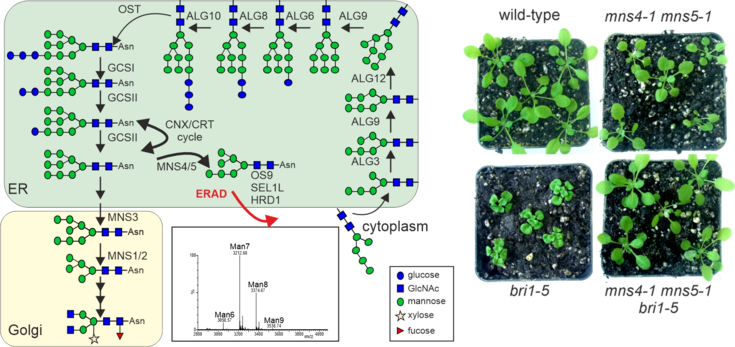
Protein glycosylation is an essential co- and post-translational modification process for secretory and membrane proteins in all eukaryotes. The initial steps of N-glycosylation and N-glycan processing are highly conserved in plants, mammals and yeast. However, the late steps of N-glycan maturation in the Golgi differ significantly in plants. This results in the formation of complex N-glycans that contain β1,2-linked xylose, core α1,3-linked fucose and Lewis A-type structures. While the essential role of N-glycan modifications on distinct mammalian glycoproteins is well documented, the biological function of this ubiquitous protein modification in different plant species has only recently begun to be elucidated. In this project, we focus on the biosynthesis and function of various plant protein N-linked glycans. Particular attention is given to the oligosaccharyltransferase (OST) complex, which initiates N-glycosylation, and to the function of distinct terminal N-glycan modifications.
Investigation of glycan-dependent ER quality control systems in plants
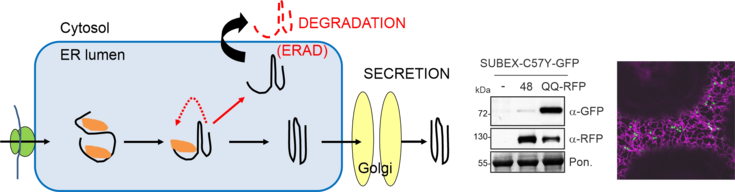
Protein folding is an error-prone process. Various stresses can cause proteins to misfold, which endangers the survival of cells and whole plants under different environmental conditions. The endoplasmic reticulum (ER) is a major site of protein biosynthesis and maturation. To promote glycoprotein folding and target potentially harmful misfolded proteins for degradation, plants utilise conserved glycan-dependent ER-quality control (ERQC) and ER-associated degradation (ERAD) systems. ERAD involves mannosidase-mediated trimming and recognition of a conserved glycan degradation signal by a membrane-embedded protein complex involved in retrotranslocation to the cytosol. However, the molecular mechanisms of ERAD client recognition and retrotranslocation remain unknown in plants. Here, we examine the function of specific mannosidase complexes and a group of rhomboid-like proteins that are involved in an as yet unknown ERAD-related pathway for the disposal of misfolded glycoproteins.
Plant-based recombinant protein production
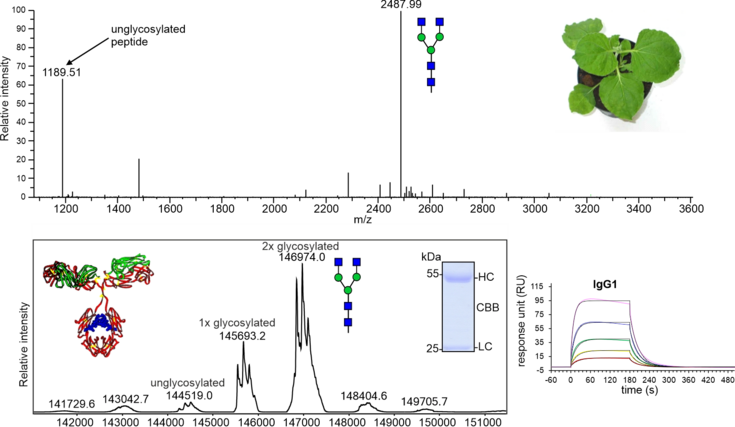
Many recombinant proteins and protein-based therapeutics undergo glycosylation, whereby sugar chains are attached to the protein. These glycans can influence the stability, activity, half-life and immunogenicity of the protein. The type of cells used to produce the recombinant protein strongly affects its glycosylation profile, making glycosylation a critical factor in ensuring the quality of biopharmaceuticals. In this project, we use glycoengineering approaches to remove undesirable, plant-specific glycan modifications and create glycoproteins with customised, human-like N- and O-glycan structures for use in functional studies.
Publications
Authors' Self-Archiving Publications
- Schoberer J, Shin YJ, Vavra U, Veit C, Strasser R. (2024) Analysis of Protein Glycosylation in the ER. Methods Mol Biol. 2772: 221-238. doi: 10.1007/978-1-0716-3710-4_16. PDF
- Vavra U, Veit C, Strasser R. (2026) Studying Glycan-Dependent ERAD of Misfolded Glycoproteins in Plants. Methods Mol Biol. 3069: 157-168. doi: 10.1007/978-1-0716-5508-5_11. PDF
- Dicker M, Strasser R. Using glyco-engineering to produce therapeutic proteins. Expert Opin Biol Ther. 2015;15(10):1501-1516. doi: 10.1517/14712598.2015.1069271. Epub 2015 Jul 14. PDF
- Strasser R. (2018). Protein Quality Control in the Endoplasmic Reticulum of Plants. Annu Rev Plant Biol 69: 147-172. doi: 10.1146/annurev-arplant-042817-040331
- Schoberer J, Shin YJ, Vavra U, Veit C, Strasser R. (2018). Analysis of Protein Glycosylation in the ER. Methods Mol Biol. 1691: 205-222. doi: 10.1007/978-1-4939-7389-7_16. PDF
- R. Strasser (2009) Localization of plant N‐glycan processing enzymes along the secretory pathway, Plant Biosystems - An International Journal Dealing with all Aspects of Plant Biology, 143:3, 636-642, DOI: 10.1080/11263500903233391. PDF
- Göritzer K, Strasser R. Glycosylation of Plant-Produced Immunoglobulins.Exp Suppl. 2021;112:519-543. doi: 10.1007/978-3-030-76912-3_16. PDF
- Margolin EA, Strasser R, Chapman R, Williamson AL, Rybicki EP, Meyers AE. Engineering the Plant Secretory Pathway for the Production of Next-Generation Pharmaceuticals. Trends Biotechnol. 2020 Sep;38(9):1034-1044. doi: 10.1016/j.tibtech.2020.03.004. PDF