
Demonstration facility for different irrigation strategies
In the research and demonstration facility in the courtyard of the Emil-Peres-House at Muthgasse 18, 1190 Vienna, the Institute for Institute of Sanitary Engineering and Water Pollution Control, together with the Institute for Soil-Bioengineering and Landscape Construction, developed and researched a multifunctional vertical greening system for different irrigation strategies with appropriately adapted planting:
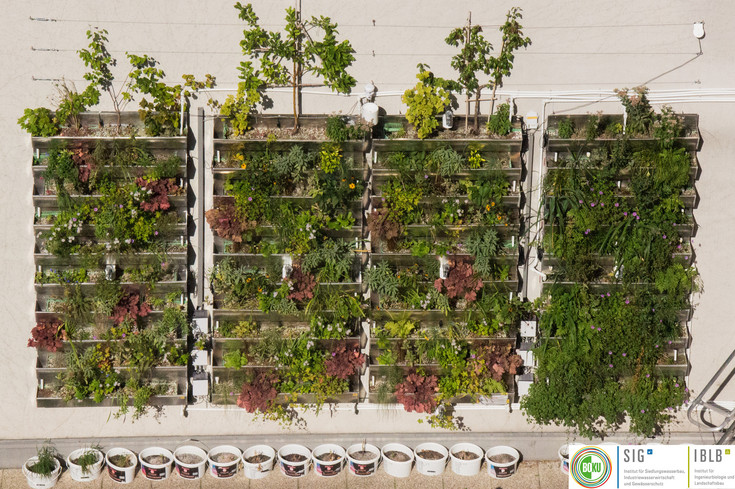
Wall 1 (left) focused on drought-resistant plants and a water-saving irrigation strategy (irrigation 1-2 times/week).
Walls 2+3 (centre) served to compare the irrigation of an ornamental perennial wall with grey water and drinking water (irrigation once daily).
Wall 4 (right) examined the cleaning performance of vertical greening for grey water (hourly irrigation).
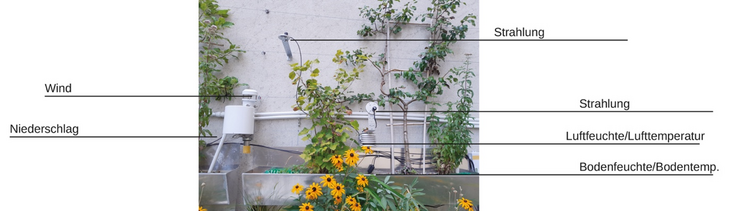
By measuring soil moisture, air temperature and humidity, radiation, and water consumption, etc., insights into plant use and the interaction of the system with the environment can be gained.
The aim of the development was to design a resilient, easy-to-maintain vertical greening system with different water uses and water resources.
The following scenarios were envisaged:
a) Daily irrigation to achieve the highest possible evaporation rate for urban cooling. Tap water was used for irrigation, as this is the usual water source for vertical greening systems. In addition, the use of grey water for resource-saving irrigation was also investigated.
For this “typical” application of a vertical greening system, the aim was to use plants with the longest possible flowering period that would be attractive all year round.
b) Integration of rainwater and irrigation to achieve the lowest possible water consumption.
As dry periods can occur, the plants should be undemanding and drought resistant.
c) Treatment of grey water. Since the grey water must be treated, it is necessary for a large amount of water to flow through the plant substrate. Therefore, the plants must be adapted to the constantly moist site conditions.
To achieve the above objectives, the following 4 steps of the design process were carried out.
Step 1: Selecting a vertical greening system that promotes healthy plant growth, supports high biodiversity, and also meets the requirements for functioning as a greywater treatment system
Specific design recommendations for greywater treatment include the choice of substrate (mainly in terms of hydraulic conductivity), irrigation amount and intervals, and the number of planters required, which is usually described as the total horizontal area. General recommendations include the following (Cross et al., 2021):
- Area per person: 1-2 m2
- Height per pot: >20 cm
- Hydraulic loading rate: 0.1-0.5 m3.m-2.d-1
- Organic loading rate: 10-160 gCOD.m-2.d-1
- Hydraulic conductivity: ~10-4 m.s-1
- Porosity: ~0.4 m3.m-3
In order to meet the requirement of 90 l per day on 1-2 m² and to provide sufficient root space for healthy plant development, an existing vertical greening system (“green wall, Techmetall”) was adapted in terms of its proportions. The dimensions of the aluminium pots are h=20 cm, w=18 cm/20 cm, and l=150 cm. A special fleece is inserted as an insulation and ventilation layer, onto which approx. 17 cm of planting substrate is applied. A test wall consisted of 10 planters, which were fixed to an aluminium substructure at intervals of 15 cm. Four walls were set up next to each other. The regular irrigation scenario (a) was tested in wall 2 with tap water and in wall 3 with grey water. The dry scenario (b) was investigated in wall 1, and the grey water purification scenario (c) was investigated in wall 4.
Step 2: Development of a simple low-tech irrigation system
A conventional irrigation system with drippers in each pot requires a lot of maintenance due to clogging of the small irrigation pipes and possible failure of individual drippers. Clogging problems can increase when water sources other than tap water are used.
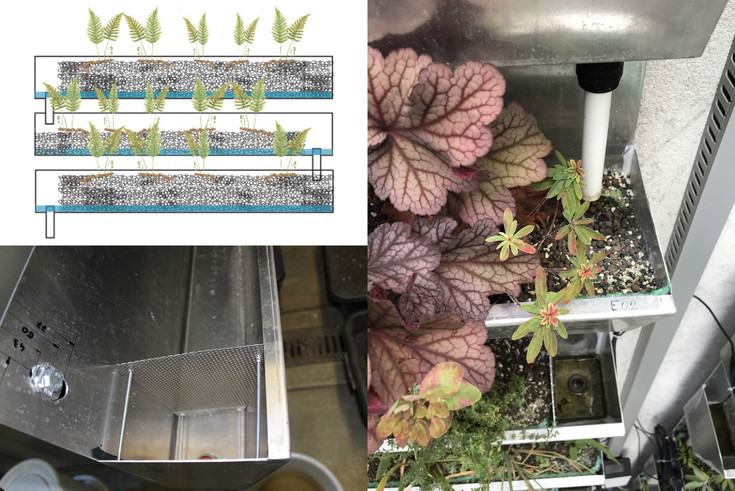
Instead of using drip hoses, the individual tubs were watered in cascades via open pipes:
The water enters the topmost plant pot via a pipe, flows through the pot and fills the dammed reservoir (height 2 cm). The water then flows down into the next plant pot. A perforated plate at a distance of 10 cm prevents the pipe from becoming clogged by plant roots. The water stored in the reservoir is either used directly by the plants through root water absorption or first transported upwards through capillary rise in the substrate before being absorbed by the plant roots.
The pipes were made from PVC pipes (22 mm) with press fittings, as are commonly used for water pipes. These pipes are more durable and tighter than the screw connections used for agricultural irrigation systems. Walls 1 and 2 were irrigated with tap water, while walls 3 and 4 were operated with grey water. A tank was set up for grey water use, from which the water was pumped to the green areas. The water supply speed was set to 0.3 l/min to prevent overflow into the planters.
The excess water from the last planter flows out of the system. In the interests of sustainability, excess water should be returned to the tank and reused.
Step 3: Development of the planting substrate
As part of this project, a list of parameters was developed to serve as a guide for the required parameters and the proposed value ranges. Based on these recommendations, the planting substrate for the system in this project was selected. The final components were expanded clay (4-8 mm), zeolite (1-2.5 mm), perlite (0-6 mm), sand (0.06-2 mm), and crushed expanded clay (0-8 mm) in equal volume percentages.
Step 4: Identification of suitable plants
In order to find suitable plants for the various water usage scenarios, 39 plant species were tested over a period of two years. Table of plant species examined (excerpt from Maria Antoni's master's thesis). Wall 2 was watered with 25 l of tap water per day, wall 3 was watered with 25 l of grey water per day (scenario a). Tap water (25-50 l/week) was used on wall 1 (scenario b), and wall 4 was treated with 90 l of grey water per day (scenario c).
In scenario (b), only four species survived in good condition with low water requirements (Heuchera x cultorum ‘Berry Smoothie’, Aster ageratoides ‘Asran’, Geranium wallichianum ‘Rozanne’, and Satureja montana). For the scenario with sufficient irrigation (a), in which daily watering was provided, the species Iris barbata nana ‘Brassie’, Rudbeckia fulgida ‘Goldsturm’, Hemerocallis middendorfii, and Salvia officinalis were very well suited in addition to the species recommended for the dry scenario. Iris pseudacorus, Bergenia cordifolia, Calamagrostis x acutiflora ‘Karl Foerster’, Fragaria x ananassa ‘Delikatess’, Allium schoenoprasum, and Rosmarinus officinalis ‘Miss Jesopp's Upright’ were also in good condition. In the greywater treatment plant (scenario c), the species Eupatorium cannabinum, Mentha aquatica, Sedum telephium, Eriophorum vaginatum, Thelypteris palustris, and Lythrum salicaria were suitable.
It was found that more water was better for the plants than dry conditions, and a similar result was seen when measuring biomass, with the highest biomass being produced in the wall with the highest irrigation intensity. When comparing plants irrigated with treated greywater and tap water, no differences in plant development were observed after 2 years of operation.
Two master's theses were written on plant development:
- Maria Antoni (2021): Pflanzen für Living-Wall-Systeme mit unterschiedlichen Bewässerungsszenarien, sowie Grauwasserbewässerung und -reinigung.
https://forschung.boku.ac.at/fis/suchen.hochschulschriften_info?sprache_in=de&menue_id_in=107&id_in=&hochschulschrift_id_in=21576 - Rebecca Braunegger (2022): Fassadenbegrünung – Auswirkungen unterschiedlicher Bewässerungsszenarien auf die Bepflanzung .
https://litsearch.boku.ac.at/primo-explore/fulldisplay?docid=BOK_alma2188394070003345&context=L&adaptor=Local%20Search%20Engine&vid=BOK&lang=de_DE&search_scope=default_scope&tab=default_tab&query=addsrcrid,exact,AC16673678