Activities
BIOSS at the 1st IASNR European Hub Conference in Berlin, 8th-10th March 2023
The BIOSS team was proud to participate in the 1st International Association for Society and Natural Resources (IASNR) European Hub Conference in Berlin. We hosted two workshops on science-society interactions in protected areas and Biosphere Reserves. It was a great opportunity to present our exciting project and engage with this diverse community of researchers, practitioners, and policymakers.

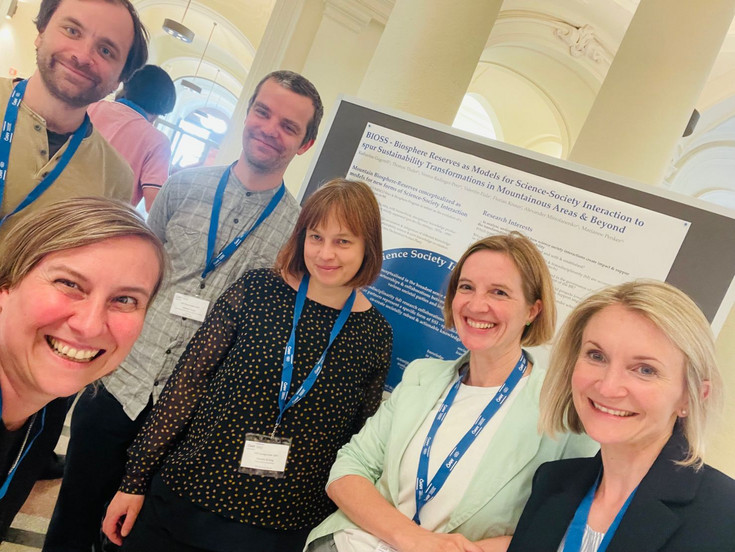
BIOSS at the OeAW's Earth System Sciences (ESS) Symposium, 1st of June, 2023
On June 1st, 2023, the BIOSS team presented a project poster at the ESS symposium hosted by the Austrian Academy of Sciences (ÖAW). We highlighted our research on hashtag#science-society interactions and transdisciplinarity in mountain Biosphere Reserves. Check out the poster here.
BIOSS at the 3rd Caucasus Mountain Forum in Kutaisi, Georgia, 4th-6th of July, 2023
Alexander Mitrofanenko from the BIOSS project team presented a theoretical poster on the project at the Third Caucasus Mountain Forum today in Kutaisi, Georgia! The forum sparked exciting discussions on transdisciplinarity in mountainous Biosphere Reserves, icluding the ones in the Caucasus region. A great opportunity to connect with fellow researchers and explore new ideas. Check out the poster here.

BIOSS in the Field: Fieldwork at the Dedoplistskaro Biosphere Reserve in Eastern Georgia, May 2024
The BIOSS project team as well as students and staff from BOKU University and Ilia State University collaborated to explore science-society interactions in the Dedoplistskaro Biosphere Reserve in Eastern Georgia. From engaging with local communities to mapping stakeholders and co-creating future visions, the experience was both enriching and inspiring.

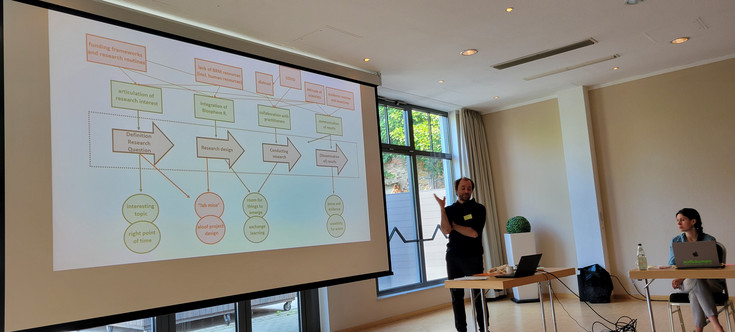
BIOSS at the EUROMAB 2024, Elbe River Landscape Biosphere Reserve, Germany
The BIOSS team participated in the EUROMAB 2024 conference, hosted from June 3 to 7 by the German MAB National Committee, the Federal State of Saxony-Anhalt, and the UNESCO Biosphere Reserve “Elbe River Landscape.” During the event, we co-hosted a workshop focused on impactful research, transdisciplinarity, and science-society interactions within MAB Biosphere Reserves. A heartfelt thanks to Valentin Fiala for the fantastic preparation and moderation!
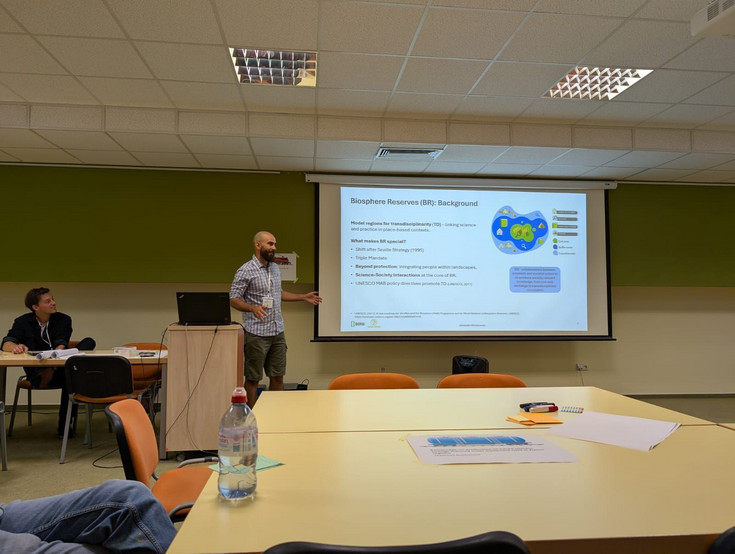
BIOSS at the IALE 2025 European Landscape Ecology Congress
At the IALE Europe 2025 European Landscape Ecology Congress, held in Bratislava, Slovakia, from 1–5 September 2025, the BIOSS project was featured with two oral presentations. Alexander Mitrofanenko presented published findings from the Q-study component of WP1, highlighting diverse understandings of science–society interactions among representatives of mountain Biosphere Reserves and their alignment with UNESCO MAB policy directives. Verena Radinger-Peer presented findings from WP2, based on a social network analysis of five mountainous Biosphere Reserves, examining how science–society research collaborations are initiated and shaped within transdisciplinary settings.
BIOSS at the International Mountain Conference 2025
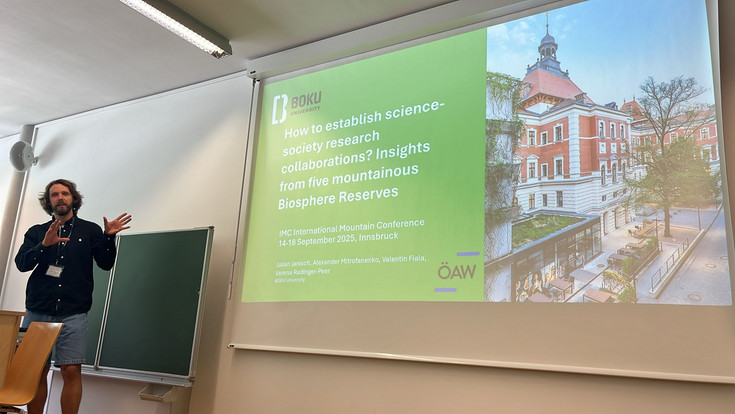
At the International Mountain Conference 2025, held in Innsbruck, Austria, from 14–18 September 2025, the BIOSS project was represented by Julian Janisch, who presented WP2 results on science–society interactions and knowledge networks in mountain BRs. Drawing on social network analysis across five case study regions, the presentation highlighted how mountain BRs can act as models for innovative forms of science–society collaboration within the global mountain research community.
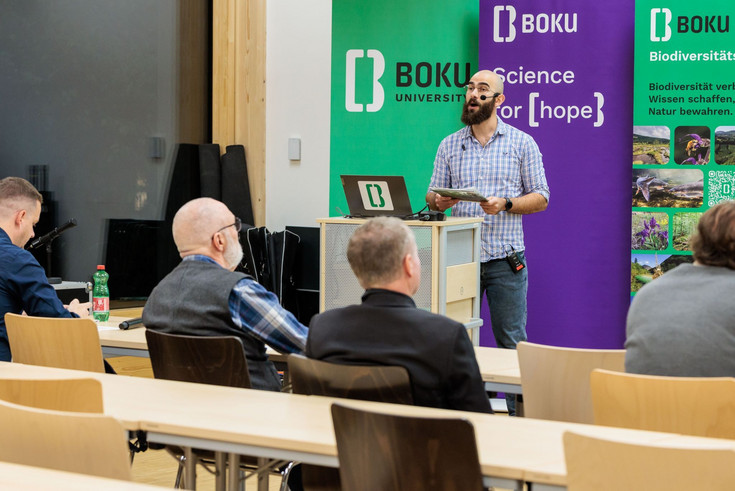
BIOSS at the BOKU University Sustainability Day 2025
The BIOSS WP1 Q-study paper “Understanding Science–Society Interactions: Diverse Viewpoints from Mountain Biosphere Reserves” was selected for presentation at the BOKU Sustainability Day 2025 on 13 November 2025 in Vienna, Austria. Alexander Mitrofanenko presented the published findings in the PechaKucha format, providing a concise and engaging overview of diverse understandings of science–society interactions in mountain BRs and their alignment with UNESCO MAB policy directives.
The presentation can be viewed here.