
BOKU University Value Chain
General information about the value chain
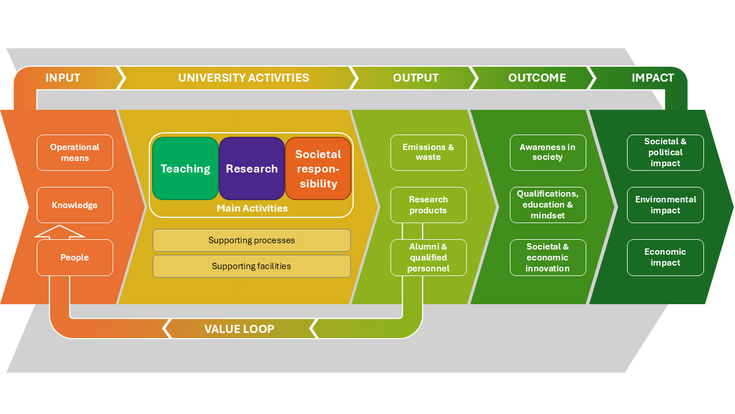
The BOKU value chain was developed as part of BOKU’s sustainability initiatives.
The goal in developing this value chain is to gain a deeper understanding of how value is co-created through BOKU’s core processes and how the supporting processes and facilities enable and sustain them. Moreover, the value chain illustrates how BOKU fulfills the objective of universities as stated in §1 of the Austrian Universities Act 2002:
“The mission of the universities is to serve academic research and teaching and the advancement, appreciation and teaching of the arts, and thereby to contribute to the personal development of the individual and to the welfare of society and the environment.”
The value chain of BOKU University illustrates how various inputs are transformed through university processes into meaningful outputs, and further into outcomes and impacts. It includes activities, resources and relationships to fulfill its objectives and tasks. By describing BOKU’s value chain, the complex and diverse activities of the university are broken down into a structured framework.
We have developed the value chain by following a logic model approach[1]. This links inputs, activities, outputs, outcomes and impacts, clarifying how resources and actions lead to measurable results for people, society and the environment.
The value chain is used in workshops as part of the materiality assessment to discuss BOKU’s impacts, risks and opportunities (IROs) in relation to sustainability, ensuring that no relevant aspects are overlooked.
Detailed description
At the center of BOKU’s value chain are three main activities, often called the three missions of a university: “teaching”, “research” and “societal responsibility”. These main activities define universities and are predetermined by the Austrian university law. Teaching refers to conveying knowledge and skills based on current research, as well as preparing students for future careers. Research includes independent, ethical pursuit of knowledge with academic freedom and refers to multiple forms of research. Societal responsibility is meant to contribute to social, cultural, and economic development through outreach, cooperation, and innovation.
In order to fulfill these main activities, supporting processes and facilities are needed. “Supporting processes” are e.g., governance and leadership, administration and supporting services. “Supporting facilities” refer to physical and digital infrastructure and equipment such as laboratory devices and furnishing.
In order to fulfill the main activities, BOKU needs inputs that are categorized into three main groups. “People” refers to students, academic and non-academic staff, who bring in their knowledge, skills, ideas, engagement, and work-power. Also, external stakeholders who collaborate with BOKU through partnerships or in networks, shape BOKU’s core processes. “Knowledge” refers to data and information that flow into the university through publications, existing research and external datasets. “Operational means” refers to purchased goods (e.g., renewable and non-renewable materials, or energy), purchased services (e.g., cleaning, tax consulting, etc.) as well as financial means necessary for the university’s functioning.
The outputs, referring to direct and tangible results of the main activities, are categorized in three groups: “Alumni & qualified personnel” on the one hand are people who have gained experience and skills through their education or work at BOKU. On the other hand, research generates different outcomes and products, summarized as “research products” in the value chain. These are on the one side scientific products, e.g. data, insights, innovation, scientific publications. On the other side, research results are also spread to a non-scientific audience via media or by consulting or collaborating with societal, political or economic stakeholders. Next to these immaterial outputs, university activities also result in “emissions & waste”.
Many outputs directly serve as inputs for further university activities. E.g., students with their acquired knowledge and qualifications start working at BOKU, pre-docs become post-docs, research results form the basis for further research, etc. This direct feedback to the value chain is called the value loop of outputs.
Outcomes refer to short- or medium-term changes or benefits outside BOKU: This encompasses the (sustainable) “mindset of BOKU alumni & former staff” in their lives outside of BOKU. Alumni and qualified personnel have gained “education & qualifications” that go beyond their time and activities at BOKU. Research products can further become “societal & economic innovation”, which includes e.g., spin offs, patents or new partnerships & programs.
Lastly, impacts are long-term changes with societal or environmental benefits: BOKU’s activities contribute – in the best case – to a more informed and resilient society, to social welfare, democracy and sustainable development. Such impacts are illustrated in the value chain as “societal & political impact”, “environmental impact” and “economic impact”.
[1] W.K. Kellogg Foundation (2004) in: Davey, T., Plewa, C., Galán Muros, V. (2014). University-Business Cooperation Outcomes and Impacts – A European Perspective. In: Kliewe, T., Kesting, T. (eds) Moderne Konzepte des organisationalen Marketing. Springer Gabler, Wiesbaden. https://doi.org/10.1007/978-3-658-04680-4_10