
18.06.2026 - 2026 CDG Prize for Paradigm Shifts in the Life Sciences awarded to BOKU researcher Brigitte Gasser
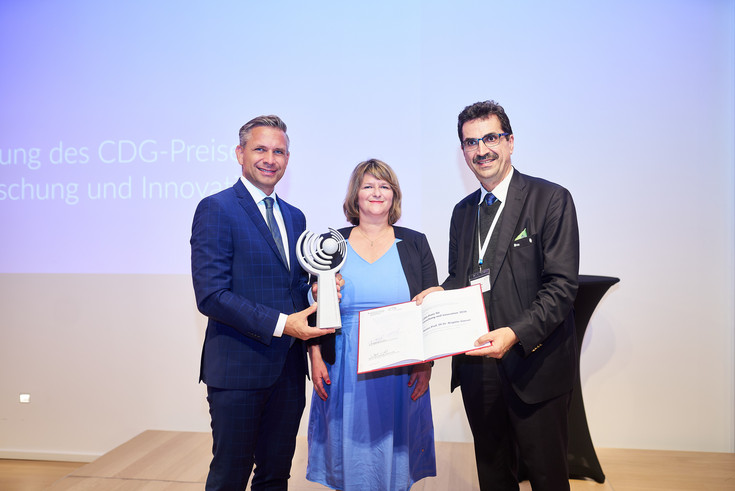
v.l.n.r. Bundesminister Wolfgang Hattmannsdorfer, Preisträgerin Brigitte Gasser, CDG-Präsident Martin Gerzabek (c) BMWET/Holey
Yeasts are becoming increasingly important in numerous areas of biotechnology – from the manufacture of modern medicines, through applications in the food industry, to the production of technical enzymes. Already today, around one in five biopharmaceuticals (e.g. vaccines against hepatitis B or HPV) is produced using yeasts, whilst the demand for biotechnologically produced proteins is growing steadily worldwide. As a result, yeasts are now among the most important biotechnological production systems in the life sciences.
What was still considered very difficult at the start of Brigitte Gasser’s research in 2017 is already being put into practice today: yeasts produce specific proteins in industrial bioreactors without having to grow continuously.
This represents a genuine paradigm shift, as the biomass produced by continuous growth is ultimately waste from a production perspective. If yeast can produce the desired proteins largely without this unwanted growth, this not only saves energy and costs but also reduces the need for complex technical solutions for aeration and cooling at the yeast’s ‘workplace’ – the bioreactor.
The intensive basic research carried out at the CD Laboratory for Growth-Decoupled Protein Production in Yeast focused in particular on translation – that is, the process by which genetic information is translated into proteins. It was demonstrated that targeted interventions in a cell’s translational machinery are possible, thereby successfully decoupling growth from the active, selective transport of proteins out of a cell.
For the corporate partner Lonza AG, the methods and mechanisms researched in the CD laboratory are of great significance. The company provides its customers with expertise and infrastructure for biotechnological production processes, and is already able to offer this new knowledge to external partners from various industries. As a result, the findings from the CD laboratory are rapidly being put to commercial use and are making an important contribution to the sustainable production of high-quality proteins in large quantities.
Federal Minister Wolfgang Hattmannsdorfer: “CD laboratories are a vital tool for translating new knowledge from basic research into industrial applications quickly and directly. This year’s award winner demonstrates this once again in an impressive manner: through close collaboration with her corporate partner, Lonza AG, her highly significant scientific breakthroughs are also commercial breakthroughs that will benefit several industries at once. This strengthens Europe’s position as a centre for biotechnology, as well as Austria’s strong international role in the life sciences. I warmly congratulate the award winner, Brigitte Gasser, on her innovative research, which has made all this possible.”
CDG President Martin Gerzabek: “This year’s award winner and her achievements are a particularly vivid example of the effectiveness of our funding model: on the one hand, the industrial challenges formulated by the corporate partner form the starting point for research in a CD laboratory. On the other hand, basic research requires the freedom to pursue scientific curiosity – and it is precisely this freedom that is firmly embedded in CD laboratories. In the case of laboratory head Brigitte Gasser and her team, it was precisely this freedom that led to the now award-winning innovative approach of decoupling yeast cell growth from protein production. The resulting findings have brought about a lasting change in the state of research. Congratulations to Brigitte Gasser!"
Award winner Brigitte Gasser: “CD laboratories are something quite special, as they enable long-term research into a particular topic. By exploring new research questions and methods, we were able to make significant advances in the biology of the yeast Komagataella phaffii whilst also developing practical approaches for industrial protein production. Through our collaboration with our industry partner, we always kept the practical application in mind.
The CD Laboratory acted as a catalyst for the visibility of my research group: through over 100 published papers at conferences and in specialist journals, the visibility of our field was enhanced, international networks were expanded, and we succeeded in securing further national and European projects. At the same time, the CD Laboratory provided an excellent framework for the training and career development of the next generation of highly qualified scientists. Overall, the CD Laboratory has contributed significantly to shaping my scientific profile and has considerably strengthened the long-term impact of my research.”
Yves Balmer, Director of R&D Microbial Biopharma at Lonza AG: “The CD laboratory provided the ideal setting for us to explore an ambitious, scientifically challenging and, at the same time, industry-relevant concept in collaboration with an internationally renowned yeast research group. For Lonza, this results in tangible competitive advantages through more efficient, robust and potentially more cost-effective production processes, as well as a strengthening of its technological leadership.”
Christoph Pfeifer, Vice-Rector for Research and Innovation at BOKU University: “CD laboratories are a key driver of application-oriented excellence in research at BOKU University. They connect industrial partners with cutting-edge research, generate fundamental knowledge and link this to applied research. This strengthens technology transfer, increases international visibility, trains highly qualified specialists and secures third-party funding for strategic future fields.
In one such future-oriented field, Prof. Brigitte Gasser and her team are investigating how protein synthesis in yeasts used in biotechnology can be decoupled from their growth. The findings pave the way for sustainable production platforms and reinforce BOKU’s leading role in industrial biotechnology – to the direct benefit of science, industry and society.”
About the CDG Prize for Research and Innovation
The CDG Prize for Research and Innovation carries a total prize fund of 40,000 euros and honours current or former directors of Christian Doppler Laboratories (CD Laboratories) or Josef Ressel Centres (JR Centres) who have demonstrated an outstanding ability to put the core principles of the Christian Doppler Research Association into practice: Achieving excellent results in application-oriented basic research and, building on this, strengthening the innovative capacity and competitiveness of partner companies. In doing so, they also underscore the great importance of the Christian Doppler Research Association for securing Austria’s position as a centre of science and business in the long term.
CD Laboratories and JR Centres are jointly funded by the public sector and the participating companies. Public funding bodies include the Federal Ministry for Economic Affairs, Energy and Tourism (BMWET) and the Austrian National Foundation for Research, Technology and Development.
Further information:
A paradigm shift in protein production: the success story behind the 2026 CDG Prize: https://www.cdg.ac.at/aktuelles-termine/aktuelles/article/paradigmenwechsel-in-der-proteinproduktion-880
Photo gallery of the award ceremony: https://www.apa-fotoservice.at/galerie/39798
Enquiries & Contact
Federal Ministry for Economic Affairs, Energy and Tourism
Email: presseabteilung@bmwet.gv.at
Christian Doppler Research Association
Mag. Christiana Griesbeck
Tel.: +43 1 504 22 05 – 24
Email: christiana.griesbeck@cdg.ac.at