
Disentangling the biophysical basis of provisioning systems
Supervisor: Helmut HABERL
Project assigned to: Simon GRAF
The concept of provisioning systems (PS) has gained prominence in interdisciplinary sustainability research, including the IPCC’s AR6 and UNEP’s Global Resource Outlook. PS are increasingly understood as boundary concepts that link biophysical stocks and flows of production and consumption with agency, economic structures, and power relations, thereby connecting resource use to societal well-being and transformative change.
Despite this growing relevance, PS research remains highly heterogeneous, as contributions emerge from diverse theoretical traditions. Common frameworks for the conceptualization of PS—especially regarding their biophysical dimensions—are hence largely absent. Especially material stocks remain largely excluded from current PS research, although they are crucial for understanding the relationship between well-being and resource use through the stock–flow–service nexus.
Moreover, previous PS research utilizing socio-metabolic approaches operated at highly aggregate levels (i.e. using aggregate resource footprints). This obscures the analytical potential of the concept, which would require differentiating PS along complex and overlapping supply chains to meaningfully relate stakeholders and institutions to the biophysical basis of PS. These limitations are rooted in persistent methodological challenges in industrial ecology and socio-metabolic research.
This doctoral project addresses these gaps by working along three research questions:
(1) how socio-metabolic research is conceptually and methodologically integrated into PS research
(2) how PS can be assessed along complex supply chains
(3) how meaningful system boundaries for distinct PS can be drawn.
To address the first question, the project conducts a systematic literature review within the interdisciplinary REMASS consortium, drawing on scientific databases and expertise within the authors’ team. The review maps comprehensively definitions operationalizations, and the broader research landscape of PS (see figure 1).
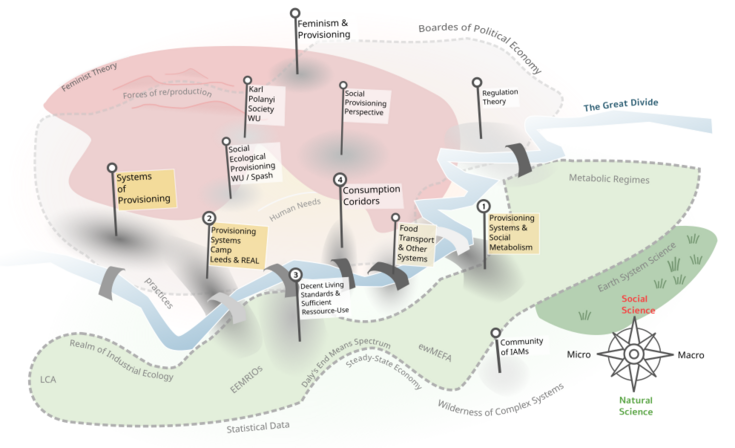
Figure 1. Schematic illustration of the provisioning systems landscape (hypothesis by Graf and Wiedenhofer). Central research “camps” are bridging the “great divide” between disciplines.
The second and third questions are addressed through a case study of the U.S. mobility and housing provisioning systems from 1964 to 2022, followed by a global cross-country analysis. The first study delineates material stocks and flows along supply chains by advancing and applying waste input–output analysis in combination with dynamic MFA (MISO2), yielding sectoral infrastructure stocks across households, government, and private industries. To link biophysical structures to provisioning outcomes, the project introduces a double-counting-free infrastructure footprint that allocates upstream stock accumulation to the housing and mobility PS. The second study extends the developed methodology to a global comparative level using multi-regional input–output tables to generate deeper insights into how housing and transportation PS relate to sectorial-institutional configurations and infrastructural patterns
Together, these contributions realize the analytical potential of the provisioning systems concept by delineating system boundaries and linking its biophysical basis to key social structures.