
From caring co-living to climate-social action. Exploring community and strategies for climate-social futures together with youth
SUPERVISOR: Stefanie LEMKE, Christina PLANK
PROJECT ASSIGNED TO: Lisa Lena LORENZ
Tronto and Fisher (1991, p. 40) describe care as “a species activity that includes everything we do to maintain, perpetuate, and repair our `world´, so that we can live in it as well as possible. This world includes our bodies, ourselves, and our environment”. This emphasis on care and the non-human environment can also be found in feminist and urban political ecology (Kaika et al. 2026; Tzaninis et al. 2021; Elmhirst 2015). In the light of nowadays environmental and social crises, care clearly has a global and a future dimension that requires knowledge as much as a commitment to action (Caruana et al. 2021).
Young people are among the most affected groups of the current crises, such as global warming, with severe implications for their future. At the same time, they have little to no participation in relevant decision-making processes (Rebelo et al. 2026; Kapeke et al. 2023). Not surprisingly, Hickman et al. (2021) found that 59 % of 10.000 young people in ten countries across the globe were very or extremely worried about climate change. The most reported emotions were fear, sadness, anxiety, anger, powerlessness, and guilt; each of them reported by more than 50 % of participants while optimism and indifference were least often reported. Additionally, over 80 % think that “[p]eople have failed to take care of the planet” (Hickman et al. 2021, p. 868). To facilitate the shift from isolation and despair, Divakaran and Nerbonne (2017) describe the potential of relational community organizing to support social togetherness and collective action.
The Austrian Science Fund project “Transforming climate-social futures” (FUTURES) looks at this relational aspect of societal change: Together with young people, activists, artists, educators, social workers, and the city administration, the five-year project explores ideas and strategies for responsible and caring co-living in and beyond the city of Salzburg (see project page BOKU & FUTURES website.
While care has a long history in feminist debates on architecture, urban planning and urban development, the privatization of care after World War II has led to care becoming not only a social and cultural private matter but has also been established within the built environment: houses for the nuclear family, car-centric infrastructure, and functional urban segregation (Müller et al. 2025). As a reaction to that, in the last decade, concepts of the “caring city” have focused on policies that are centered around integrating care needs within the city (Müller et al. 2025). Published in 2020, the special issue “Cities of care” provides several articles which look at urban studies through the lens of ethics of care to address pressing issues of nowadays cities (Wiesel et al. 2020).
The three strategies for transformation – ruptural, interstitial, and symbiotic – by Wright (2010) can serve as strategic canvas for movements dedicated to the social-ecological transformation (Chertkovskaya 2022) and offer an analytical framework for researching transformational strategies. In that, it follows the demands of (critical) participatory action research (Halder 2022; Fine & Torre 2021) to move beyond solely researching critical issues and instead include and empower the people most affected by these issues in the research process. From these perspectives, the concept of collective care provides the opportunity to not only research city policies and urban design theoretically but also built a ground for organizing a community of care that leads to joint action and induces societal transformation.
Embedded in the FUTURES project, my PhD research investigates the imagining, building, and enlivening of caring co-living spaces together with youth, as well as the possibility of caring co-living spaces as a form of community organizing for climate-social action.
The PhD research addresses the following research questions:
What does “caring co-living” mean to a diverse group of youth? How do they imagine a future city where people care for themselves, each other, and their natural environment?
How can a caring space be co-created? What helps co-creating a caring space, and what is hindering? Which dimensions of caring co-living are represented in the co-created space?
What strategies for transformation are developed from and within the caring co-living space? In what ways do the strategies initiate change on an individual, collective, and institutional level?
The data collection for my PhD research project will be embedded within the second and third critical participatory action research (CPAR) cycle of FUTURES. The research questions will be addressed by a mix of qualitative research methods including journaling (Feekery 2003), observation (Kawulich 2005), arts-based methods (Horvath et al. 2025; Muhr 2020), qualitative interviews (Knott et al. 2022) and photovoice (Wang & Burris 1997).
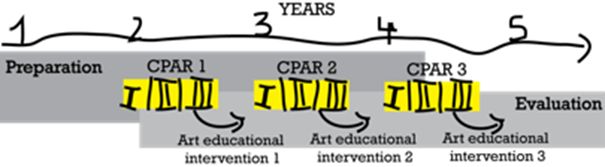
Figure 1: Workshop cycles within the project "Transforming climate-social futures". Illustration: Iris Laner.
Through envisioning, developing, and practicing caring co-living with a diverse group of youth, my research contributes to a multifaceted perspective on climate-social futures and strengthens the understanding of critical participatory action research as leverage point for societal change.
List of references
Caruana, C., Gatt I., Vella R., Zammit C. (2021). A Politics of Care and Responsibility: Art and Education for Sustainable Development. Research in Arts and Education, 4 / 2021.
Chertkovskaya, E. (2022). A strategic canvas for degrowth: In dialogue with Erik O. W. Wright. In Degrowth & strategy: How to bring about social-ecological transformation, 56-71. Mayfly Books.
Divakaran, B. M., Nerbonne, J. (2017). Building a Climate Movement Through Relational Organizing. Interdisciplinary Journal of Partnership Studies Vol 4, Issue 2, Article 7.
Elmhirst, R. (2015). Feminist Political Ecology. In: Perreault, Tom; Bridge, Gavin; McCarthy, James (eds.): The Routledge Handbook of Political Ecology. Routledge: New York, 519-530.
Feekery, A. (2023). The 7 C’s framework for participatory action research: inducting novice participant-researchers. Educational Action Research, 32(3), 332-347. doi.org/10.1080/09650792.2023.2234417
Fine, M., Torre, M. E. (2021). Essentials of Critical Participatory Action Research. American Psychological Association.
Halder, S. (2022): Aktionsforschung(en). In: Gottschlich, D., (eds): Handbuch Politische Ökologie DOI: 10.14361/9783839456279-051
Hickman, C., Marks, E., Pihkala P., Clayton, S., Lewandowski, E., Mayall, E., Wray, B., Mellor, C., van Susteren, L. (2021). Climate anxiety in children and young people and their beliefs about government responses to climate change: a global survey. The Lancet Planetary Helth, 5, e863-e873
Horvath, S.-M., Payerhofer, U., Wals, A., & Gratzer, G. (2025). The art of arts-based interventions in transdisciplinary sustainability research. Sustainability Science, 20(2), 547–563. https://doi.org/10.1007/s11625-024-01614-2
Kapeke, K., Muse, K., Rowan, J., Saw, P., White, T., Ojinnaka-Psillakis, A., Peries, T. D., Miranda, N. P., Ali, S., Dau, A., Taafua, L., Nalupta, C., Harvey, M., Zorbas, C. (2023). Who holds power in decision making for young people's future? Med J Aust, 219: S30-S34. https://doi.org/10.5694/mja2.52147
Kawulich, B. B. (2005). Participant Observation as a Data Collection Method. Forum Qualitative Sozialforschung Forum: Qualitative Social Research, 6(2). doi.org/10.17169/fqs-6.2.466
Knott, E., Rao, A. H., Summers, K., Teeger, C. (2022). Interviews in the social sciences. Nat Rev Methods Primers 2 (73), https://doi.org/10.1038/s43586-022-00150-6
Muhr, M. M. (2020). Beyond words – the potential of arts-based research on human-nature connectedness. Ecosystems and People, 16(1), 249–257. doi.org/10.1080/26395916.2020.1811379
Müller, H., Huning, S., Böcker, N. (2025): Caring Cities: Towards a Public Urban Culture of Care? Urban Planning, 10(00). https://doi.org/10.17645/up.10016
Rebelo, D., Santos, T. R., Dias Garcia, A., Carvalho, A., Malafaia, C., Fernandes-Jesus, M. (2026). Young people’s conceptions of political agency in relation to climate change. Environmental Politics, 35(3), 477–499. doi.org/10.1080/09644016.2025.2489206
Tronto, J. C., Fischer B. (1991). Towards a feminist theory of care. In E. Abel & M. Nelson (Eds.), Circles of care: Work and identity in women’s lives. Albany, NY: State University of New York Press.
Wang, C., Burris, M. A. (1997). Photovoice: concept, methodology, and use for participatory needs assessment. In Health Education & Behavior 24 (3), pp. 369–387. DOI: 10.1177/109019819702400309.
Wright, E. (2010): Envisioning Real Utopias. Verso.