
Hazards, Vulnerability and Resilience in Colonial India
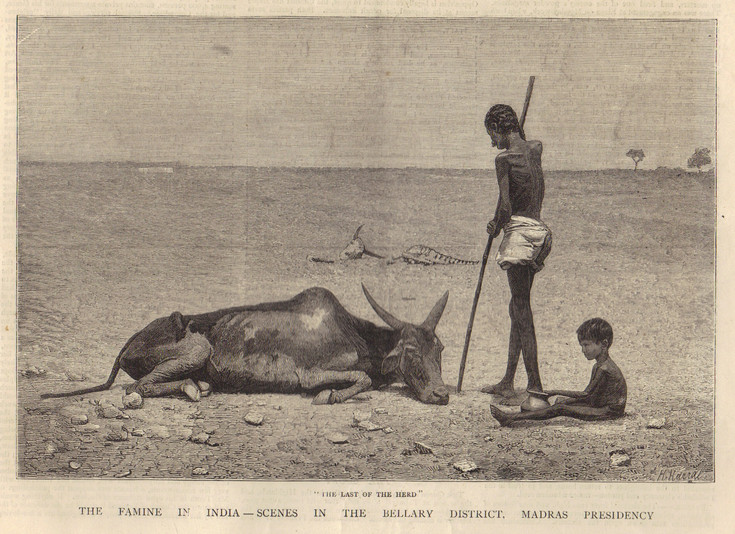
Horace Harral, “The Last of the Herd”. The Graphic, 6 October 1877
Hazards, Vulnerability and Resilience in Colonial India: A Comparative Analysis of Three Famines in Nineteenth-Century Bihar
This project aims to deepen our understanding of the causes of famines. Why does a drought in one instance lead to a catastrophic famine with thousands of deaths, while in another it results in minimal impact? How do societies respond to droughts, and what factors improve or worsen their chances of survival? In the context of advancing climate change and increasingly frequent droughts, these questions—and their answers—are more urgent and relevant than ever.
The second half of the nineteenth century witnessed a global wave of famines, with India being among the worst-affected regions. These famines were both frequent and devastating, resulting in the deaths of millions. Scholars have long debated whether the extraordinary famine mortality during this period was primarily due to "natural" factors or "man-made" causes. More recently, famine studies have shifted toward an interdisciplinary perspective, particularly within the field of historical disaster studies. Here, famines are understood as the result of an interaction between natural hazards and the vulnerabilities of the affected society.
This project adopts this framework to conduct a comparative analysis of three major Indian famines: the famines of 1866, 1873–74, and 1896–97. These events serve as compelling case studies because they occurred within a relatively small, ecologically coherent region over a short but eventful period.
The research proceeds in two key steps. First, it reconstructs the natural hazard—drought—that preceded each famine. This reconstruction is based on a combination of paleoclimatic and instrumental data, as well as meteorological information extracted from archival records. Second, the project evaluates the vulnerability and resilience of the affected society over time. This includes analysing shifts in real wages, cash-crop production, access to common property resources, and the availability of famine relief. Particular attention is given to the most vulnerable social groups, including landless labourers, lower castes, and women.
At its core, this research project functions as a historical experiment. By holding certain variables—such as general climatic conditions, agricultural patterns, and basic social structures—constant, the study isolates and examines other factors that may have influenced the outcomes of these famines. This approach provides valuable insights into the complex interplay of natural and societal forces that shaped famine mortality in nineteenth-century India.
This project is led by Rolf Bauer and has received funding from the Austrian Science Fund FWF (Grant-DOI: 10.55776/PAT1407424). It started in March 2025 and will end in February 2029.
Contact: Rolf Bauer
