
Multi-scale spatial analyses of freshwater ecosystems to support conservation and restoration in Industrialized River Landscapes
SUPERVISOR: Thomas HEIN
PROJECT ASSIGNED TO: Justine CAREY
The Earth is undergoing a sixth mass extinction, with biodiversity declining at unprecedented rates as a consequence of human activity (Ceballos et al., 2017). Freshwater ecosystems are particularly affected: despite covering only a small fraction of the Earth’s surface, they support a disproportionately large share of global biodiversity, while freshwater species populations have declined by more than 83% since 1970 (WWF, 2018). Human society drives this rapid degradation despite our reliance on the ecosystem services provided by functioning freshwater ecosystems. These include drinking water, irrigation, fish production, flood and erosion control, and climate regulation, alongside the profound cultural significance of rivers and lakes, including spiritual connection and practices, recreation, and tourism (Jackson et al., 2001; Kaval, 2019).
Urgent action is therefore needed to conserve and restore freshwater ecosystems. However, effective conservation is frequently constrained by a lack of base ecological information, particularly in data-limited regions, as well as by the inherent complexity of freshwater systems and the challenges of managing them across administrative boundaries. Freshwater ecosystems are shaped by interacting physical, ecological, and social processes that extend far beyond their immediate boundaries (Hein et al., 2021; Wiens, 2002), and their structure and functioning are derived from nested spatial and temporal scales (Frissell et al., 1986; Gurnell et al., 2016). Sufficient information on the dynamics of these systems is therefore needed to effectively prioritise conservation and restoration action in the context of limited time and financial resources (Linke et al., 2019).
This PhD project uses spatial analysis and rapidly growing open-source data to investigate how natural hydrogeomorphic gradients and anthropogenic pressures shape the structure, condition, connectivity, and biota of freshwater ecosystems across multiple spatial scales. Particular emphasis is placed on the potential of open-source data to generate ecological insight in regions where conventional field-based data are scarce. The research comprises four interconnected studies:
- Global scale: Mapping hotspots of freshwater fish imperilment and examining their relationships with anthropogenic pressures and landscape characteristics.
- Global scale: Conducting a meta-analysis to investigate how hydropower development interacts with multiple stressors to influence freshwater fish populations.
- Regional scale: Providing the first assessment of freshwater biodiversity in the mountain rivers of Central Asia since the Soviet period and examining relationships between biodiversity and anthropogenic stressors.
- Catchment scale: Conducting a remotely based, multi-scale assessment of hydromorphology and anthropogenic pressures in a catchment in Kazakhstan, evaluating the capacity of open-source data to support freshwater ecological assessment in data-limited regions.
Together, these studies investigate freshwater ecosystems across multiple spatial scales, focusing on the effects of anthropogenic pressures on freshwater biodiversity and ecosystem conditions. The research will contribute information needed to support conservation prioritisation while demonstrating how spatial analysis and open-source environmental data can expand the capacity for freshwater assessment and management, particularly in regions where ecological information remains limited.
References
Ceballos, G., Ehrlich, P. R., & Dirzo, R. (2017). Biological annihilation via the ongoing sixth mass extinction signaled by vertebrate population losses and declines. Proceedings of the National Academy of Sciences, 114(30). https://doi.org/10.1073/pnas.1704949114
Frissell, C. A., Liss, W. J., Warren, C. E., & Hurley, M. D. (1986). A hierarchical framework for stream habitat classification: Viewing streams in a watershed context. Environmental Management, 10(2), 199–214. https://doi.org/10.1007/BF01867358
Gurnell, A. M., Rinaldi, M., Belletti, B., Bizzi, S., Blamauer, B., Braca, G., Buijse, A. D., Bussettini, M., Camenen, B., Comiti, F., Demarchi, L., García de Jalón, D., González del Tánago, M., Grabowski, R. C., Gunn, I. D. M., Habersack, H., Hendriks, D., Henshaw, A. J., Klösch, M., … Ziliani, L. (2016). A multi-scale hierarchical framework for developing understanding of river behaviour to support river management. Aquatic Sciences, 78(1), 1–16. https://doi.org/10.1007/s00027-015-0424-5
Hein, T., Hauer, C., Schmid, M., Stöglehner, G., Stumpp, C., Ertl, T., Graf, W., Habersack, H., Haidvogl, G., Hood-Novotny, R., Laaha, G., Langergraber, G., Muhar, S., Schmid, E., Schmidt-Kloiber, A., Schmutz, S., Schulz, K., Weigelhofer, G., Winiwarter, V., … Wang, C. (2021). The coupled socio-ecohydrological evolution of river systems: Towards an integrative perspective of river systems in the 21st century. Science of The Total Environment, 801, 149619. https://doi.org/10.1016/j.scitotenv.2021.149619
Jackson, R. B., Carpenter, S. R., Dahm, C. N., McKnight, D. M., Naiman, R. J., Postel, S. R., & Running, S. W. (2001). Water in a changing world. Ecological Applications, 11(4), 1027–1045. doi.org/10.1890/1051-0761(2001)011%255B1027:WIACW%255D2.0.CO;2
Linke, S., Hermoso, V., & Januchowski‐Hartley, S. (2019). Toward process‐based conservation prioritizations for freshwater ecosystems. Aquatic Conservation: Marine and Freshwater Ecosystems, 29(7), 1149–1160. https://doi.org/10.1002/aqc.3162
Wiens, J. A. (2002). Riverine landscapes: Taking landscape ecology into the water: Riverine landscape ecology. Freshwater Biology, 47(4), 501–515. https://doi.org/10.1046/j.1365-2427.2002.00887.x
World Wildlife Fund (WWF). (2018). Living Planet Report: 2018 (p. 75). https://assets.worldwildlife.org/www-prd/documents/pff74ng76_LPR2018_Full_Report_Spreads.pdf
Figures
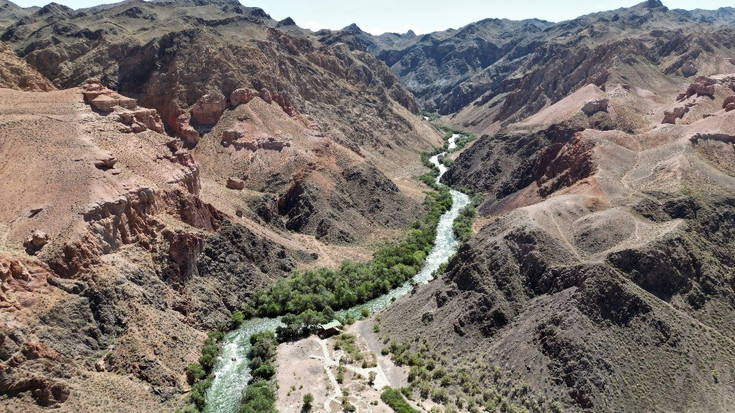
Charyn Canyon, Tamerlik, Kazakhstan (source: Anatolii Shcherbyna, Unsplash)
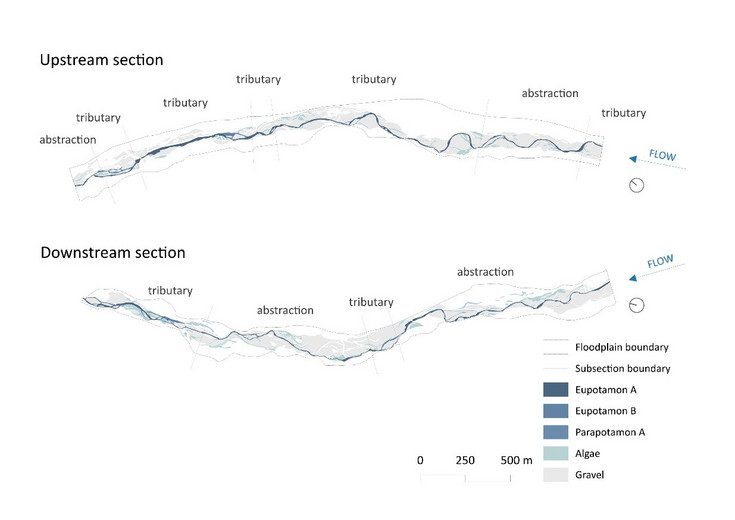
Mapping of the active channel features in the Badam River, Kakahstan (source: Justine Carey)