Quantifying the Contributions of Tropospheric and StratosphericOzone to Total Column Ozone over Europe and Alpine region
Supervisor: Harald RIEDER
Project assigned to: Thalia Alejandra MONTEJO BARATO
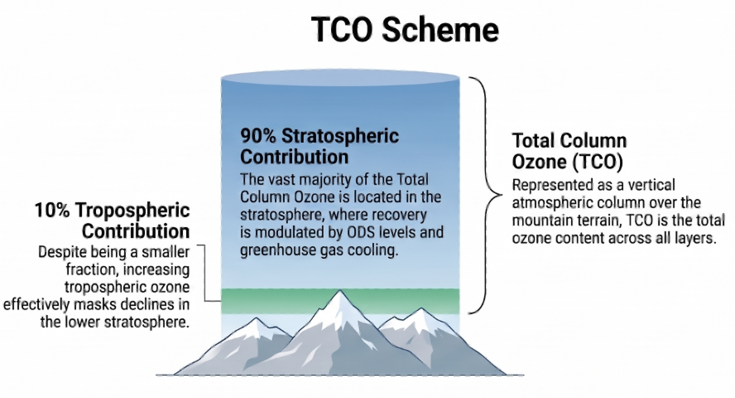
Atmospheric ozone plays a dual role in the Earth system. In the stratosphere, it protects life by absorbing harmful ultraviolet radiation, whereas in the troposphere it acts as both a greenhouse gas and an air pollutant. Although the Montreal Protocol has successfully reduced emissions of ozone-depleting substances, recent observations indicate that total column ozone (TCO) has remained nearly constant over mid-latitudes since the late 1990s. This apparent stabilization results from the combined effects of recovering upper-stratospheric ozone, continued ozone decline in the lower stratosphere, and increasing tropospheric ozone (Figure 1) making it difficult to identify the processes driving the observed changes.
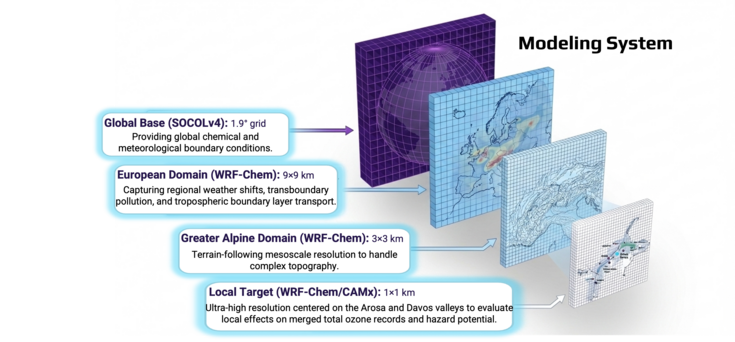
In this context, this PhD project aims to quantify the relative contributions of atmospheric chemistry and dynamics to past and future ozone variability over Europe, with particular emphasis on the Alpine region. A multi-scale modelling framework will be developed by coupling the global chemistry–climate model SOCOLv4 with the regional chemistry transport model WRF-Chem (Figure 2). Historical simulations and targeted sensitivity experiments will be used to separate the effects of ozone-depleting substances, greenhouse gases, atmospheric transport, and precursor emissions on ozone trends. Future simulations under contrasting climate scenarios will be used to assess how ozone recovery, stratosphere–troposphere exchange, and the partitioning of total column ozone may evolve during the twenty-first century.
Model simulations will be evaluated using long-term ground-based and satellite observations, including the unique Arosa/Davos ozone record and vertically resolved ozone profile measurements. The project will improve the understanding of the processes controlling ozone variability and recovery, while reducing uncertainties in future projections of ozone–climate interactions.