
Climate Resilient Durum Wheat
SUPERVISOR: Hermann Bürstmayr
PROJECT ASSIGNED TO: Salomé FOESSEL
Durum wheat, a food crop of growing importance, is suffering from increasing stresses, partly due to global changes. Two relevant threats are the fungal disease Fusarium head blight (FHB) and the viral disease Wheat dwarf virus (WDV). FHB and WDV lead to significant yield losses, with FHB also causing severe quality reductions due to mycotoxin contamination.
Climate change increases disease pressure, warm periods in autumn lead to long periods of virus vector activity and to increased incidence of virus diseases. Most durum wheat cultivars are susceptible to WDV. Exceptions are some quantitatively WDV resistant durum wheat cultivars, such as Sambadur and Tennodur from Saatzucht-Donau, but the genetic makeup of their WDV resistance is unknown. Additionally, the incidence of FHB is also increased by climate change and Durum wheat is generally more susceptible to FHB than other cereals. Among currently registered spring and winter durum cultivars none can be considered resistant against FHB. The genetic variation for FHB resistance in durum wheat is low but pre-breeding at BOKU has resulted in experimental durum lines with improved FHB resistance. Resistance breeding is the most efficient and sustainable strategy for managing FHB and WDV.
In this project, the aim is to accelerate breeding for genetic resistance to these two diseases, making durum wheat more stress resistant and "climate ready". First, a genetic analysis of a new four-parent MAGIC (Multi-parent Advanced Generation Inter-Cross) population derived from a combination of modern varieties with WDV resistance and FHB-resistant experimental lines will be conducted. It is intended to identify and map relevant QTL for the traits WDV resistance and FHB resistance using a random sample of 500 recombinant inbred lines (RILs) from a four parent MAGIC. The parental lines contribute complementary traits, including high yield, good quality, WDV and FHB resistance, leading to progeny with a combination of these desirable traits.
In parallel, a second objective is to select climate-adapted durum wheat candidates. The breeding program will start with large segregating populations, which will first be phenotypically selected to increase FHB resistance and subsequently for improved WDV resistance, in order to identify new candidate cultivars. Selected lines will be DNA fingerprinted. The project will help sustain durum wheat production, enabling regional value chains and the production of high-quality food.
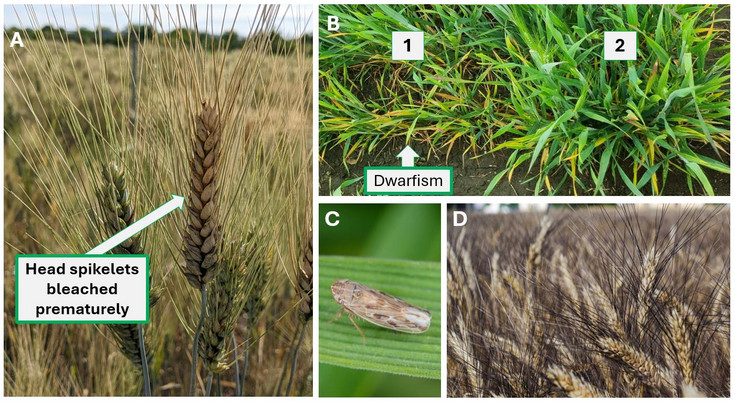
Figure: (A) Fusarium head blight symptoms, Head spikelets bleached prematurely, Portions of ears scalded with a pink-orange coloration. (B) Wheat dwarf virus symptoms 1: Infected plant 2: Healthy plant, (C) Wheat dwarf virus vector: The leafhopper Psammotettix alienus, (D) Sambadur (from Saatzucht-Donau), variety with a robust resistance to WDV.