
Institutional actor interaction in the governance of Natural Resources in a refugee-host community: A case of Rhino camp refugee settlement in the Northwestern subregion of Uganda
SUPERVISOR: Stephanie LEMKE
PROJECT ASSIGNED TO: Jessiecah Alunyu APILI
In account of its progressive refugee policy ingrained in the 2006 Refugee act, Uganda is a host to over 1. 9 million refugees and asylum seekers mainly from South Sudan, Democratic Republic of Congo, Sudan, Burundi and many other African countries. Opened in the 1980s in the aftermath of the South Sudanese civil war and influx to Uganda, the settlement is situated in the Northwestern part of Uganda and currently holds over 170,000 refugees. Within the Rhino camp settlement, the refugees and host community share resources including the natural resources (vegetation cover, water and land) and over time, this has intensified the degradation of land, loss of woodland, competition for water and rangeland resources which often resulted into tensions and conflicts, particularly due to the over utilization. There is thus need for an equitable and resilient governance system to ensure the sustainable utilisation of these natural resources.
The governance of natural resources is a collective action that requires the collaboration of all institutional actors to aid in alleviating tensions and conflicts. Co-creating strategies through the interaction of formal and informal institutional actors from both the refugee and the host communities is crucial in ensuring a sustainable governance while building a resilient refugee - host community. Further, it is paramount in mitigating the potential of recurring conflicts and tensions in an already conflict augmented community.
This study examines the state of institutional actor interaction and highlights the areas of tensions and conflicts within the study area. Additionally, it sheds light on how these cooperations shape the equitable governance of natural resources on which livelihood is highly dependent in such a set up. Therefore, the study will strengthen the equitable governance of natural resources by co-creating strategies that ensure resilient and sustainable governance of natural resources. Ultimately, this study will offer practical recommendations to support the implementation of refugee assistance programs to ensure respect and dignity of refugees nationally and globally.
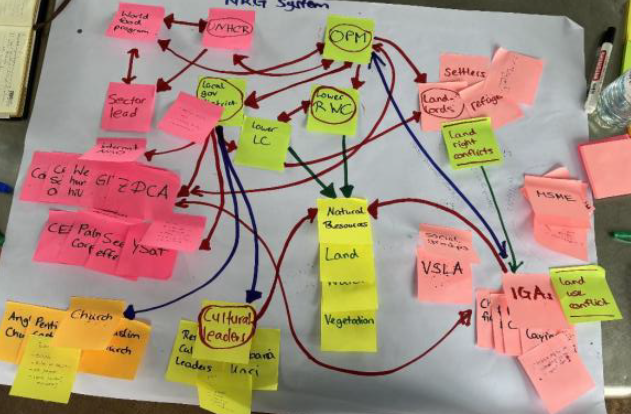
Figure 3: Systems map