
Quantification of Plant Response to Multiple Stresses in Vineyards
SUPERVISOR: Astrid FORNECK
PROJECT ASSIGNED TO: Lea LINHART
Grapevine PIWI cultivars (“Pilzwiderstandsfähige Rebsorten”) reduce fungicide inputs by resisting major fungal pathogens. Yet, organic and insecticide‑free vineyards report renewed foliar phylloxeration in both PIWI and Vitis vinifera, highlighting phylloxera as a re‑emerging pest in low‑input systems (Figure 1). Little is known about PIWI performance under other biotic or combined abiotic stress, and the ecophysiological consequences of leaf galling for water use and ripening remain underexplored (Figure 2).
We address how drought and foliar phylloxera interact—testing for synergy (combined impact > sum of single effects) or antagonism (one stress dampens the other). Synergy may arise if drought reduces resistance or if galling elevates transpiration, hastening soil water depletion. Antagonism may occur if drought‑induced morphological changes hinder gall formation. Sequential, controlled studies are required to resolve these outcomes.
Over two years, we study two PIWI cultivars (Muscaris, Souvignier gris), Pinot gris (V. vinifera), and rootstock Teleki 5C. A factorial design (drought vs. watered; phylloxerated vs. healthy) quantifies single and combined stresses, with stress order reversed across years. Precision phenotyping captures stomatal conductance, assimilation, intrinsic water‑use efficiency, PSII activity, stem water potential, growth, and image‑based gall incidence/size/density, complemented by leaf anatomy.
Targeted transcriptomics (RNA‑Seq) at defined endpoints provides differential expression profiles and co‑expression modules linked to measured traits. Integrated modelling will identify minimal, interpretable molecular signatures that classify susceptibility and predict physiological outcomes across genotypes and treatments. Deliverables include reproducible datasets, containerized analytics, and interactive visualizations. Results will inform climate‑resilient vitiviniculture and support future breeding strategies.
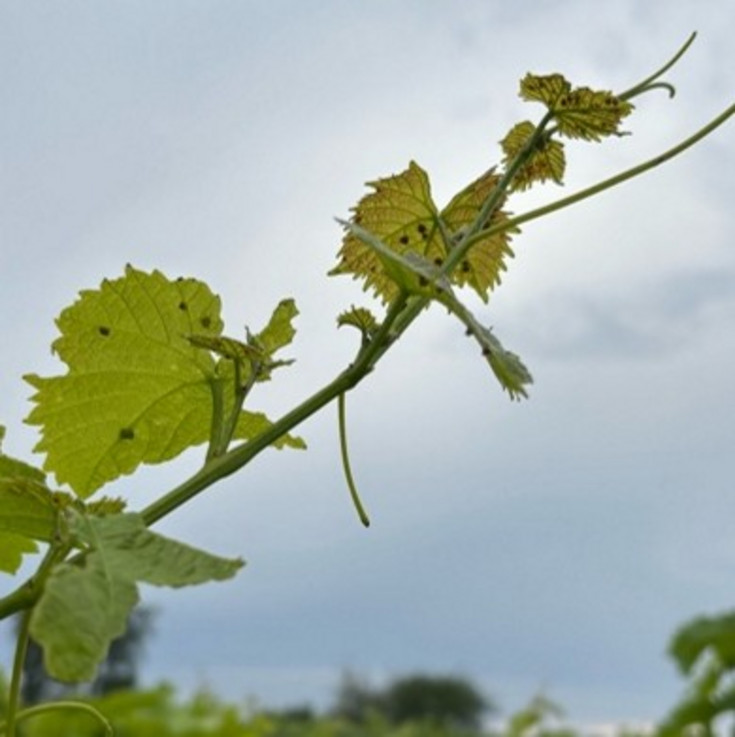
Figure 1. This photograph, taken in July 2025 at a commercial vineyard in Franconia, Germany, shows a shoot tip of moderate leaf-phylloxerated Muscaris.
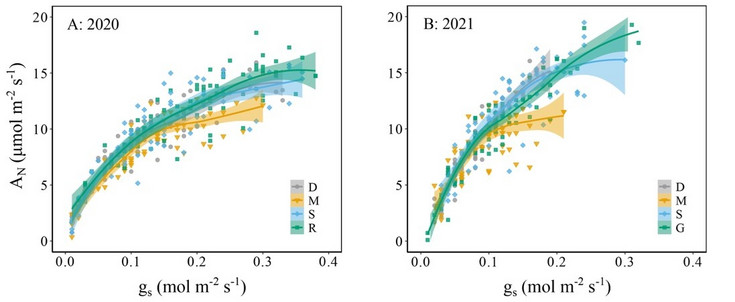
Figure 2. Relationship between stomatal conductance (gs in mol m-2 s-1) and net assimilation rate (AN in μmol m-2 s-1) throughout the experiment in seasons 2020 (A) and 2021 (B), as reported in the Pre-Doc study by Linhart et al. (2023).