
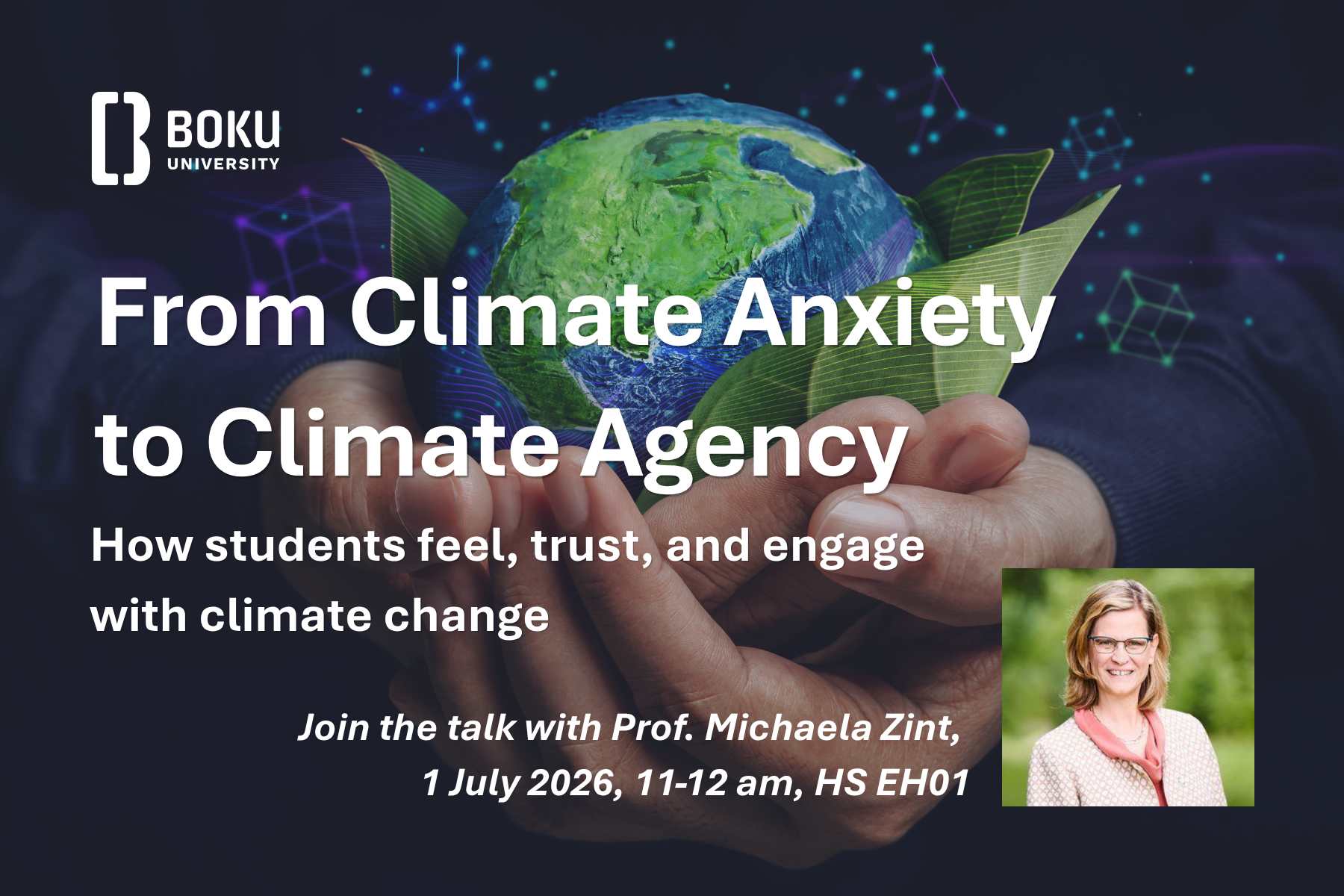
From Climate Anxiety to Climate Agency
From Climate Anxiety to Climate Agency
Understanding climate emotions, trust, and action among university students
Lecture with Prof. Michaela Zint, University of Michigan
July 1st
Many students today experience climate change not only as a scientific or political issue but also as an emotional one. Feelings such as worry, grief, and anxiety are increasingly reported among younger generations and raise important questions for universities regarding how these emotions shape learning, well-being, and engagement with climate action.
This talk presents new research from the University of Michigan (USA) examining how university students differ in their climate emotion profiles and levels of institutional trust, and how these differences influence climate engagement. Drawing on emerging data, the presentation explores how distinct student segments experience climate change and how these experiences may relate to climate action.
The talk also introduces a Climate Emotions Workshop co-designed with students that helps participants navigate difficult climate emotions while strengthening their sense of agency and collective engagement. The workshop’s rationale, structure, and participant outcomes will be described.
Taken together, these examples illustrate how universities can better understand students’ emotional responses to climate change and design educational environments that support constructive engagement and climate action. The presentation will also invite discussion about how these findings resonate with experiences at BOKU and how universities can learn from one another when supporting students in responding to the climate crisis.
Main Talk:
July 1st, 11-12 am
Exnerhaus HS EH01
Opening words by the rector Univ.-Prof. Schulev-Steindl
No registration required
Optional Mini-Workshop / Q&A
July 1st, 13-14.30 pm,
please register: Julia.buchebner(at)boku.ac.at
About Prof. Michaela Zint
Michaela Zint is a professor at the University of Michigan and an internationally recognized expert in environmental and sustainability education. Her current work focuses on how people’s emotional responses to climate change—such as anxiety—influence their willingness and ability to take action, and how universities can turn students' climate concern into meaningful engagement.