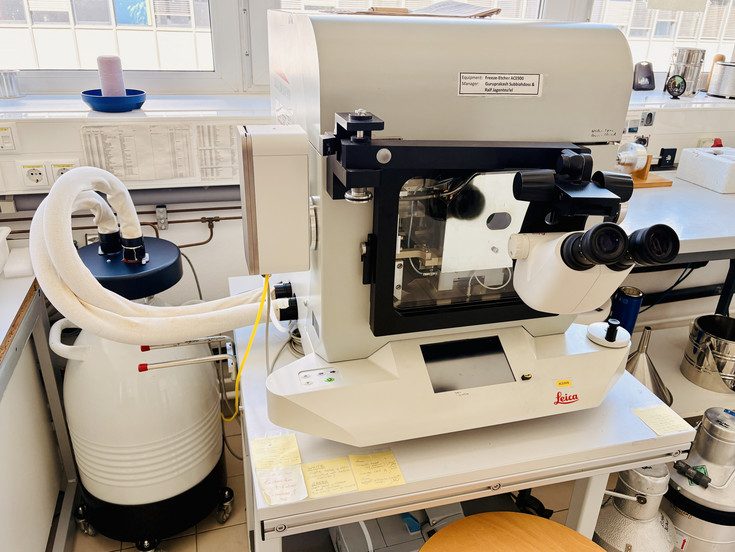
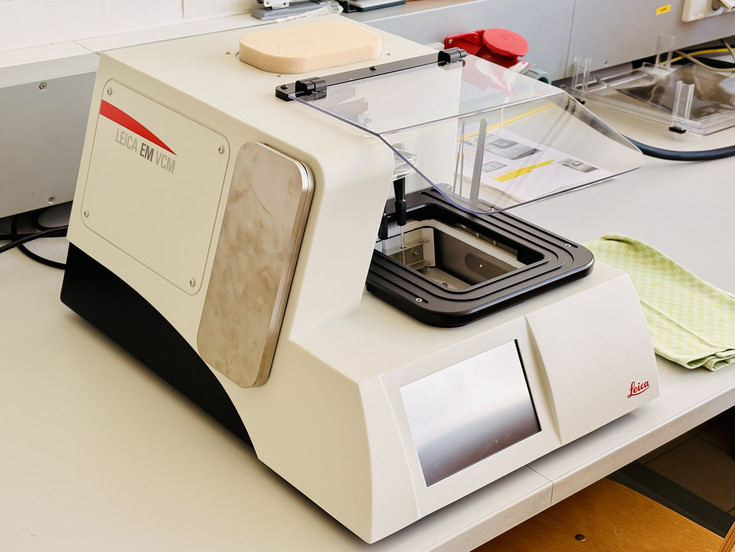
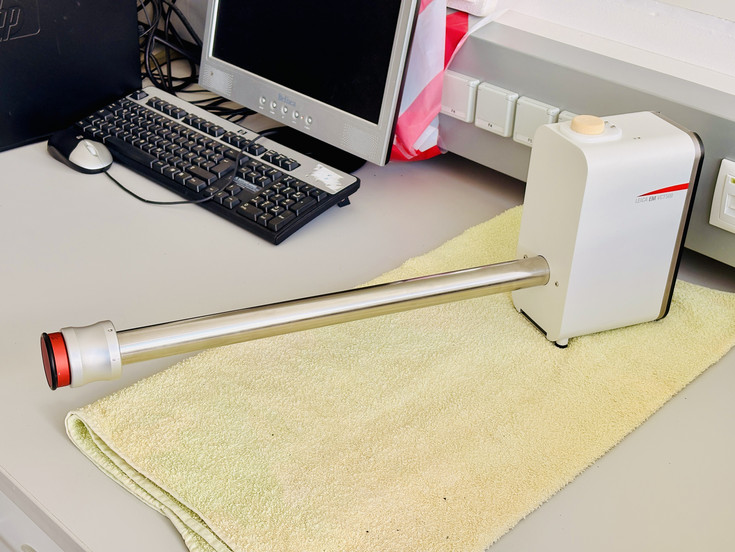
Our Leica cryo-preparation and cryo-transfer system enables the preparation, coating, transfer, and SEM imaging of frozen samples under cryogenic conditions. The workflow combines the Leica EM ACE900, Leica EM VCT500, and Leica EM VCM and is used together with the Leica EM HPM100 high-pressure freezer and the FEI Apreo VolumeScope SEM.
This setup allows high-pressure frozen or otherwise cryo-immobilized specimens to be processed and transferred while minimizing warming, ice contamination, devitrification, drying artifacts, and structural changes during preparation. It is particularly useful for biological and hydrated samples where preservation of near-native morphology is essential.
The Leica EM HPM100 is used for high-pressure freezing of biological, soft-matter, and hydrated samples. After freezing, the Leica EM VCM supports cryogenic handling and transfer of frozen samples, for example from the high-pressure freezer workflow to the Leica EM ACE900. This minimizes exposure of the sample to temperatures above liquid nitrogen temperature and reduces contact with ambient conditions during handling.
The Leica EM ACE900 is used for cryo-preparation steps such as freeze-fracturing, freeze-etching, controlled sublimation, and carbon or platinum coating. Freeze-etching and sublimation can reveal surface and fracture-face structures by removing a thin layer of ice from the specimen surface. Conductive coating with carbon or platinum improves SEM imaging conditions and can enhance topographic contrast in cryo-SEM.
The Leica EM VCT500 vacuum cryo-transfer system enables frozen samples to be transferred from the cryo-preparation workflow to the SEM while maintaining cryogenic temperature and protected transfer conditions. This helps preserve the frozen state of the sample and reduces contamination by atmospheric moisture.
Together, these instruments support a cryo-SEM workflow for specimens such as bacterial and mammalian cell cultures, plant material, tissues, biofilms, gels, emulsions, soft matter, and nanobiotechnology samples. The overall goal of the workflow is to preserve hydrated samples close to their native conformation from freezing through preparation, coating, transfer, and SEM imaging.