
Estimating sublimation in a combined modelling and monitoring approach including superconducting gravimetry for a seasonal high-alpine snowpack
Supervisor: Karsten SCHULZ
Project assigned to: Elias BÖGL
Snowpack is a crucial temporal water storage for downstream areas, a potential source of natural hazards (avalanches, droughts or floods), and a prerequisite for winter tourism. Climate change is altering snow accumulation, ablation, quantities and melt patterns across alpine regions (Immerzeel et al. 2020; Marty et al. 2023). Accurate snow-modelling in high alpine terrain, is challenging, e.g., due to a sparse database, precipitation undercatch, difficulties in capturing snow depth patterns spatiotemporally with monitoring methods as well as complex turbulence driven interaction of surface and atmospheric layers and computational demand. A superconducting gravimeter (SG) installed in the high-alpine, snow-driven area of Mt. Zugspitze, Germany, enables the first validation of cryospheric and snow-hydrological models at scales of ~40 km². It allows the precise quantification of spatio-temporal variations in the cryo-hydrological mass effect on the gravitational field (Voigt et al. 2021).
Sublimation is the direct phase change of water between its solid and vaporous state. It has an impact on the water balance and results besides snow melt in changes of snow water equivalent (SWE) over time (Lundquist et al. 2024). It is very difficult to estimate sublimation with current monitoring systems and is still a major unknown in snow-hydrology. On a point scale, sublimation could be measured by a combination of snow height sensors, snow scales and snow lysimeters, while on an intermediate scale of a radius of approx. 200 m, the observation by Eddy Covariance measurements could be used (Magnusson et al. 2015; Reba et al. 2012; Hanich et al. 2024). However, such measurements are difficult and absolutely rare in high-alpine terrain. Moreover, it remains unclear how representative isolated measurements are in complex terrain, as turbulent atmospheric conditions, preferential deposition and vegetation-snow interaction lead to significant local snowpack variations (Strasser et al. 2008; Lundquist et al. 2024). Another option to estimate sublimation is based on modelling. During the last decades, the evolution of physically-based modelling has evolved. By explicitly resolving the two-way exchange of energy, momentum, and mass between the snowpack and the overlying atmosphere detailed descriptions of snow drift and sublimation processes are possible (Vionnet et al. 2014; Sharma et al. 2023; Sigmund et al. 2025).
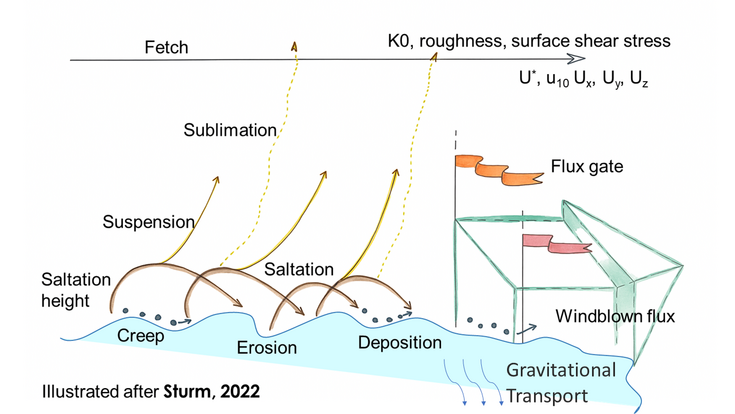
Figure 1 Snow transport processes and measurement concepts in alpine terrain: Wind-driven redistribution (saltation, suspension, creep), sublimation, and gravitational transport determine snowpack spatial variability. Flux gate measurements quantify horizontal snow mass fluxes as function of aerodynamic surface properties. Illustrated after Sturm, 2022
In this work, we propose a novel joint monitoring and modelling approach to push forward research in surface and blowing snow sublimation at scales of a few kilometres integrating signals of a superconducting gravimeter (SG). The first introduction of a SG in the well-instrumented high alpine environment of Mt. Zugspitze, Germany (Voigt et al. 2021) in the context of the FWF-DFG Weave Project G-MONARCH potentially provides an unprecedented observation in this regard. This high-alpine site is snow-dominated with the snowpack being the largest contributor to the changes of the gravity signal after separating it from all other tidal and non-tidal gravity effects (Voigt et al. 2021). The SG is installed at the Zugspitze Geodynamic Observatory Germany (ZUGOG), which is operated and maintained by GFZ Potsdam. It is constantly measuring since the end of 2018 and is situated within a dense network of automatic meteorological stations (AWS). Long-term discharge measurements enabling water balance studies that are performed at the Partnach spring, which acts as a natural lysimeter(Wetzel 2004). This permits the validation of the input forcing precipitation quantities, the simulated seasonal snowmelt dynamics and the contribution of the aquifer storage to the gravimetric residuals.
Given the sensitivity of the SG to changes in the snowpack of up to 4 km and its high temporal resolution (Voigt et al. 2021; Koch et al. 2024), the assessment of boundary layer effects on a catchment scale is feasible by allocating the contributing cryo-hydrological processes of the hydrological gravity residuals. Method-wise, we first systematically identify periods with detectable negative mass anomalies in the processed SG record, and then retrospectively verify precipitation-free conditions using AWS data, ensuring analyzed mass losses are attributable to sublimation and drift processes rather than precipitation uncertainties during peak snow season when soil moisture and groundwater changes are negligible.
Building on ongoing work that compares conceptual (CemaNeige-GR4H) versus physics-based (Alpine3D-GR4H) approaches and establishes baseline performance at Partnach Spring, we extend the physics-based framework to boundary-layer processes.With the physics-based snowpack model Alpine3D (Bartelt & Lehning 2002; Lehning et al. 2002a; Lehning et al. 2002b) we simulate in a high spatial (16 m x 16 m) and temporal (hourly) resolution. Ongoing field campaigns, with the goal of gathering manual, laserscanning, and drone-based observations on snow depth and density provide one column of model validation. In addition, we use satellite data and continuous discharge data for model validation and calibration.
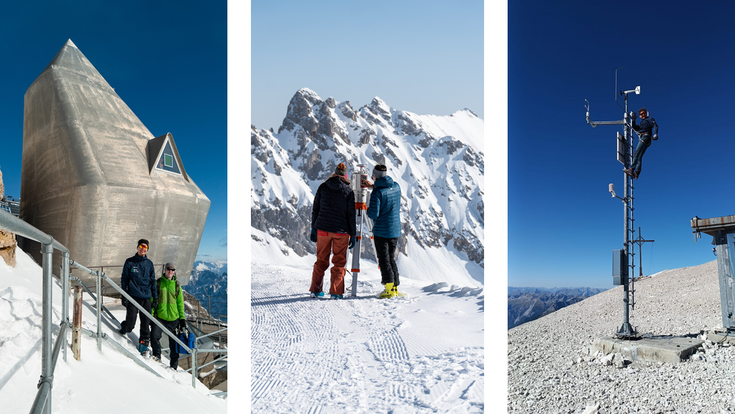
Figure 2 Observation methods deployed at the Zugspitze study site: Left: Superconducting gravimeter housing, center: Terrestrial Laser Scanning, right: Eddy covariance station installation. Photos: R. Facchinetti (left), E. Bögl (center), S. Gonzàlez Herrero (right)
In addition, we apply in-situ measurements of an Eddy-Covariance station and a particle counting sensor to permit to differentiate cases of surface and blowing snow sublimation events. To isolate drift-induced snow mass redistribution from surface sublimation, we aim to employ wind models of varying complexity, such as WindNinja (Wagenbrenner et al. 2016), or WRF (Skamarock et al. 2008; Powers et al. 2017), together with our partners as a driver for 3D wind fields in Alpine3D. The snow drift modelling will be validated against gravity signals during cold, dry periods when sublimation is minimal, establishing baseline redistribution patterns that enable sublimation quantification during radiative-driven conditions. The performance and differences of the snow-atmospheric coupled model CryoWRF (Sharma et al. 2023) by our partners at SLF in comparison to the standalone Alpine3D outputs in such periods will in addition provides a valuable insight in process representations. CryoWRF's explicit representation of both drift and blowing snow sublimation enables model-based separation of these co-occurring processes.
The thesis includes, the following research questions:
To what extent can the developed joint snow-hydro-gravimetric approach contribute to water resource management in high-alpine snow-dominated regions?
- What meteorological conditions characterize periods with SG-detected snow mass due to sublimation losses during precipitation-free intervals, and can these patterns discriminate between drift-dominated and surface sublimation-dominated processes?
Can we identify potentially high sublimation areas in the catchment from CryoWRF simulations and validate these spatial patterns against distributed observations?
Do simulated sublimation losses (amount, space and time) agree with temporal dynamics of gravitational residuals? Our validation strategy assesses: (1) integrated catchment-scale mass losses (SG vs modeled totals) across all events, and (2) process-level partitioning (EC/SPC vs modeled components) during periods with complete instrumentation.
The expected outcomes include (i) the first gravimetrically constrained estimates of catchment-scale snow sublimation, (ii) a validated framework for separating sublimation and redistribution processes, and (iii) simplified parameterizations of snow–atmosphere exchange suitable for application in non-instrumented alpine regions.
Bartelt, P & Lehning, M 2002, 'A physical SNOWPACK model for the Swiss avalanche warning', Cold Regions Science and Technology, vol. 35, no. 3, pp. 123–145.
Hanich, L, Lahnik, O, Gascoin, S, Chakir, A & Simonneaux, V 2024, 'Quantifying snow sublimation by Eddy covariance measurements on the High Atlas Mountain of Marrakech at Tazaghart plateau, Morocco', Proceedings of IAHS, vol. 385, pp. 387–391.
Immerzeel, WW, Lutz, AF, Andrade, M, Bahl, A, Biemans, H, Bolch, T, Hyde, S, Brumby, S, Davies, BJ, Elmore, AC, Emmer, A, Feng, M, Fernández, A, Haritashya, U, Kargel, JS, Koppes, M, Kraaijenbrink, PDA, Kulkarni, AV, Mayewski, PA, Nepal, S, Pacheco, P, Painter, TH, Pellicciotti, F, Rajaram, H, Rupper, S, Sinisalo, A, Shrestha, AB, Viviroli, D, Wada, Y, Xiao, C, Yao, T & Baillie, JEM 2020, 'Importance and vulnerability of the world's water towers', Nature, vol. 577, no. 7790, pp. 364–369. Available from: www.nature.com/articles/s41586-019-1822-y.
Koch, F, Gascoin, S, Achmüller, K, Schattan, P, Wetzel, K-F, Deschamps‐Berger, C, Lehning, M, Rehm, T, Schulz, K & Voigt, C 2024, 'Superconducting Gravimeter Observations Show That a Satellite‐Derived Snow Depth Image Improves the Simulation of the Snow Water Equivalent Evolution in a High Alpine Site', Geophysical Research Letters, vol. 51, no. 24.
Lehning, M, Bartelt, P, Brown, B & Fierz, C 2002a, 'A physical SNOWPACK model for the Swiss avalanche warning', Cold Regions Science and Technology, vol. 35, no. 3, pp. 169–184.
Lehning, M, Bartelt, P, Brown, B, Fierz, C & Satyawali, P 2002b, 'A physical SNOWPACK model for the Swiss avalanche warning', Cold Regions Science and Technology, vol. 35, no. 3, pp. 147–167.
Lundquist, JD, Vano, J, Gutmann, E, Hogan, D, Schwat, E, Haugeneder, M, Mateo, E, Oncley, S, Roden, C, Osenga, E & Carver, L 2024, 'Sublimation of Snow', Bulletin of the American Meteorological Society, vol. 105, no. 6, E975-E990. Available from: journals.ametsoc.org/view/journals/bams/105/6/BAMS-D-23-0191.1.xml.
Magnusson, J, Wever, N, Essery, R, Helbig, N, Winstral, A & Jonas, T 2015, 'Evaluating snow models with varying process representations for hydrological applications', Water Resources Research, vol. 51, no. 4, pp. 2707–2723. Available from: agupubs.onlinelibrary.wiley.com/doi/10.1002/2014WR016498.
Marty, C, Rohrer, MB, Huss, M & Stähli, M 2023, 'Multi-decadal observations in the Alps reveal less and wetter snow, with increasing variability', Frontiers in Earth Science, vol. 11.
Powers, JG, Klemp, JB, Skamarock, WC, Davis, CA, Dudhia, J, Gill, DO, Coen, JL, Gochis, DJ, Ahmadov, R, Peckham, SE, Grell, GA, Michalakes, J, Trahan, S, Benjamin, SG, Alexander, CR, Dimego, GJ, Wang, W, Schwartz, CS, Romine, GS, Liu, Z, Snyder, C, Chen, F, Barlage, MJ, Yu, W & Duda, MG 2017, 'The Weather Research and Forecasting Model: Overview, System Efforts, and Future Directions', Bulletin of the American Meteorological Society, vol. 98, no. 8, pp. 1717–1737.
Reba, ML, Pomeroy, J, Marks, D & Link, TE 2012, 'Estimating surface sublimation losses from snowpacks in a mountain catchment using eddy covariance and turbulent transfer calculations', Hydrological Processes, vol. 26, no. 24, pp. 3699–3711.
Sharma, V, Gerber, F & Lehning, M 2023, 'Introducing CRYOWRF v1.0: multiscale atmospheric flow simulations with advanced snow cover modelling', Geoscientific Model Development, vol. 16, no. 2, pp. 719–749. Available from: gmd.copernicus.org/articles/16/719/2023/.
Sigmund, A, Melo, DB, Dujardin, J, Nishimura, K & Lehning, M 2025, 'Parameterizing Snow Sublimation in Conditions of Drifting and Blowing Snow', Journal of Advances in Modeling Earth Systems, vol. 17, no. 5.
Skamarock, W, Klemp, J, Dudhia, J, Gill, D, Barker, D, Wang, W, Huang, X & Duda, M 2008, A Description of the Advanced Research WRF Version 3, UCAR/NCAR.
Strasser, U, Bernhardt, M, Weber, M, Liston, GE & Mauser, W 2008, 'Is snow sublimation important in the alpine water balance?', The Cryosphere, vol. 2, no. 1, pp. 53–66.
Vionnet, V, Martin, E, Masson, V, Guyomarc'h, G, Naaim-Bouvet, F, Prokop, A, Durand, Y & Lac, C 2014, 'Simulation of wind-induced snow transport and sublimation in alpine terrain using a fully coupled snowpack/atmosphere model', The Cryosphere, vol. 8, no. 2, pp. 395–415.
Voigt, C, Schulz, K, Koch, F, Wetzel, K-F, Timmen, L, Rehm, T, Pflug, H, Stolarczuk, N, Förste, C & Flechtner, F 2021, 'Technical note: Introduction of a superconducting gravimeter as novel hydrological sensor for the Alpine research catchment Zugspitze', Hydrology and Earth System Sciences, vol. 25, no. 9, pp. 5047–5064. Available from: hess.copernicus.org/articles/25/5047/2021/.
Wagenbrenner, NS, Forthofer, JM, Lamb, BK, Shannon, KS & Butler, BW 2016, 'Downscaling surface wind predictions from numerical weather prediction models in complex terrain with WindNinja', Atmospheric Chemistry and Physics, vol. 16, no. 8, pp. 5229–5241.
Wetzel, K-F 2004, 'On the hydrology of the Partnach area in the Wetterstein mountains (Bavarian Alps)', ERDKUNDE, vol. 58, no. 2, pp. 172–186. Available from: www.erdkunde.uni-bonn.de/article/view/2525.