
Landslides in a changing climate in the Austrian Alps and the Himalayans
SUPERVISOR: Christian ZANGERL
PROJECT ASSIGNED TO: Hannah ANDLINGER
Landslides are among the most destructive geohazards worldwide, endangering people and infrastructure, especially in mountainous regions (Petley, 2012), affecting approximately 4.8 million people and causing around 18,000 fatalities between 1998 and 2017 (WHO, 2019). These falling, toppling, sliding, spreading or complex slope processes (Cruden and Varnes, 1996) are predisposed, triggered and controlled by multiple and interacting factors. Prominent triggers include heavy precipitation, rapid snowmelt, tectonic and volcanic movements (e.g., earthquakes) or also human activities, either directly through e.g., road construction or indirectly through e.g., higher emissions and global warming (McGoll, 2015). In high mountain areas, climate change, driven indirectly from increasing anthropogenic emissions, alters the temporal and spatial precipitation patterns and accelerates permafrost degradation and glacier melting (Patton et al., 2019). As a result, both frequency and magnitude relationships are modified, making hazard assessments of extreme meteorological events (e.g., heavy precipitation due to stationary weather cells, see f.e. Tichavský et al., 2019; Pöppl and Sass, 2020) increasingly uncertain and challenging (Hervás and Montanarella, 2007; Gariano and Guzzetti, 2016; Jin et al., 2021). As climate dynamics continue evolving, innovative, combined and integrated approaches to monitor and investigate landslide processes, like rockfalls and rockslides, are essential to maintain effective risk management, especially in high alpine regions (Gariano and Guzzetti, 2016; Gariano and Rianna, 2025).
In this context, this PhD research project aims to investigate rockfall processes in high alpine areas at different scales, with a focus on their behavior under the change of climate and meteorological patterns. Beside others in Tyrol, particularly, the Stubai Valley is selected as a case study with permafrost degradation and glacier retreat leading to increasing rockfall activities in recent years. Particularly, the newly established rock slope laboratory (Felslabor) at the Stubai Glacier (Figure 1), established by the IAG, is going to be maintained and the network further extended, as a long-term monitoring is the key to contribute to a comprehensive process understanding and hazard assessment over time.
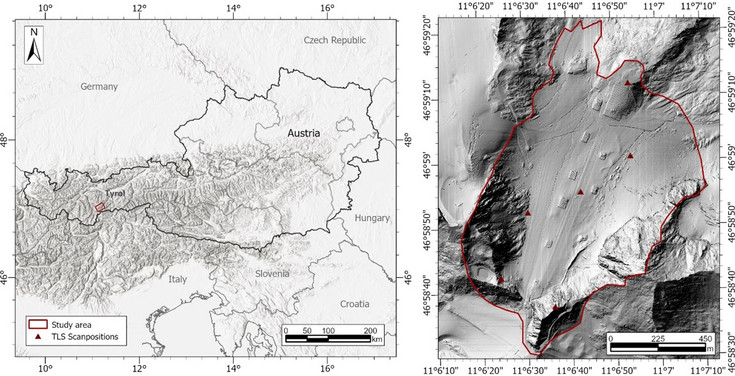
Figure 1. Map of the main study area, the Stubai Glacier; (a) Overview of the study area within Austria (red); (b) Hillshade map of the study area of the Stubai Glacier (red) and the used scan positions for the TLS (red triangle).
Conventional geological and geomorphological field mapping will be combined with remote sensing techniques, such as ground-based synthetic aperture radar interferometry (GB-InSAR) and terrestrial laser scanning (TLS). These methods, integrated with the use of UAV thermal and photogrammetric surveys and image processing, are used to better understand the driving factors of these processes and related increased rock mass fracturing. Webcams allow the timing of specific events through change detection analysis and photomonitoring. Further, in-situ measuring devices like temperature sensors or crackmeters capture spatial and temporal temperature variations, enabling the identification of potential rockfall activation areas.
The expected goal of this research is seen in the transferability of the knowledge gained at the rock slope laboratory to understand similar processes at different scales and with different triggers in high mountain regions. For this reason, research will be also undertaken in the Nepalese Himalayans, specifically in the Langtang valley (Figure 2), where a large-scale cascade, triggered in 2015 by an earthquake, is known and further investigated.
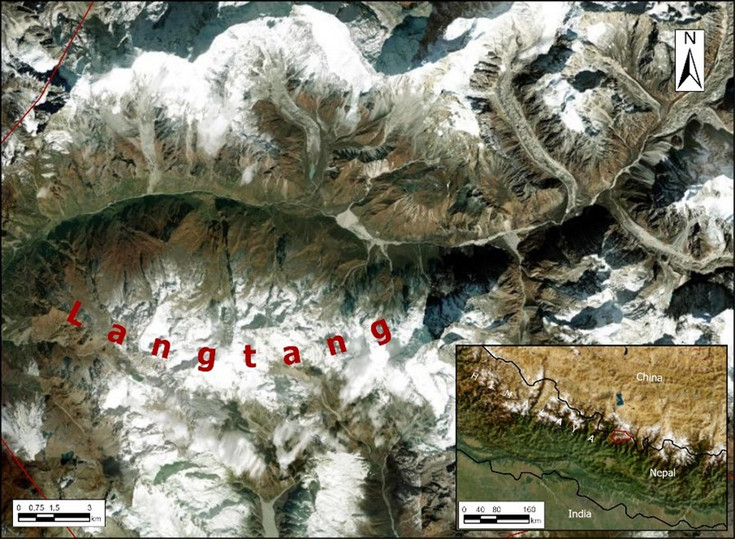
Figure 2. Overview map of the Langtang Valley (in red) within Nepal.
Outputs will include: (i) the identification of different scaled rockfall processes in a high alpine setting; (ii) the characterization of rock slope instability drivers, acceleration phases and failure, (iii) validated workflows for sensor setups and combinations, change detection and photomonitoring, and (iv) investigations of a large-scale cascade event in the Langtang valley in Nepal.
References:
- Cruden, D. and Varnes, D.J. (1996). Landslide Types and Processes, Transportation Research Board, U.S. National Academy of Sciences, Special Report, 247: 36-75. Special Report - National Research Council, Transportation Research Board, 247, 36–57.
- Gariano, S. L. and Guzzetti, F. (2016). Landslides in a changing climate. Earth-Science Reviews, 162, 227–252. https://doi.org/10.1016/j.earscirev.2016.08.011
- Gariano, S. L. and Rianna, G. (2025). How will the projected climate change influence rainfall-induced landslides in Europe? A review of modelling approaches. Landslides. https://doi.org/10.1007/s10346-025-02550-7
- Hervás, J. and Montanarella, L. (2007). Main issues on landslide mapping harmonisation in EU memberstates in the framework of European Commission soil policy. In: Hervás, J. (2007). Guidelines for mapping areas at risk of landslides in Europe. European Commission. Joint Research Centre (JRC). Institute for Environment and Sustainability. Publications Office. data.europa.eu/doi/10.2788/63147 (28.06.2025).
- Jin, H.-J., Wu, Q.-B., & Romanovsky, V. E. (2021). Degrading permafrost and its impacts. Advances in Climate Change Research, 12(1), 1–5. https://doi.org/10.1016/j.accre.2021.01.007
- McGoll, S.T. (2015). Landslide Causes and Triggers. In: Landslide Hazards, Risks, and Disasters (p. 17–42). Academic Press. https://doi.org/10.1016/B978-0-12-396452-6.00002-1
- Petley, D. (2012). Global patterns of loss of life from landslides. Geology, 40(10), 927–930.https://doi.org/10.1130/G33217.1
- Tichavský, R., Ballesteros-Cánovas, J. A., Šilhán, K., Tolasz, R., & Stoffel, M. (2019). Dry Spells and Extreme Precipitation are The Main Trigger of Landslides in Central Europe. Scientific Reports, 9(1), 14560. https://doi.org/10.1038/s41598-019-51148-2
- World Health Organization (WHO). (2019). Landslides. Retrieved April 2025, from World Health Organization website: www.who.int/health-topics/landslides