
Toward Social-Ecological Sustainability? The impact of institutional regimes and their framing on semi-natural grassland governance in Austria and South Tyrol
SUPERVISOR: Katharina GUGERELL
PROJECT ASSIGNED TO: Hannah FÄßLE
Grasslands make up unique social-ecological systems comprising a diverse range of geographies, flora, fauna, and humans. Due to their large extent (up to 40% of earth’s terrestrial area) they play an important role in animal migration, biodiversity conservation, water regulation and carbon sequestration (Petermann and Buzhdygan 2021; Wesche et al. 2016). In addition, grasslands directly influence the livelihoods of millions of people involved in animal husbandry around the world (Yao et al. 2021). Despite this multifunctionality or exactly because of it, they are amongst the most threatened ecosystems globally (Török et al. 2021). Increased agricultural intensification, land-use change, pollution, demographic changes, economic pressures and climate change, amongst others, are reducing the extent of formerly vast areas of grasslands and their ecological status (Wesche et al. 2016; Kamp et al. 2016; Gang et al. 2014). Further, in areas where the existence of grasslands relies on human management (i.e. semi-natural grasslands), depopulation, agricultural modernization and economic pressures are prompting intensification in favorable areas and abandonment in less accessible areas, resulting in loss of ecosystem functions on the one hand and encroachment and forestation on the other (Darnhofer et al. 2017). This mixture of biophysical and socio-economic pressures is changing both the ecological status of grasslands and how humans interact with them; processes further exacerbated by a lack of effective regulatory arrangements to counteract them (e.g. Gorris et al. 2025; Darnhofer et al. 2017; Haensel et al. 2023).
This lack of effective regulation is rarely the result of an absence of policy altogether but rather stems from how existing arrangements are structured and coordinated. Due to the multifunctional goods and services provided by grasslands, they are rarely governed by a single, coherent set of rules. Instead, they are regulated by a multitude of policies — for example agricultural, environmental, and land-use policies — and related organizations and actors that often pursue contradictory objectives (Gieseke 2019; Cleaver 2002; Knoepfel & Gerber 2008). In addition, various property right holders hold rights, which can be juxtaposed with policy goals, hence resulting in inconsistencies (Gerber et al. 2020). Taken together, this lack of coordination between the policies, property rights, and actors governing grasslands can undermine the effectiveness of each individual regulation, producing gaps and overlaps that hinder sustainable use (Gorris et al. 2025).
Against this backdrop, this PhD proposes to investigate the institutional regimes governing semi-natural grasslands in the alpine regions of Austria and South Tyrol, Italy (with additional case studies located in Denmark, Hungary and Kazakhstan). The PhD is embedded within the interdisciplinary research project “Enabling transformative actions to leverage sustainability of Eurasian grasslands (ActSustainably)” (FWF/ Biodiversa+) being conducted at BOKU. In accordance with the project goals, this PhD not only aims to identify relevant institutional regimes shaping semi-natural grasslands in these two case study areas, but also to gain insight into their formation, dynamics and local manifestations. In addition, it aims to investigate overlaps, gaps and rivalries between different institutions and the actors entrenched within. To do so, this PhD will use the IRR framework in combination with frame analysis and comparative policy analysis to contribute to understanding the multi-level regulatory landscape surrounding semi-natural grasslands in Europe and identifying institutional shortcomings and possible starting points for policy improvements. The following research questions will be addressed:
Under what circumstances do formal institutions governing semi-natural grasslands in Ennstal and Vinschgau create effective regulatory structures for sustainable management?
How are formal institutions related to and manifested in local regulatory agreements within these two case study areas?
What type of frames are employed by local, regional, national, and supranational actors to further their policy goals?
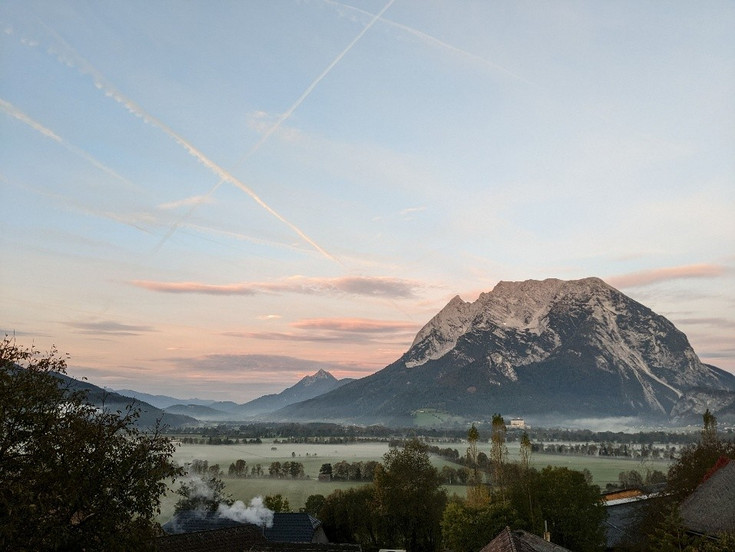
Ennstal, Styria
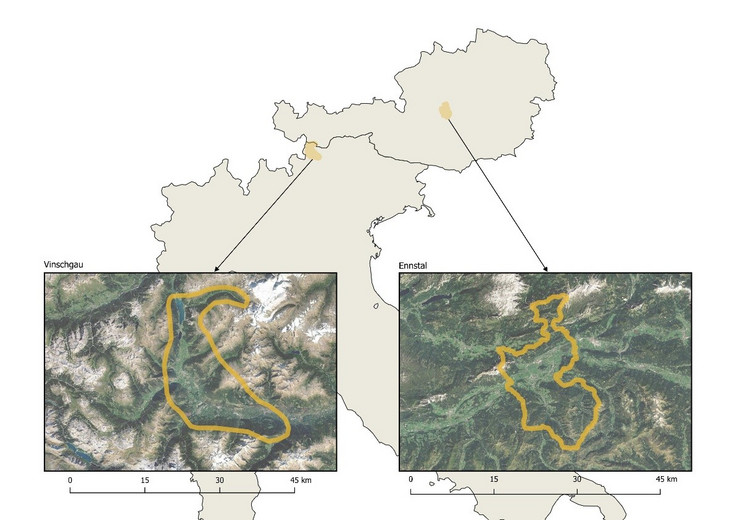
Case Study Areas
Sources:
Cleaver, F., 2002. Reinventing institutions: Bricolage and the social embeddedness of natural resource management. The European journal of development research, 14(2).
Darnhofer, I., Schermer, M., Steinbacher, M., Gabillet, M. and Daugstad, K., 2017. Preserving permanent mountain grasslands in Western Europe: Why are promising approaches not implemented more widely? Land Use Policy, 68.
Gang, C., Zhou, W., Chen, Y., Wang, Z., Sun, Z., Li, J., Qi, J. and Odeh, I., 2014. Quantitative assessment of the contributions of climate change and human activities on global grassland degradation. Environmental Earth Sciences, 72(11).
Gerber, Jean-David, Lieberherr, Eva, and Knoepfel. Peter. 2020. Governing Contemporary Commons: The Institutional Resource Regime in Dialogue with Other Policy Frameworks. Environmental Science & Policy 112.
Gieseke, T., 2019. Collaborative environmental governance frameworks: A practical guide. CRC Press.
Gorris, P., Bodin, Ö., Giralt, D., Hass, A.L., Reitalu, T., Cabodevilla, X., Hannappel, I., Helm, A., Prangel, E. and Westphal, C., 2025. Social-ecological perspective on European semi-natural grassland conservation and restoration: Key challenges and future pathways. Biological Conservation, 304.
Haensel, M., Scheinpflug, L., Riebl, R., Lohse, E.J., Röder, N. and Koellner, T., 2023. Policy instruments and their success in preserving temperate grassland: Evidence from 16 years of implementation. Land Use Policy, 132.
Kamp, J., Koshkin, M.A., Bragina, T.M., Katzner, T.E., Milner-Gulland, E.J., Schreiber, D., Sheldon, R., Shmalenko, A., Smelansky, I., Terraube, J. and Urazaliev, R., 2016. Persistent and novel threats to the biodiversity of Kazakhstan’s steppes and semi-deserts. Biodiversity and conservation, 25(12).
Knoepfel, P. and Gerber, J.D., 2008. Institutional landscape regimes. vdf Hochschulverlag AG.
Petermann, J.S. and Buzhdygan, O.Y., 2021. Grassland biodiversity. Current Biology, 31(19).
Török, P., Brudvig, L.A., Kollmann, J., N Price, J. and Tóthmérész, B., 2021. The present and future of grassland restoration. Restoration Ecology, 29.
Wesche, K., Ambarlı, D., Kamp, J., Török, P., Treiber, J. and Dengler, J., 2016. The Palaearctic steppe biome: a new synthesis. Biodiversity and conservation, 25(12).
Yao, L., Yan, X., Xu, M., Wu, M., Yu, Z. and Li, M., 2021. Study on Herders’ willingness to protect grassland based on the IAD extended decision model. Land, 10(4)