Prefabricated Façade Elements for Sustainable Building Renovation: Supporting Decision-Making Processes in Early Design Stages through an Optimized Digital Process Chain
SUPERVISOR: Benjamin KROMOSER
PROJECT ASSIGNED TO: Natasa KRAL
Buildings are major contributors to global greenhouse gas emissions, accounting for 39% of energy-related carbon emissions. Meanwhile renovation rate is critically low, at only 1% per year. Prefabricated façade elements offer a promising solution for decarbonisation of the building stock, by enhancing envelope performance and reducing operating costs, while improving the pace and quality of the renovations.
This dissertation investigates how prefabricated elements can be efficiently developed and applied serially, with focus on the impact of early design process on overall renovation planning. It aims to support informed decision-makings at early design stages while considering the renovation's overall quality, including life cycle performance in terms of costs and emissions. The goal is to provide effective planning solutions that balance customization and standardization to fit individual building contexts.
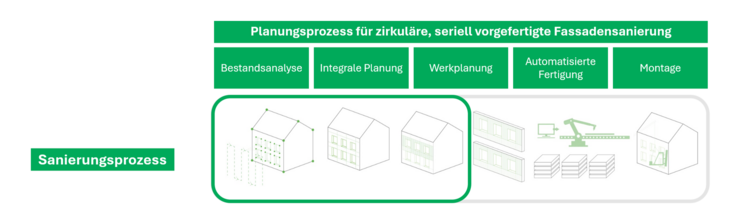
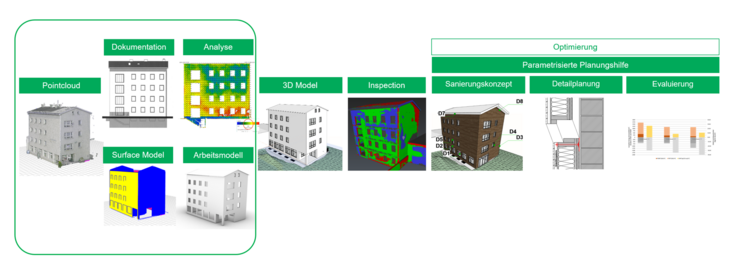
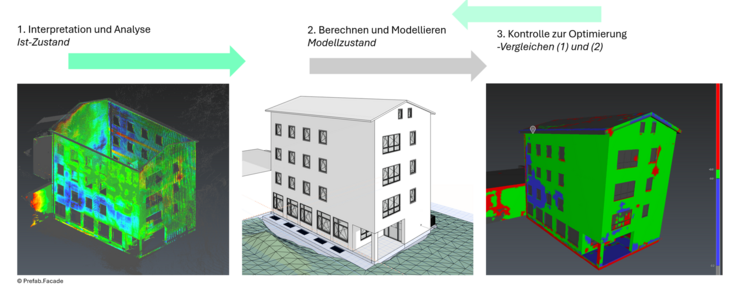
The research considers the analysis of existing buildings as crucial component of initial project development and integral planning. It focuses on defining essential tasks, determining which information must be communicated and processed, and deciding how to use this information to meet predefined goals related to quality, energy performance, budget, and schedule. The goal is to identify critical planning leverage points to optimize envelope design, reduce embodied energy in materials, lower operational costs, and shorten renovation times. This will be facilitated through the effective use of digital tools for planning and calculation, particularly in managing communication and information flow.
To address the existing gap between growing research and low implementation in practice, planning strategies for serial renovations will be defined. These strategies like standardized analysis and design steps aim to be integrated into the early project stages to support informed decision-making processes. Various design options, including their spatial layouts and characteristics, are to be considered.
Although the research draws on insights from various disciplines, it is approached with a primary expertise in architectural design and planning. The methodology relies on profound theoretical analysis as its foundation, gaining a comprehensive overview of the topic. It extends further through empirical tests, focusing mainly on the application of given hardware and software solutions. Finally, comprehensive knowledge and proof of practice are provided through case studies.