
Microplastic Pollution in Soil: Ecotoxicological Risks, Effects on Microbiome and Potential Remediation Strategies
SUPERVISOR: Katharina KEIBLINGER
PROJECT ASSIGNED TO: Katharine WIEßNER
A major contributor to soil contamination, especially in urban regions, are tire wear particles (TWPs). TWPs are released into the environment by mechanical abrasion of tire tread, caused by the friction between the surface of tires and the road the vehicle is driving on. TWPs pose a threat to soil organisms, not only due to their small size, ranging from more than 20 micrometers to less than a micrometer, but also due to their composition, which includes additives that are showing toxic effects on soil fauna and flora as well.
So far, little is known about the holistic effects of tire wear particles on the ecosystem, that would consider terrestrial macro- and microorganisms together with aquatic organisms that would potentially be affected as well by substances leaching out from the contaminated soil into water bodies.
In this project, the ecotoxicological effects of TWPs on representatives of different trophic levels, encompassing both terrestrial and aquatic organisms, will be investigated by spiking soil with tire particles (TP) derived from recycled and ground tire rubber. The soil will be used for testing on earthworms and subsequently on zebrafish embryos and daphnia by creating leachates from the soil samples. The effects of TPs on changes in the biodiversity of the soil microbiome in the presence of macrofauna will also be tested by subjecting the soil to DNA extraction and subsequent sequencing via Illumina Metabarcoding.
The effects of TP contamination in soil will also be investigated for plant germination and growth by colleagues.
To investigate the detoxification potential of selected adsorbents, the organisms will also be exposed to soil contaminated with TPs and mixed with each adsorbent.
The aim of this thesis is to investigate potential effects of tire particles and its leachable components on terrestrial macro- and microorganisms and on aquatic organisms imperiled by contaminants which are transported from soil into water bodies and the remediation of these effects by the application of adsorbents. For this investigation, ecotoxicological and bioinformatic tools are combined to support this holistic approach.
This project will give a holistic insight into the effects of TPs on soil health and the remediation potential of different contamination scenarios. A project overview can be seen in Figure 1.
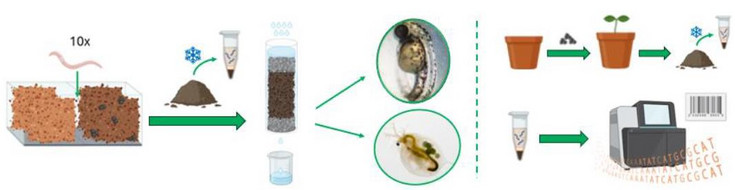
Figure 1: Schematic overview of Whole-System Experiment, depicting from left to right: earthworm avoidance test, soil sample collection, production of leachates via column percolation, aquatic toxicity tests with zebrafish embryos and daphnia, plant growth test and eDNA sequencing.