
A model-based decision-support Framework for the Deployment of Flexible Flood Protection Systems
Supervisor: Helmut HABERSACK
Project assigned to: Lena STÖTTINGER
Background and Motivation
Climate change is increasing the frequency and intensity of flood events worldwide, with severe impacts on infrastructure and society (Krug, et al., 2022). In Central Europe, extreme precipitation – often associated with Vb-cyclones – is further intensified by rising sea surface temperatures (Volosciuk, et al., 2016; Messmer, et al., 2015), while land use changes such as urban expansion increase flood risk (Formayer, et al., 2009). Alpine regions are particularly vulnerable due to their complex topography (Crespi, et al., 2025), creating growing challenges for flood risk management and rapid, well-informed decision-making.
Mobile flood protection systems – such as sandbags, modular barriers and water-filled systems – are essential in emergency response but differ significantly in performance, costs and operational constraints (Massolle, et al., 2018; Przybylski, et al., 2019; Thieken, et al., 2016). Sandbags are widely used but labour-intensive and less reliable under severe conditions, while alternative systems offer advantages but involve logistical and financial trade-offs (Reeve & Badr , 2003; Kishore & Madabhushi, 2025).
Despite existing hazard maps, systematic decision-support tools for the optimal selection and placement of these systems are largely missing. My previous optimization-based approaches show strong potential but do not adequately account for hydrological processes and practical constraints. This project addresses this gap by developing a decision-support framework integrating mathematical optimization, artificial intelligence, hydraulic modelling and practical expertise, supported by experimental studies and collaboration with emergency services.
Research Questions
The project addresses the following key questions:
How can mobile flood protection systems be optimally selected and deployed under varying conditions?
What are the limitations and failure mechanisms of different systems?
How can material choice and deployment improve system performance?
How can optimization models and AI support real-time decision-making under uncertainty?
How can hydraulic processes and system reliability be analysed using simulations and experiments?
Methods
The project follows an interdisciplinary approach combining mathematical modelling, AI-based data analysis, hydraulic simulations and experimental validation. Models will be extended to include relevant environmental and infrastructural factors and evaluated using real-world data. Numerical simulations and physical experiments in BOKU’s River Lab will be used to analyse flow processes, hydraulic loads, stability conditions and failure mechanisms of mobile flood protection systems. Collaboration with practitioners, including workshops with emergency services and the military, will support the testing of deployment strategies and ensure practical applicability.
Expected Outcomes
The project will develop a decision-support framework to improve the deployment of mobile flood protection systems in emergency situations. It will provide a structured catalogue of systems, including their applicability and limitations.
By integrating scientific methods with practical expertise, the project contributes to improved flood resilience, enhanced emergency response planning and more efficient resource use.
Pictures
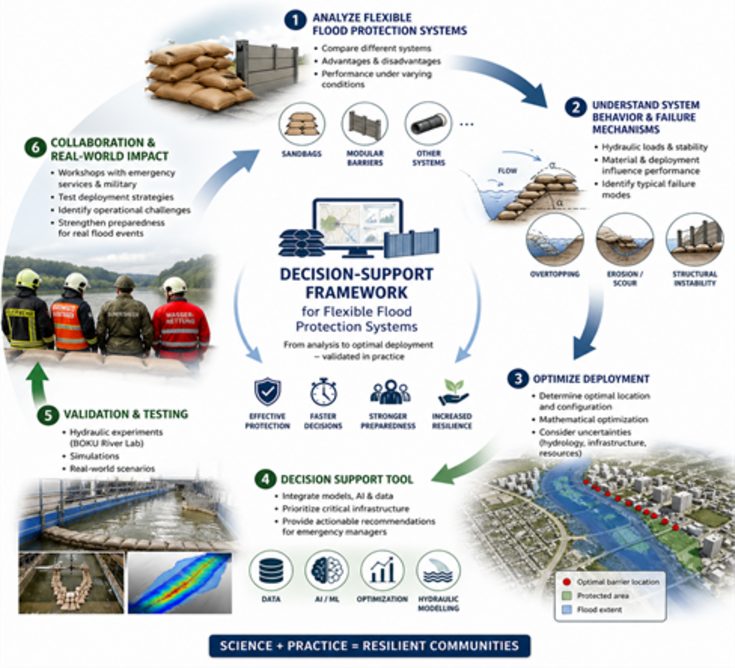
Figure 1. Conceptual workflow of the PhD project for developing a decision-support framework for flexible flood protection systems. The project combines system analysis, hydraulic modelling, optimization, validation experiments, and collaboration with emergency services to improve the deployment of temporary flood protection measures and strengthen community resilience.
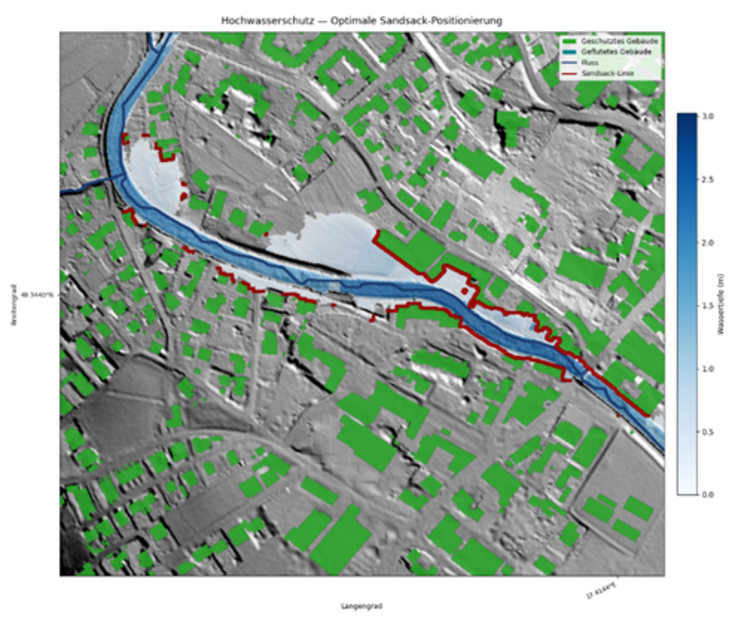
Figure 2. Study area and results of the optimized placement of flexible flood protection measures. The flooded area is shown in blue, buildings are highlighted in green, and the red line indicates the optimal positioning of the flexible flood protection barriers computed using the MINCUT algorithm. As no buildings are located within the flooded area after optimization, all endangered buildings are successfully protected. The results are based on flood simulations generated with JFLOW and the MINCUT algorithm.
References
Crespi, A. et al., 2025. Detection and characterization of precipitation extremes and geohydrological hazards over a transboundary Alpine area based on different methods and climate datasets. EGUsphere, pp. 1-27.
Formayer, H., Kromp-Kolb, H. & Schwarzl, I., 2009. Effects of climate change on flooding events in Upper Austria. BOKU-Met Report, Volume 2.
Kishore, Y. & Madabhushi, S. G., 2025. Sustainable flood defence using sandbags. In: E. P. Limited, ed. Proceedings of the Institution of Civil Engineers-Engineering Sustainability. s.l.:s.n., pp. 1-12.
Krug, A., Aemisegger, F., Sprenger, M. & Ahrens, B., 2022. Moisture sources of heavy precipitation in Central Europe in synoptic situations with Vb-cyclones. Climate Dynamics, pp. 3227-3245.
Massolle, C., Lankenau, L. & Koppe, B., 2018. Emergency flood control: practice-oriented test series for the use of sandbag replacement systems. Geosciences, 8(12).
Messmer, M., Gómez-Navarro, J. J. & Raible, C. C., 2015. Climatology of Vb cyclones, physical mechanisms and their impact on extreme precipitation over Central Europe. Earth system dynamics, 6(2), pp. 541-553.
Przybylski, A., Klamroth, K. & Lacour, R., 2019. A simple and efficient dichotomic search algorithm for multi-objective mixed integer linear programs. arXiv preprint arXiv:1911.08937.
Reeve , D. & Badr , A., 2003. Performance of sandbags for domestic flood defence. Proceedings of the Institution of Civil Engineers-Water and Maritime Engineering, 156(4), pp. 341-349.
Thieken, A. H. et al., 2016. Review of the flood risk management system in Germany after the major flood in 2013. Ecology and society, 21(2).
Volosciuk, C. et al., 2016. Rising Miditerranean sea surface temperatures amplify extreme summer precipitation in central Europe. Scientific reports, 6(1).