
Atmospheric and climatic effects of geomagnetic excursions and reversals
Supervisor: Harald RIEDER
Project assigned to: Bruno LEHNER
The geomagnetic field surrounding our planet exhibits continuous variations. Data derived from several paleomagnetic records show that the geomagnetic field has reversed its polarity multiple times throughout Earth’s history. During a full geomagnetic reversal, the polarity of the magnetic field remains switched for extended geological timescales (Gee & Kent, 2007; Ziegler et al., 2011). Geomagnetic excursions are characterized by a shorter-lived temporary wandering of the poles before returning to their original orientation. These changes are characterized by substantial variations in field intensity and field configuration (Gee & Kent, 2007; Korte et al., 2019; Mahgoub et al., 2023; Mukhopadhyay et al., 2025).
One prominent example is the Laschamps excursion, which occurred approximately 41 kyr ago. During the Laschamps event the dipole moment, which is a proxy for the global field strength, decreased substantially and the geomagnetic field changed to a multipolar regime (Cooper et al., 2021; Korte et al., 2019; Mahgoub et al., 2023; Mukhopadhyay et al., 2025).
This matters for the atmosphere because the geomagnetic field shields the atmosphere from energetic particles (EP) of magnetospheric, solar and galactic origin. When charged particles enter the atmosphere, they collide with neutral gas molecules, removing electrons and breaking molecular bonds. This leads to the production of charged and excited chemical species. Two important secondary products formed during atmospheric ionization by EP are reactive nitrogen oxides (NOX = N + NO + NO2) and hydrogen oxides (HOX = H + HO + HO2) (Mironova et al., 2015). In the stratosphere and mesosphere, NOX
acts as a potent ozone depleting substance (Brasseur & Solomon, 2005; Mironova et al., 2015). Under present-day, dipolar conditions, only EP with high kinetic energies can penetrate to low latitudes, while most of the particle flux is concentrated at the polar regions, where field lines run nearly vertical (Brasseur & Solomon, 2005; Mironova et al., 2015). It has been shown in several studies, that EP-induced changes aaect atmospheric chemistry, impact the radiative balance and alter atmospheric dynamics and climate (see e.g. Nesse et al., 2026; Seppälä et al., 2025, Arsenovic et al., 2016). Chemical changes from galactic cosmic rays due to a change in geomagnetic field strength and structure, as well as the resulting temperature and zonal wind response are illustrated in Fig. 1.
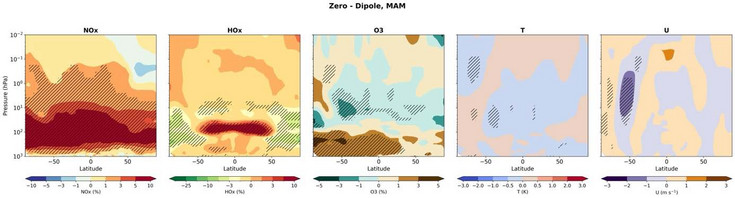
Figure 1: Zonally averaged di2erences (Laschamps excursion - present-day dipole) in NOx, HOx, O3, temperature (T), and zonal wind (U) for boreal spring, simulated with SOCOLv4 forced by galactic cosmic ray (GCR) ionization under a reconstruction of the geomagnetic field during the Laschamps excursion (Mukhopadhyay et al., 2025), relative to the present-day dipole configuration. Panels show, from left to right: NOx (%), HOx (%), O3 (%), temperature (K), and zonal wind (m/s). Hatching indicates statistically significant di2erences at the 95% confidence level.
While the atmospheric eaects of energetic particle precipitation under the present-day field are well studied, geomagnetic excursion and reversal (GER) conditions have received far less attention. Early one- and two-dimensional modeling studies established that reduced shielding drives stratospheric ozone loss and elevated surface UV-radiation (e.g. Hauglustaine & Gerard, 1990; Sinnhuber et al., 2003). More recently, three-dimensional chemistry-climate models have enabled more comprehensive assessments (Suter et al., 2014; Cooper et al. 2021, Arsenovic et al., 2024)
Despite these advances, existing studies share key limitations: geomagnetic field configurations are typically approximated as either fully dipolar or entirely absent, without capturing the true multipolar structure and the resulting geographic deviation of particle precipitation during a GER. Fig. 2A shows the galactic cosmic ray ionization rates of the current dipolar regime, while Fig. 2B illustrates the ionization rates during one phase of
the Laschamps excursion (Mukhopadhyay et al., 2025).
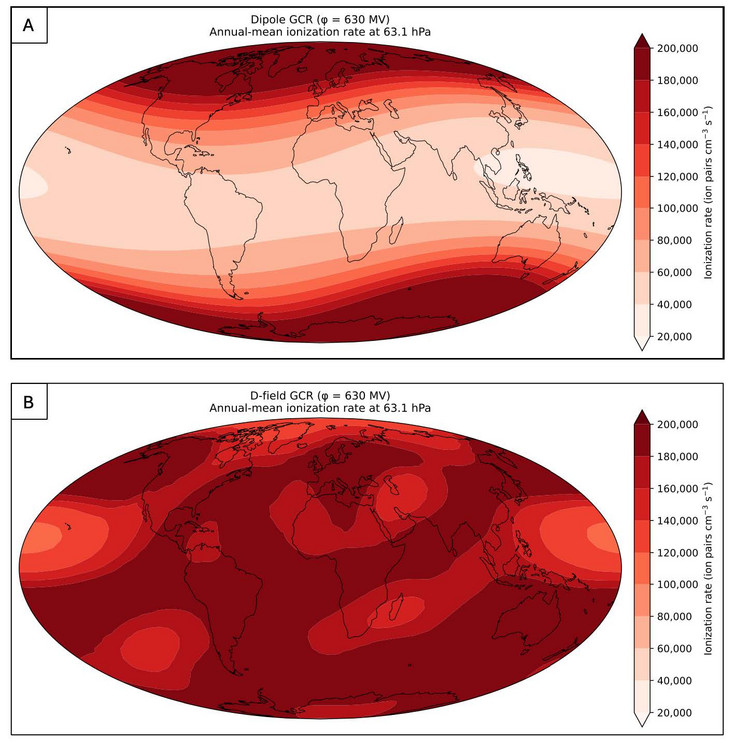
Figure 2: Annual-mean galactic cosmic ray (GCR) ionization rates (ion pairs cm-3 s-1) at 63.1 hPa for a solar modulation potential of phi = 630 MV. (A) Present-day dipole geomagnetic field configuration. (B) Reconstructed geomagnetic field during the Laschamps excursion (Mukhopadhyay et al., 2025).
This PhD project aims to advance understanding of GER-driven changes in atmospheric composition and climate dynamics. It will (1) incorporate more realistic, multipolar reconstructions of the geomagnetic field; (2) explore particle-forcing scenarios ranging from moderate repeated events to plausible worst-case extremes; (3) assess how GER forcing interacts with other environmental forcings such as volcanic eruptions under
diaerent background climates; and (4) use ensemble-based chemistry-climate model experiments to robustly separate the GER-forced signal from internal variability.
Together, these steps aim to provide a more robust assessment of how weakened and reconfigured geomagnetic shielding aaects stratospheric chemistry, atmospheric dynamics, and surface climate.
Arsenovic, P., E. Rozanov, A. Stenke, u. a. 2016. „The Influence of Middle Range Energy Electrons on Atmospheric Chemistry and Regional Climate“. Journal of Atmospheric and Solar-Terrestrial Physics 149 (November): 180–90. doi.org/10.1016/j.jastp.2016.04.008.
Arsenović, Pavle, Eugene Rozanov, Ilya Usoskin, u. a. 2024. „Global Impacts of an Extreme Solar Particle Event under Diaerent Geomagnetic Field Strengths“. Proceedings of the National Academy of Sciences 121 (28): e2321770121. https://doi.org/10.1073/pnas.2321770121.
Brasseur, Guy P., und Susan Solomon. 2005. Aeronomy of the Middle Atmosphere: Chemistry and physics of the stratosphere and mesosphere. Springer Science & Business Media.
Cooper, Alan, Chris S. M. Turney, Jonathan Palmer, u. a. 2021. „A Global Environmental Crisis 42,000 Years Ago“. Science 371 (6531): 811–18. doi.org/10.1126/science.abb8677.
Gee, Jearey S. und Kent, Dennis V. 2007. Source of oceanic magnetic anomalies and the geomagnetic polarity time scale. doi.org/10.7916/D8DV1V8P.
Hauglustaine, D., und J. C. Gerard. 1990. „Possible composition and climatic changes due to past intense energetic particle precipitation“. Annales Geophysicae 8 (Februar): 87–96.
Korte, Monika, Maxwell C. Brown, Sanja Panovska, und Ingo Wardinski. 2019. „Robust Characteristics of the Laschamp and Mono Lake Geomagnetic Excursions: Results From Global Field Models“. Frontiers in Earth Science 7 (April): 86. doi.org/10.3389/feart.2019.00086.
Mahgoub, Ahmed Nasser, Monika Korte, und Sanja Panovska. 2023. „Characteristics of the Matuyama-Brunhes Magnetic Field Reversal Based on a Global Data Compilation“. Journal of Geophysical Research: Solid Earth 128 (2): e2022JB025286. doi.org/10.1029/2022JB025286.
Mironova, Irina A., Karen L. Aplin, Frank Arnold, u. a. 2015. „Energetic Particle Influence on the Earth’s Atmosphere“. Space Science Reviews 194 (1–4): 1–96. doi.org/10.1007/s11214-015-0185-4.
Mukhopadhyay, Agnit, Sanja Panovska, Raven Garvey, u. a. 2025. „Wandering of the Auroral Oval 41,000 Years Ago“. Science Advances 11 (16): eadq7275. doi.org/10.1126/sciadv.adq7275.
Nesse, Hilde, Timo Asikainen, Margot Decotte, u. a. 2026. „Why Is Energetic Particle Precipitation Important for Climate Research and Seasonal Forecasting?“ Surveys in Geophysics, Online-Vorab-Publikation, März 30. doi.org/10.1007/s10712-026-09946-7.
Seppälä, Annika, Niilo Kalakoski, Pekka T. Verronen, Daniel R. Marsh, Alexey Yu. Karpechko, und Monika E. Szelag. 2025. „Polar Mesospheric Ozone Loss Initiates Downward Coupling of Solar Signal in the Northern Hemisphere“. Nature Communications 16 (1): 748. doi.org/10.1038/s41467-025-55966-z.
Sinnhuber, Miriam, John P. Burrows, Martyn P. Chipperfield, u. a. 2003. „A Model Study of the Impact of Magnetic Field Structure on Atmospheric Composition during Solar Proton Events“. Geophysical Research Letters 30 (15): 2003GL017265. doi.org/10.1029/2003GL017265.
Suter, I., R. Zech, J. G. Anet, und T. Peter. 2014. „Impact of Geomagnetic Excursions on Atmospheric Chemistry and Dynamics“. Climate of the Past 10 (3): 1183–94. doi.org/10.5194/cp-10-1183-2014.
Ziegler, L. B., C. G. Constable, C. L. Johnson, und L. Tauxe. 2011. „PADM2M: A Penalized Maximum Likelihood Model of the 0-2 Ma Palaeomagnetic Axial Dipole Moment: PADM2M Revised“. Geophysical Journal International 184 (3): 1069–89. doi.org/10.1111/j.1365-246X.2010.04905.x.