
Closing the plastic material loop: enzymatic decomposition of polyesters into small molecules for re-synthesis of sustainable plastics
SUPERVISOR: Georg M. GÜBITZ
PROJECT ASSIGNED TO: Florent PRUVOST
The increasing accumulation of plastic waste highlights the urgent need for recycling strategies that are both efficient and environmentally sustainable. Within this context, this PhD project—carried out as part of the European Upcycle initiative—focuses on the development of enzyme-based processes for the depolymerization of synthetic polyesters into reusable low-molecular-weight compounds. Particular attention will be given to poly(butylene adipate-co-terephthalate) (PBAT)/starch blends, which represent a widely used class of biodegradable packaging materials, while additional reference polyesters such as polyethylene terephthalate (PET) and polylactic acid (PLA) will also be considered.
The central objective is to optimize enzymatic depolymerization processes in order to achieve high monomer and oligomer yields with improved selectivity and purity, while minimizing the need for harsh chemical treatments or energy-intensive pre-processing steps. Compared to conventional mechanical or chemical recycling routes, enzymatic approaches offer a more sustainable alternative, operating under mild conditions and enabling a high degree of control at the enzyme–polymer interface. In this context, ester-hydrolysing enzymes such as cutinases and PETases will be investigated for their activity toward aliphatic–aromatic copolyesters like PBAT, whose structural heterogeneity represents a major challenge for efficient degradation.
In parallel, reaction parameters and enzyme–substrate interactions will be optimized to improve process robustness, scalability, and reproducibility. Ultimately, the products generated from enzymatic depolymerization of PBAT and related polymer blends will be reused as feedstocks for microbial fermentation or for the synthesis of new polyesters, thereby contributing to closed-loop material cycles. By integrating enzyme biotechnology, biomaterials science, and green polymer chemistry, this project aims to advance sustainable recycling strategies for packaging plastics and reduce their reliance on fossil-based resources.
Beyond the use of commercially available hydrolases, the project will explore enzymatic diversity through the screening and characterization of selected polyester-degrading enzymes with enhanced activity and stability. Promising candidates will be expressed, purified, and systematically characterized to establish structure–function relationships linking enzyme properties, polymer microstructure, and catalytic performance.
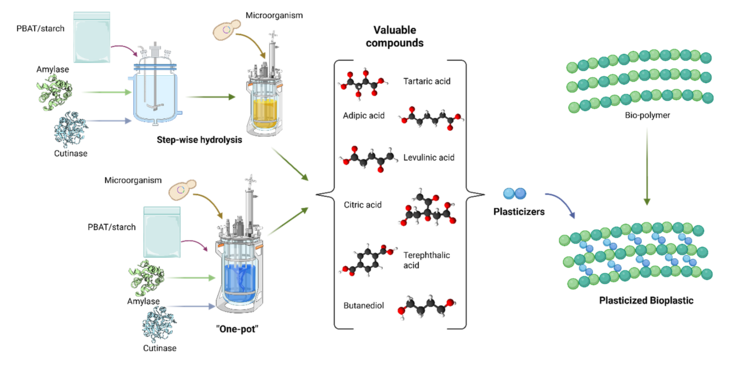
Fig 1: Schematic illustration of the project strategy, where packaging materials serve as a feedstock for enzymatic depolymerization and subsequent synthesis of new sustainable bioplastics.