Engineering of enzymes for coupling reactions of solid lignins
SUPERVISOR: Georg M. GÜBITZ
PROJECT ASSIGNED TO: Gabriele MONTRASIO
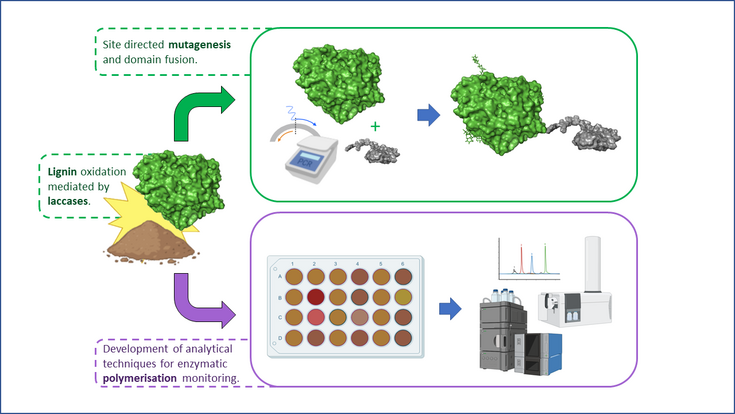
Enzymatic control of functionalization/polymerization of lignin particles will be aimed by the engineering of polyphenol oxidases (i.e. laccases) for the synthesis of value-added materials from lignins. Objectives are: (i) establishment of analytical techniques for characterization and monitoring of enzymatic polymerization such as by using size exclusion chromatography (SEC) coupled to multi angle light scattering (MALS) detection or Matrix Assisted Laser Desorption/Ionization time of flight mass spectrometry (MALDI-TOF) and further methods established at BOKU (ii) investigation of different kind of lignins (organosolv, ionosolv, kraft, etc; in cooperation with DC1) in order to choose those lignin defined fractions that best fit enzyme requirements for polymerization reactions and desired products; (iii) tuning surfaces properties of enzymes and sorption processes which are expected to have a strong impact on both lignin polymerization and coupling reactions (in cooperation with DC3, 5 and 11, 15). Surface properties will be engineered by exchanging hydrophobic and hydrophilic amino acids located on the surface and by fusing to binding modules with different hydrophobicity or fungal hydrophobins; (iv) to study the mechanism of the enzymatic reaction. Therefore, the chemical structure as well as the linkages formed between phenolic groups will be observed using 2D-NMR (HSQC). The agglomeration behavior of the (fluorescence labeled) mutant enzymes within the polymerizing matrix will be studied with Confocal Laser Scanning Microscopy (CLSM). Binding properties will be studied based on protein adsorption on already generated lignin films and with sophisticated methods like quartz crystal microbalance analysis.