
New publication - Maximilian Dorfer et al. 2026
Development of a vegetation growth modelling framework to predict effects of Nature-based Solutions
Maximilian Dorfer, Hans Peter Rauch, Fabian Franta, Magdalena von der Thannen
Keywords
Growth Modelling, Soil and Water Bioengineering, Pioneer Vegetation, Individual-based Models, Black locust, Robinia pseudoacacia, Engineered Slopes, Railroad Embankments Safety
Abstract
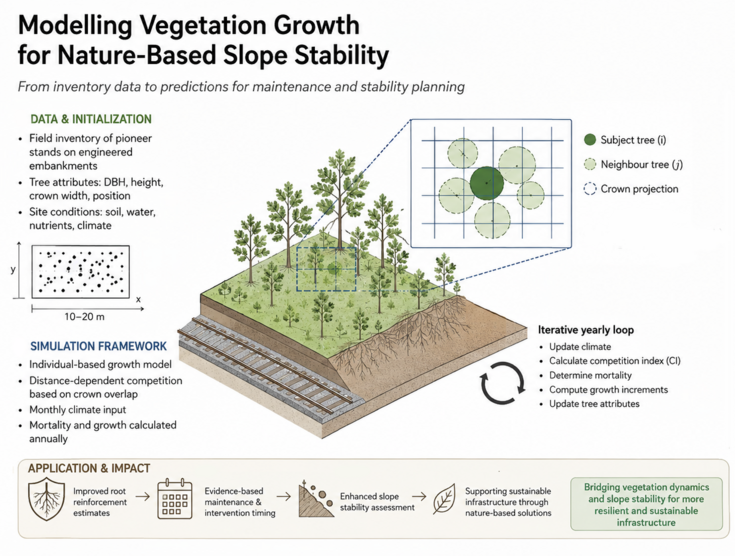
Soil and water bioengineering (SWBE) techniques depend on predictable vegetation development to ensure long-term slope stability, operational safety, and manageable maintenance effort. However, quantitative data describing growth dynamics of pioneer vegetation on engineered embankments are scarce, limiting the assessment and planning of long-term ecological and mechanical performance of SWBE interventions. This study develops a growth-modelling framework for SWBE applications that supports maintenance and intervention planning by improving the predictability of vegetation development during early successional stages. The framework is evaluated using three SWBE sites of different stand ages in Lower Austria dominated by pioneer stands of black locust. Existing vegetation growth models were systematically assessed and adapted to derive a modelling approach suitable for SWBE conditions under the data-limited circumstances typical of infrastructure projects. A structured flowchart informs model application and data requirements by linking ecological and biological parameters across relevant temporal and spatial scales. The principal outcome is a distance-dependent competition modelling approach that enables representation of dynamic suppression processes, which strongly influence biomass accumulation, vegetation structure, and maintenance-relevant development in pioneer stands. Model simulations provide medium-term predictions of vegetation development on engineered slopes and embankments over a 20-year horizon, validated against inventory data from a corresponding control stand. Overall, the framework improves decision-making related to maintenance effort, intervention timing, and long-term structural stability of SWBE measures. The results further emphasize the need for long-term monitoring, systematic data generation, and standardized documentation to strengthen model-based decision support in infrastructure-related SWBE applications.