
Soil Bioengineering in the Field 2026
BOKU University master’s students on a field trip in Styria and Vienna, Austria
Summary:
As part of the Master’s programme Landscape Planning and Landscape Architecture, the Institute of Soil Bioengineering and Landscape Construction at BOKU University led a three-day excursion in Styria and Vienna. The trip was guided by DI Anna Katharina Briefer, BSc, Univ.-Prof. Dipl.-Ing. Dr. Rosemarie Stangl, and Prof. Priv.-Doz. DI Dr.nat.techn. Johann Peter Rauch. Students examined bioengineering measures of different ages at rivers, slopes, embankments, ditches and erosion-control sites above the treeline.
Day 1: Longsgraben spoil area – Semmering Base Tunnel (Styria). A core site of the ÖBB project: 4.25 million m³ of excavated material were deposited and the area was greened with about 53,000 trees and shrubs. DI Jakob Grohmann (Topio) explained layered construction, erosion control and reforestation, showcasing both the project’s technical scale and the integration of ecological goals.


Day 2: Steep-slope stabilization in Gasen (Styria). After a warm welcome by Mayor Erwin Gruber, the focus was on the educational trail “Water: Source of Life and Natural Hazard,” opened in 2024 and already a triple award-winner. It links flood protection with environmental education and nature experience, featuring the floating water cinema “Aquaplexxx,” interactive learning stations, a water playground and artistically designed protective structures. DI Armin Schillinger (Torrent and Avalanche Control Service, Styria East) then presented current stabilization and protection projects, highlighting the role of bioengineering in alpine infrastructure and the related logistical challenges.


Day 3: Liesingbach (Vienna). On site, students explored river restoration and flood protection along the Liesingbach. The measures include near-natural bed and bank design, ecological enhancement through habitat structures, local channel widenings to improve flood protection, continuity for aquatic organisms, and careful integration of recreational paths.
Learning outcomes: Students gained hands-on knowledge of diverse bioengineering methods, understood application, implementation, function and development, can assess site-appropriate use, reflect on maintenance needs, and discuss cross-method and cross-site contexts professionally.
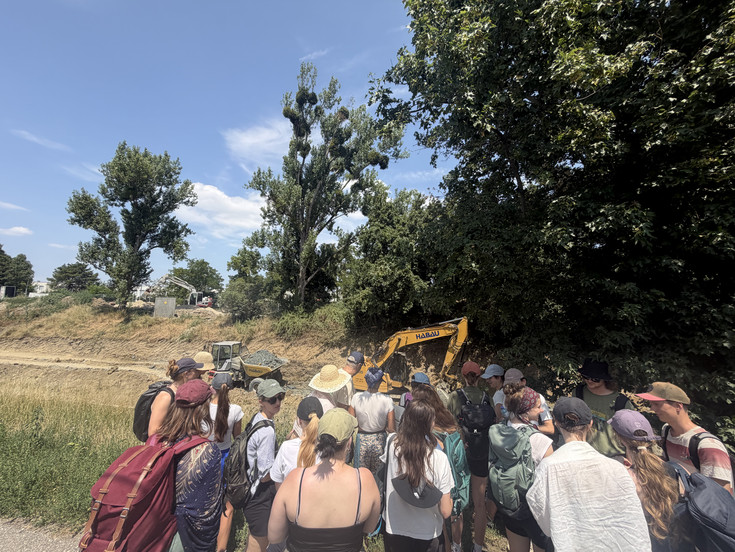
Tag 3: Liesingbach, Wien