Finite Element Analysis of wood-hybrid building elements
SUPERVISOR: Benjamin KROMOSER
PROJECT ASSIGNED TO: Karl ZECHMEISTER
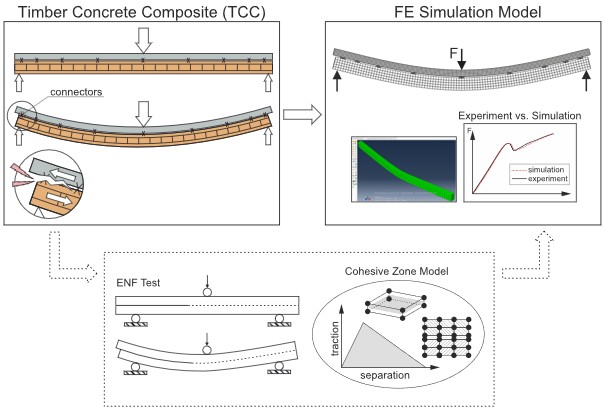
To meet the increased requirements for longer spans, sound insulation, vibration properties and sustainability in civil engineering, hybrid timber concrete composite structures are particularly well suited compared to pure timber constructions. In this project, the timber concrete composites (TCC) are joined with special single-point connections to achieve mechanical coupling between the two ceiling sections. These connections will transfer the shear forces and are glued in between the two layers. Despite the advantages of such hybrid solutions, predicting their complex nonlinear failure behaviour remains a major challenge due to the complicated interaction between the materials and the adhesives.
My PhD research aims to develop and validate a straightforward finite element modelling (FEM) approach to describe the shear failure behaviour of adhesive joints in these TCC systems. The focus lies on characterizing the bonded interface as a single compound system defined by its mode II fracture energy and linear elastic parameters. The mechanical response is captured using a cohesive zone model (CZM), which is implemented by cohesive zone elements in the finite element analysis (FEA).
Experimentally, end-notched flexure tests (ENF) are used to determine the mode II fracture energy of various composite combinations. Digital image correlation (DIC) provides displacement data which, together with load-displacement curves and measured crack lengths, enables the derivation of the cohesive law for each adhesive bond. The ENF tests will then be simulated using the finite element method.
The validated cohesive zone parameters will be integrated into large-scale finite element simulations of TCC ceiling systems. The ultimate goal is to reliably predict deformation and failure behaviour under bending loads, contributing to the efficient and safe design of next-generation timber concrete composite structures.