
Robust Structural Colour Coatings from Cellulose Nanocrystals on Wood Substrates
SUPERVISOR: Johannes KONNERTH
PROJECT ASSIGNED TO: Bharathan GOVINDARAJAN
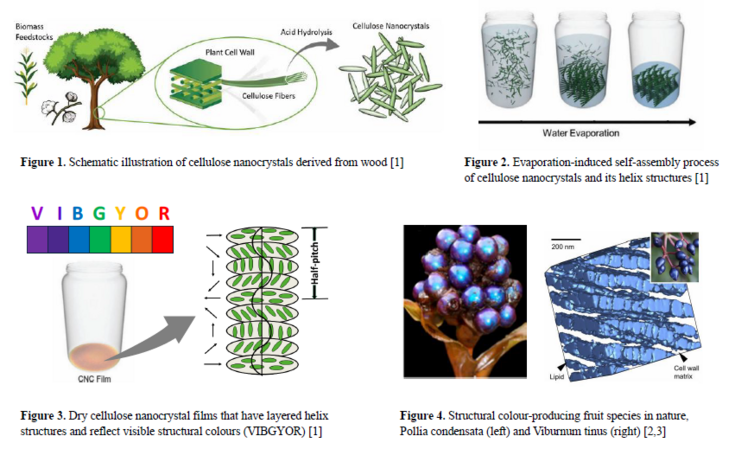
Cellulose is nature’s most abundant polymer and is found in different bio-based feedstocks like wood, cotton, bagasse, and other agricultural wastes. From these feedstocks, rod-like nanoparticles known as cellulose nanocrystals (CNCs) are extracted through, e.g., an acid-hydrolysis process (see Figure 1). They are highly crystalline materials, known for their exceptional strength, high stiffness, large surface area, and biodegradability. When cellulose nanocrystals (CNCs) are dispersed in water, evaporation induces their self-assembly into twisted helix-like structures, which are preserved upon drying as solid chiral nematic CNCs films (see Figures 2 and 3).
One of the exceptional features of these helix structures in chiral nematic CNCs films is their tendency to selectively reflect light in the visible spectrum, producing vivid, non-pigment-based structural colours (see Figure 3). These structurally coloured CNCs films have found applications in biosensors, optical devices, and aesthetic coatings. Despite their attractive optical properties, these hydrophilic CNCs films are water-sensitive as they swell, causing them to lose colour when in contact with water and moisture. This drawback limits their application in outdoor and indoor coatings, biological applications, and humid environments. In addition, CNCs films are brittle due to their high rigidity and tend to delaminate and break upon drying when coated onto different substrates. Hence, it is highly challenging to fabricate CNCs films that are water-stable with improved mechanical properties, that can still reflect structural colours.
This research project focuses on developing bio-based, robust CNCs thin-film coatings on wood surfaces, specifically overcoming the mentioned limitations. The project will draw inspiration from naturally occurring structurally coloured fruits, such as Pollia condensata and Viburnum tinus species (see Figure 4), for their hierarchically organized structures and molecular compositions that govern interfacial interactions and confer exceptional water stability. By combining chemical, enzymatic, and physical methodologies, water-stable CNCs structural colour coatings that adhere strongly to wood surfaces and exhibit improved mechanical properties will be fabricated for their application in humid environments.
REFERENCES:
[1] De France, K.J., Chiral nematic cellulose nanocrystal composites: An organized review. The Canadian Journal of Chemical Engineering, 2024. 102(8):p. 2695–2713.
[2] Vignolini, S., et al., Pointillist structural color in Pollia fruit. Proceedings of the National Academy of Sciences, 2012. 109(39): p. 15712–15715.
[3] Middleton, R. et al., Viburnum tinus Fruits Use Lipids to Produce Metallic Blue Structural Color. Current Biology, 2020. 30(19): p. 3804–3810.e2.