
Project completion HEDWIG
The HEDWIG research project has now been successfully completed! In its course, vegetation parameters and performance characteristics were determined, which will continue to serve as a basis for thermal building simulations and for the optimisation of planning processes.
In project HEDWIG research was carried out at 16 locations in Vienna and Lower Austria to assess the impact of standard-compliant greening of buildings, whereby the investigations were based on a multidimensional approach that linked microclimatic, building physics and plant physiological parameters. The aim was to obtain reliable parameters for green infrastructure, which is gaining massively in importance as a strategy for climate change adaptation in view of the increasing overheating of urban areas (Urban Heat Island Effect), but is often not used enough in planning practice due to a lack of quantitative impact assessment.
In order to enable permanent measurements, the HEWIG permanent measuring objects were equipped with stationary sensor technology indoors and outdoors throughout the entire project period.
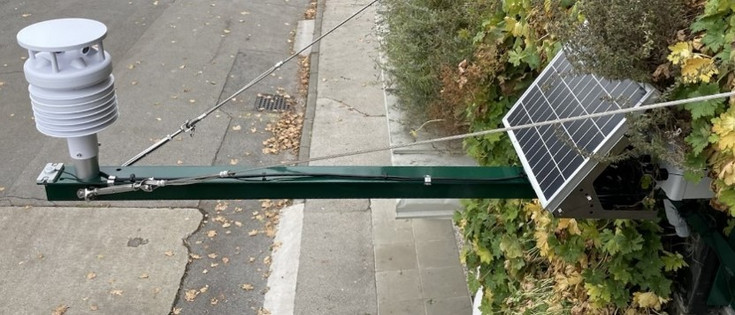
Stationary weather station [MS WRS305] and pyranometer [EKO ML-02-5P] incl. solar panel – 1.5m away from the examined plant body.
In addition, measurement campaigns were carried out in 2023 and 2024, in which plant development was documented with the help of manual measurement technology and relevant plant parameters, such as the projective coverage ratio or the WLAI/LAI, were collected. In addition, sensor technology was used to determine the short-wave radiation balance. Furthermore, the green shading factor (Fbs) developed in the course of the GLASGrün project was also used, which serves as the basis for measuring the shading performance of vertical greenery.
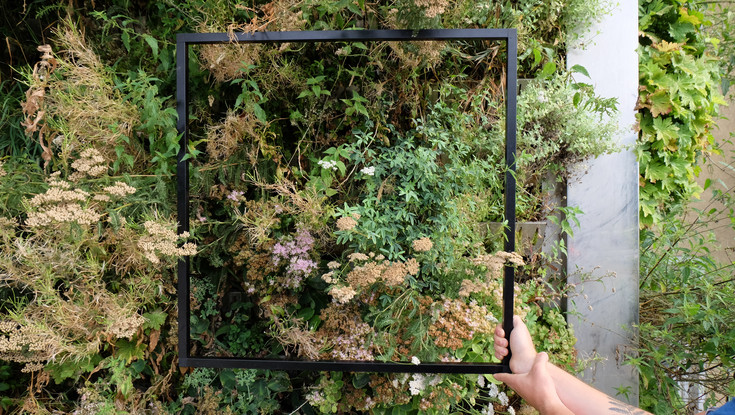
Measurement campaign with measuring frame on the biodiverse modular façade greening (tub system) at the measurement object MA48 Gürtel in Vienna
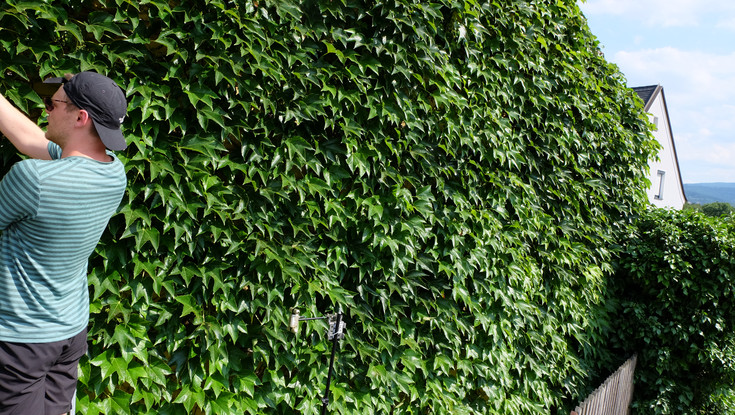
Full commitment to the 2024 measurement campaign at the measuring object Privathaus Ternitz, Lower Austria
Thermal simulations were carried out in ICA ICE by the third-party project service provider IBO, which enabled an energetic assessment and quantification of the cooling capacity of the building greening.
Solar radiation reductions of up to 97 % were determined for the permanent measurement objects with facade greening of different greening systems – whereby the associated reductions in transmission resulted in an improvement in thermal comfort. This was investigated in more detail by 2 complementary approaches – the adaptive comfort model according to ÖNORM EN 16798-1 and the comfort model according to Freymark and Leusden – by the project third-party service provider IBO.
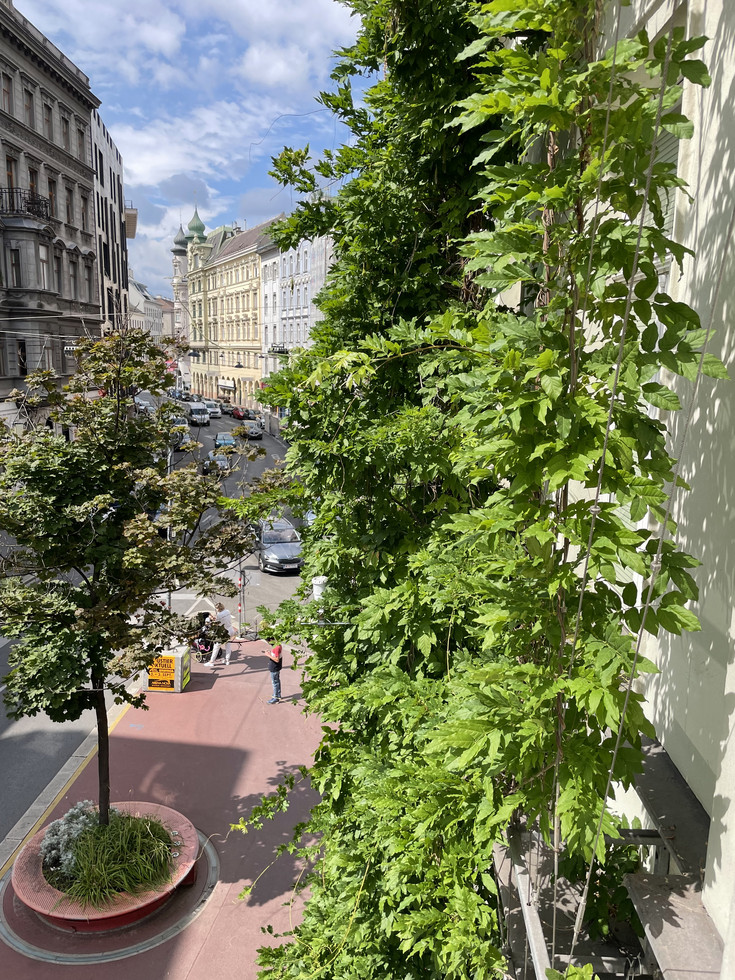
Trough-bound facade greening at the measuring object Amtshaus Margareten in Vienna, consisting of Wisteria sinensis and Parthenocissus tricuspidata
In addition to the HEDWIG final report, a literature study was also prepared to survey the international state of knowledge. Furthermore, the measurement results from the long-term monitoring as well as relevant parameters for impact assessment on the 16 knife objects are shown in a separate data catalogue. The workshop, which served to involve the stakeholders, was professionally prepared by the third-party project service provider GRÜNSTATTGRAU and is available as an independent publication within the same series of publications.
Furthermore, the collected measurement data are available as three publications in ZENDODO as open source.
In the course of the HEDWIG project, central, previously unavailable measurement data on the performance of building greening in indoor and outdoor spaces were generated, which represent a groundbreaking basis for argumentation and test processes as well as an orientation in planning practice.
About the HEDWIG project
Additional project information
- Project number: 893535
- Research programme: FFG, ENERGY OF THE FUTURE, City of the Future, SdZ 9th call 2021
- Project duration: October 2022 to December 2025 (extended cost-neutrally)
- Project coordination: Institute of Engineering Biology and Landscaping (IBLB), BOKU University
- Project partners: Institute for Building and Ecology GmbH (IBO), Grünstattgrau (GsG), RED Bernard GmbH
HEDWIG Reports and Supplementary Publications:
- Result report (59a): https://nachhaltigwirtschaften.at/resources/sdz_pdf/schriftenreihe-2026-59a-hedwig-ergebnisbericht.pdf
- Data catalogue sub-report (59b): https://nachhaltigwirtschaften.at/resources/sdz_pdf/schriftenreihe-2026-59b-hedwig-datenkatalog.pdf
- Partial report of the literature study (59c): https://nachhaltigwirtschaften.at/resources/sdz_pdf/schriftenreihe-2026-59c-hedwig-literaturstudie.pdf
- Partial Report Stakeholder Workshop (59d): https://nachhaltigwirtschaften.at/resources/sdz_pdf/schriftenreihe-2026-59d-hedwig-stakeholderworkshop.pdf
- ZENODO measurement data from continuous monitoring (outdoor space): https://zenodo.org/records/21980849
- ZENODO measurement data from measurement campaigns: https://zenodo.org/records/20525116
- ZENODO measurement data from continuous monitoring (interior): https://zenodo.org/records/21981452
If you have any questions about the HEDWIG research project, please contact nicole.jalits(at)boku.ac.at!