Nanocellulose Hypercrosslinked Polymer Hybrid Membranes
SUPERVISOR: Robert T. WOODWARD
PROJECT ASSIGNED TO: Cédric NORMAND
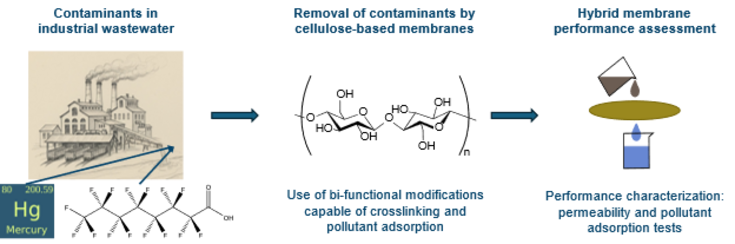
One of the current global challenges is the pollution of freshwater, especially by contaminants hazardous to the environment and to human health, such as heavy metal ions, forever chemicals such as per- and polyfluoroalkyl substances (PFAS), and biologically active compounds such as pharmaceuticals. Ion exchange resins have been developed for the adsorption of some of these pollutants; hoever, leading resins can be high-cost and are primarily composed of fossil-based materials. To overcome the use of fossil-based materials for water purification, researchers have developed nanocellulose-hypercrosslinked polymer hybrid membranes capable of both heavy metal adsorption and ultrafiltration for the removal of contaminants from water. The use of cellulose is highly favourable due to its renewability, chemical versatility, and low cost. In this project, the chemical versatility of cellulose will be exploited by bifunctional chemical modifications able to crosslink cellulose for improved mechanical properties and to enable adsorption of a broad spectrum of contaminants such as heavy metal ions or PFAS, the removal of which is urgent due to their bioaccumulative properties. Produced membranes are to be characterized according to their permeability and pollutant adsorption performance.