
Neue Publikation - Kuschel et al. 2025
A Systematic Framework for Assessing the Temporally Variable Protective Capacity of Nature-Based Solutions Against Natural Hazards
Erik Kuschel, Michael Obriejetan, Tamara Kuzmanić, Matjaž Mikoš, Lukas Seifert, Slaven Conevski, Maria Wirth, Eriona Canga, Sérgio Fernandes, Johannes Hübl and Rosemarie Stangl
22 November 2025
https://doi.org/10.3390/infrastructures10120318
Abstract
Natural hazards pose an increasing threat to infrastructures, lives, and livelihoods in alpine regions due to climate change and the growing demand for settlement space. While grey protective structures are commonly deployed to provide immediate safety, their sustainability, and thus protective function, is limited by cost-intensive maintenance. Nature-based solutions (NbS) can alleviate these shortcomings by offering cost-effective, adaptive protection that strengthens over time, making their deployment a key factor in building resilience to climate-induced hazards. This paper introduces a systematic methodology for the strategic deployment of NbS to enhance climate resilience. It integrates a three-level hazard classification system with an expert-led assessment rating 74 NbS against 29 hazards. A subsequent Principal Component Analysis (PCA) synthesises these into six functional groupings based on their shared mitigation characteristics. The core of this framework introduces two key innovations: a novel Mitigation Score and a Hazard Mitigation Profile. Together, they evaluate NbS effectiveness dynamically through the different phases of natural hazards, surpassing traditional static ratings by evaluating NbS performance across the hazard management cycle—from predisposition to post-event recovery. Significant variation in mitigation scoring was observed for individual hazard classes and types. Erosion processes (e.g., sheet, rill, and gully erosion) achieved the highest mitigation scores (1.90), as they can be addressed by many highly effective NbS (21–33 types). Conversely, flood-related hazards, such as fluvial and pluvial floods, showed moderate scores (1.64–1.66) with a balanced mix of mitigative and supportive NbS, while options for mitigating impact floods and coastal floods were far more limited (1.00–1.42). The resulting methodology provides a crucial, practical link between specific climate-related threats and viable, nature-based responses, serving as a robust framework to guide the decisions of planners, engineers, and policymakers. By enabling a more strategic and temporally aware deployment of NbS, our findings inform the development of adaptive management strategies to ensure their long-term effectiveness.
Keywords: nature-based solutions (NbS); natural hazards; mitigation and protection; climate change adaptation; critical infrastructure; mitigation scoring; hazard profiles
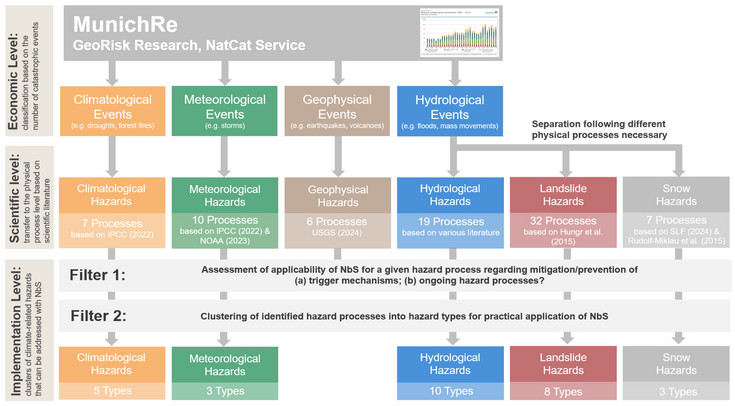
Figure 2. Hazard classification system developed for the deployment of nature-based solutions within natural hazard management, integrating economic, scientific, and implementation levels. The economic level establishes broad hazard categories based on global reinsurance frameworks. The scientific level refines these categories by incorporating detailed physical processes relevant to specific contexts, such as landslides and avalanches, through extensive literature reviews and established frameworks. The implementation level applies a two-step filtering process: Filter 1 excludes hazards where NbS have no meaningful impact, while Filter 2 clusters similar processes into intuitive hazard types for practical use.