
Neue Publikation - Anna Lindenberger et al. 2026
Contrasting carbon dynamics in grazed and flood-prone grasslands on mineral and degraded peat soils
Anna Lindenberger, Magdalena von der Thannen, Hans Peter Rauch, Dennis Baldocchi, Mihkel Pindus, Daphne Szutu, Joseph Verfaillie, Kuno Kasak
1 October 2026
https://www.sciencedirect.com/science/article/pii/S016788092600318X
Abstract
Ecosystem-scale methane (CH₄) flux measurements from grazed grasslands remain scarce, despite their importance for understanding grassland contributions to the global carbon budget. In this study, we present full annual budgets of both carbon dioxide (CO₂) and CH₄ derived from eddy covariance measurements at two contrasting grazed grasslands: a floodplain grassland at Marchegg, Austria, and an intensively grazed pasture at Sherman Barn, California. By combining continuous, year-round observations of CO₂ and CH₄, this study provides a rare, comparative assessment of greenhouse gas dynamics across distinct climatic, hydrological, and management regimes. Our results highlight how environmental conditions, grazing intensity, and hydrology jointly regulate CO₂ exchange and CH₄ emissions, underscoring the importance of including methane alongside net ecosystem exchange when evaluating grassland carbon balances. At Marchegg, characterized by seasonal flooding and moderate horse grazing on mineral soils, the ecosystem acted as a weak carbon sink in 2024, with a GWP100 of 42.2 ± 113.4 g CO₂ eq m⁻². Net CO₂ uptake (–27.3 ± 30.2 g C m⁻² yr⁻¹) was partly offset by CH₄ emissions (1.6 ± 0.04 g C m⁻² yr⁻¹), which were strongly linked to soil moisture and inundation events. In contrast, Sherman Barn, a cattle pasture on degraded peat soils, was a consistent carbon source in 2019, with a GWP100 of 567.6 ± 120.5 g CO₂ eq m⁻², associated with high ecosystem respiration during summer. The site released 125.3 ± 32.2 g C m⁻² yr⁻¹ of CO₂ and 3 ± 0.06 g C m⁻² yr⁻¹ of CH₄. Across both sites, net ecosystem exchange was primarily linked to photosynthetically active radiation and vegetation greenness, while CH₄ fluxes were related to soil moisture rather than grazing intensity. Flooding at Marchegg reduced CO₂ uptake but enhanced CH₄ emissions, highlighting the critical role of flood timing within the growing season. Moreover, inundation appeared to suppress the spread of invasive plant species, emphasizing the ecological value of dynamic hydrological regimes. Together, these findings reveal the complexity of grassland carbon budgets and the need for site-specific, year-round CO₂ and CH₄ monitoring to inform climate-adaptive management strategies.
Keywords
Eddy Covariance; Carbon sequestration; Methan; Flooding; Grazing; Pasture
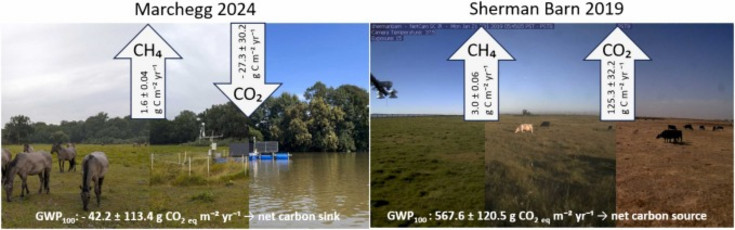
Summary of the C budget of Marchegg in 2024 and Sherman Barn in 2019.