
Development of Rapid, Scalable Downstream Processing for Recombinant Proteins in Nicotiana benthamiana
SUPERVISOR: Johannes BUYEL
PROJECT ASSIGNED TO: André REDONDO
The regulation and oversight of compounds constituting chemical, biological, radiological, and nuclear (CBRN) threats remain a critical priority for international governments. While significant milestones have been achieved—most notably the Organization for the Prohibition of Chemical Weapons (OPCW) verifying the destruction of all declared chemical weapon stockpiles as of 2023 [1]—the broader security landscape remains fragile. Bilateral nuclear arms control frameworks, such as the New START treaty, face suspension amidst geopolitical instability [2], while the Biological Weapons Convention (BWC) continues to struggle with institutional funding and a lack of enforceable verification mechanisms [3]. Despite international bans, the dual-use nature of these agents means they remain a high risk for misuse by third parties. Furthermore, disasters ranging from global pandemics to accidents at nuclear facilities can result in similar devastating consequences.
To ensure resilience against these diverse threats, the establishment of a robust supply chain for Medical Countermeasures (MCMs) is imperative. Essential therapeutics include butyrylcholinesterase for organophosphate detoxification [4], granulocyte colony-stimulating factors (G-CSF) for acute radiation syndrome [5], and monoclonal antibodies for viral outbreaks [6]. However, in the event of a rapid-onset global crisis, current manufacturing paradigms—reliant heavily on mammalian cell culture or fractionation of human plasma—lack the surge capacity and speed required to meet global demand [7, 8].
This research operates within a broader framework aimed at developing a rapid-response, scalable biomanufacturing pipeline. Plant molecular farming, specifically utilizing Nicotiana benthamiana, has emerged as a cost-effective and scalable upstream solution [9]. Despite these upstream advantages, the downstream processing (DSP) remains a significant technoeconomic bottleneck [10].
The primary objective of this project is to engineer a platformized downstream process capable of effectively recovering high-purity recombinant proteins. To satisfy the requirements for scalability and rapid deployment, the proposed process is designed to be intrinsically continuous, minimizing reliance on specialized equipment or supply-chain-sensitive consumables.
This thesis investigates and optimizes distinct unit operations for the extraction, clarification, and purification of model proteins with varying physicochemical properties. The experimental scope includes, but is not limited to mechanical disruption (bead milling and high-shear blade homogenization), solid-liquid separation (screw press extrusion and hydrocyclone clarification) and purification (chemical/thermal precipitation and depth filtration).
The study focuses on the development of continuous scalable downstream processes. Experimental data will be integrated with process modeling to establish a predictive framework, ensuring the successful and rapid translation of new protein targets into purified clinical-grade products.
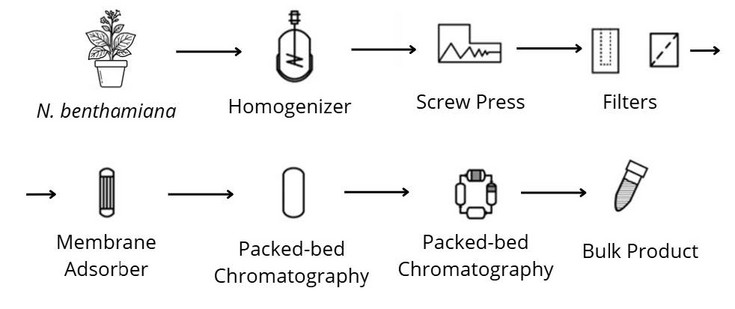
Figure 1: Graphical abstract with possible downstream processing pipeline for molecular farming in N. benthamiana. Figure adapted from Buyel et al (2017).
REFERENCES
[1] OPCW, OPCW confirms: All declared chemical weapons stockpiles verified as irreversibly destroyed, 2025 (11.18.2025).
[2] Federation of American Scientists (FAS). (2024). "Status of World Nuclear Forces."
[3] BWC Meeting Stumbles Over Money, Politics | Arms Control Association, 2025. Available from: www.armscontrol.org/act/2019-01/news/bwc-meeting-stumbles-over-money-politics (02.02.2025).
[4] Masson, P., & Nachon, F. (2017). Cholinesterase reactivators and bioscavengers for pre- and post-exposure treatments of organophosphorus poisoning. Journal of neurochemistry, 142 Suppl 2, 26–40. https://doi.org/10.1111/jnc.14026
[5] Kulkarni, S., Singh, P. K., Ghosh, S. P., Posarac, A., & Singh, V. K. (2013). Granulocyte colony-stimulating factor antibody abrogates radioprotective efficacy of gamma-tocotrienol, a promising radiation countermeasure. Cytokine, 62(2), 278–285. https://doi.org/10.1016/j.cyto.2013.03.009
[6] Kelley B. (2020). Developing therapeutic monoclonal antibodies at pandemic pace. Nature biotechnology, 38(5), 540–545. https://doi.org/10.1038/s41587-020-0512-5
[7] Tripathi, N. K., & Shrivastava, A. (2019). "Recent developments in bioprocessing of recombinant proteins: expression hosts and process development." Frontiers in Bioengineering and Biotechnology, 7, 420.
[8] Lockridge O, David E, Schopfer LM, Masson P, Brazzolotto X, Nachon F. Purification of recombinant human butyrylcholinesterase on Hupresin®. J Chromatogr B Analyt Technol Biomed Life Sci. 2018 Dec 1;1102-1103:109-115. doi: 10.1016/j.jchromb.2018.10.026. Epub 2018 Oct 25. PMID: 30384187; PMCID: PMC6275104.
[9] J.F. Buyel, R.M. Twyman, R. Fischer, Biotechnology Advances 35 (2017) 458–465.
[10] P. Novák and V. Havlíček, “4 - Protein Extraction and Precipitation,” in Proteomic Profiling and Analytical Chemistry (Second Edition), P. Ciborowski and J. Silberring, Eds., Boston: Elsevier, 2016, pp. 51–62. doi: 10.1016/B978-0-444-63688-1.00004-5.